Hammerspace AI Data Platform Unifies Enterprise Data for Operational AI
Over the past year, the focus of the AI market has increasingly shifted from extreme-scale model training toward enterprise AI deployments built around inference, retrieval-augmented generation (RAG), and agentic AI.
That transition is placing new pressure on the access, management, and governance of multimodal enterprise data.
The Critical Barrier: Timely Delivery of AI-Ready Data
According to Hammerspace, the enterprise AI market is now moving decisively from experimentation to production. As organizations seek measurable business outcomes from AI initiatives, tolerance for stitching together disconnected AI tools and fragmented storage architectures is rapidly declining.
The company argues that data fragmentation has evolved beyond a technical inconvenience into one of the primary barriers to AI success. Transforming distributed raw enterprise data into AI-ready data streams has become increasingly difficult within traditional infrastructure environments.
Hammerspace points to the structural complexity of modern enterprise storage environments as the underlying issue. The company says many organizations now require 15 or more tools stitched across distributed storage estates simply to prepare data for AI consumption — an operational model that carries substantial cost and complexity before ROI is ever realized.
The company’s broader thesis is that successful AI deployments require more than incremental optimization. Instead, organizations increasingly need a unified storage and data management architecture purpose-built for continuous AI pipelines and real-time inference environments.
The Hammerspace AI Data Platform Overview
Hammerspace positions its AI Data Platform (AIDP) as what it describes as a “converged storage and data preparation solution” designed to bridge existing enterprise infrastructure with operational AI workloads.
Rather than forcing organizations to migrate massive data sets into newly purchased flash storage systems, the platform is built around a “data-in-place” philosophy that allows enterprises to continue leveraging heterogeneous storage investments already deployed across their environments.
The company says the architecture is designed to accelerate high-demand AI workloads across both on-premises and cloud-based environments while eliminating many of the data silos that slow AI operations.
“Hammerspace AIDP delivers the fastest access to AI outcomes in the industry,” the company states in its solution brief. “By unifying storage infrastructure and automating data transformation, AIDP allows organizations to bridge the gap between legacy data silos and real-time AI applications.”
Architectural Core: Data Activation and Global Orchestration
At the center of the architecture is a global namespace designed to unify enterprise data across systems, locations, and cloud environments.
Hammerspace describes the namespace not simply as a file system, but as the strategic orchestration layer that eliminates data gravity and continuously feeds AI applications regardless of where the data physically resides. The model is intended to maximize utilization of existing infrastructure while avoiding expensive and disruptive migrations into standalone AI storage platforms.
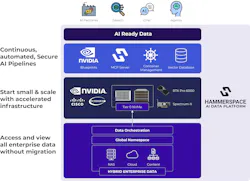
The platform is built around three operational principles: unify, automate, and accelerate.
Unify
Leveraging what the company calls “data-in-place” assimilation, the platform creates an immediate centralized view across existing storage infrastructure without moving data. Hammerspace says this approach preserves data sovereignty while reducing the proliferation of distributed copies.
Automate
Using automated pipelines integrated into the global namespace, AIDP identifies relevant datasets, orchestrates movement of selected data, and transforms information into AI-ready formats.
The company says the pipeline remains fully instrumented, governed, and secure while allowing organizations to analyze workflows for further optimization.
Accelerate
The acceleration layer is designed to deliver AI-ready data to GPU infrastructure with high throughput and low latency across both on-premises and cloud-based AI resources.
The end-to-end workflow combines Hammerspace orchestration with NVIDIA AI Enterprise software, MCP server integration, and vector database technologies. According to the company, the environment can ingest raw unstructured data and automate the full sequence from data gathering and curation through inference and model serving.
While the platform automates the end-to-end AI data pipeline, Hammerspace emphasizes that the environment is not a “black box.” Each stage of the workflow can be queried, analyzed, and integrated through APIs into broader visibility, governance, and security frameworks.
The company also says the complete solution is delivered fully configured with hardware powered by NVIDIA RTX Pro GPUs and accelerated networking infrastructure, enabling organizations to start with smaller deployments and scale toward enterprise-wide adoption.
Buy Outcomes, Not Toolkits
A recurring theme throughout the Hammerspace positioning is reducing the operational sprawl surrounding enterprise AI infrastructure.
“In high-stakes deployments, simplicity is the ultimate form of resource optimization,” the company states. “The Hammerspace AIDP solution reduces the complication of an end-to-end data pipeline into a single optimized outcome: a continuous source of reliable AI-ready data.”
Hammerspace argues that consolidating AI data workflows into a unified namespace reduces the burden of manual tagging, labeling, and data movement while improving governance, sovereignty, and compliance controls.
The company also frames the platform as a “project-based beginnings” architecture that allows organizations to start with targeted AI initiatives before scaling deployments more broadly across the enterprise using existing heterogeneous storage infrastructure.
The Instant Leap Forward
Hammerspace positions the AI Data Platform as a way for enterprises to bridge the gap between existing infrastructure investments and future operational AI requirements.
The company says the architecture is intended to simplify questions surrounding AI hosting environments, tool selection, and intellectual property protection while accelerating access to AI-ready data.
By unifying distributed storage environments into a continuous real-time AI data pipeline, Hammerspace argues enterprises can move beyond oversubscribed infrastructure and fragmented orchestration stacks toward what it describes as a “unified, real-time engine” for operational AI.