How Hammerspace’s AI Data Platform Enables AI Anywhere
Enterprise AI has reached a critical inflection point. Organizations across industries want to deploy generative AI, agentic AI, and domain-specific models — but many initiatives continue to stall long before they deliver measurable value.
Unified. Automated. AI-Ready. Anywhere.
According to Hammerspace, the underlying problem is rarely GPUs or algorithms alone.
Instead, the company argues that enterprise AI is increasingly constrained by fragmented, duplicated, and siloed data spread across storage platforms, clouds, and business units, combined with a shortage of specialized personnel capable of managing increasingly complex AI data pipelines.
The result, Hammerspace says, is that a large percentage of AI initiatives fail before production deployment — not because of model quality, but because enterprises struggle to prepare, govern, and connect data quickly enough to operationalize AI workloads.
The New Reality: Complexity Is the Enemy of AI
Years of multi-vendor storage deployments, hybrid infrastructure architectures, and cloud expansion have left many enterprises managing disconnected data environments where each storage system, protocol, and dataset requires its own operational tooling.
Hammerspace says data scientists are now commonly forced to manage between seven and 15 separate tools simply to move, clean, and prepare data for AI workflows, while many organizations spend months preparing data before AI applications become operational.
At the same time, proving AI ROI often requires substantial infrastructure investment before meaningful business outcomes are realized.
According to the company, data fragmentation and data readiness have become primary barriers to enterprise AI deployment at scale.
A Unified Path Forward: The Hammerspace AI Data Platform
Unveiled at NVIDIA GTC Washington D.C., the Hammerspace AI Data Platform is designed to eliminate much of the operational complexity slowing enterprise AI deployments.
Aligned with NVIDIA’s AI Data Platform reference design, the architecture is intended to provide enterprises with a unified data foundation capable of supporting AI workloads across on-premises, cloud, and hybrid environments.
What Makes It Different
Buy an Outcome
Hammerspace says its architectures aligned with NVIDIA’s reference design are intended to provide predictable performance and rapid deployment for enterprise AI environments.
Collapse Complexity
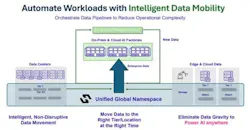
The platform is designed to replace between seven and 15 disconnected tools with a unified orchestration layer capable of automating data movement, preparation, and access across distributed enterprise storage environments.
Start Small, Scale Fast
Rather than requiring organizations to build entirely new AI storage silos, the architecture is designed to leverage existing infrastructure investments, allowing enterprises to begin with smaller deployments and scale without large-scale migrations or forklift upgrades.
Inside the Platform: Built for Real-World AI
At the core of the Hammerspace AI Data Platform is a global namespace providing a unified operational view of unstructured enterprise data across storage platforms and physical locations.
Using data assimilation technology, the platform can make millions of files across cloud and on-premises environments accessible without physically relocating data.
The architecture supports open standards-based protocols including NFS, SMB, S3, and pNFS, enabling high-performance data delivery to GPU environments without proprietary storage lock-in.
Additional architectural elements include:
- Tier-0 NVMe architecture: Integrates local GPU storage into a shared high-performance storage pool designed to turn each GPU node into a high-throughput data contributor.
- Model Context Protocol (MCP) integration: Connects enterprise business data directly to AI agents and retrieval-augmented generation workflows.
- Embedded vector database: Converts enterprise files into searchable embeddings designed to support contextual, real-time access across distributed storage environments.
The platform also integrates NVIDIA Blackwell RTX PRO 6000 GPUs and NVIDIA Spectrum-X Ethernet networking. According to Hammerspace, the environment is designed to deliver significantly higher data movement performance than traditional Ethernet architectures while ensuring AI pipelines continuously feed the appropriate data to GPU infrastructure.
Why It Matters
Accelerate AI Time-to-Value
Hammerspace says the platform is designed to shorten the timeline between infrastructure deployment and production-ready AI operations.
Reduce Infrastructure Waste
The architecture emphasizes utilizing existing infrastructure assets and scaling incrementally rather than overbuilding speculative new storage environments.
Simplify Operations
The company positions the platform as a unified operational environment built around a single namespace intended to reduce storage silos and orchestration complexity.
Empower Teams
Hammerspace argues that simplifying data orchestration allows data engineering teams to spend less time integrating fragmented environments and more time focused on AI development and operational outcomes.
The Bottom Line
Hammerspace positions the AI Data Platform as a way to transform fragmented enterprise data into a continuously accessible AI-ready resource capable of supporting operational AI at scale.
The company’s broader thesis is that AI success increasingly depends less on isolated GPU deployments and more on unified, orchestrated access to distributed enterprise data.
“No migrations. No silos. No chaos. Just results,” the company states.