Zayo, NVIDIA Build the Long-Haul Backbone for Distributed AI
Key Highlights
- AI-driven data center site selection is increasingly based on power availability combined with high-capacity fiber infrastructure to support distributed workloads.
- Zayo is expanding its North American fiber network with 8,000 route miles, including new long-haul routes and overbuilds in key AI corridors, to meet growing demand.
- NVIDIA is integrating scale-across networking technology and optical innovations, such as Spectrum-XGS and co-packaged optics, to enable geographically dispersed AI factories.
- Demand for long-haul dark fiber and metro capacity is surging, driven by large training clusters and distributed inference workloads, with hyperscalers leading the investments.
- The physical infrastructure supporting AI is becoming as critical as compute power, requiring coordinated development of fiber, power, cooling, and interconnection systems across markets.
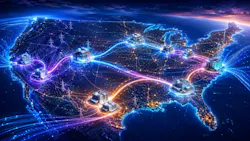
The data center industry’s increasingly power-first approach to site selection has created a follow-on question: Once the megawatts are found, is there enough network infrastructure to make the site useful at AI scale?
Zayo and NVIDIA are putting real infrastructure behind that question.
Zayo said it is working with NVIDIA to expand network capacity supporting AI factories across North America, including an 8,000-route-mile program targeting some of the fastest-growing AI corridors in the United States. The project encompasses six new long-haul routes along with overbuilds of existing network across 10 high-demand corridors.
The announcement arrives as AI data center development moves beyond the largest established hubs toward markets where power and land may be more readily available, but fiber capacity cannot necessarily be taken for granted.
That geography is increasingly important. NVIDIA has separately developed “scale-across” networking technology designed to allow AI infrastructure distributed among different buildings — or even data centers separated by hundreds of kilometers — to operate as a more unified computing environment.
Put together, the developments suggest that networking is becoming inseparable from the AI factory buildout itself.
Power may determine where the next generation of AI infrastructure can be built. Fiber will increasingly determine how effectively those sites can participate in the larger AI ecosystem.
Fiber Follows the Power
Zayo CEO Steve Smith said AI demand is changing both where network infrastructure is needed and how aggressively capacity must be deployed ahead of development.
“AI is fundamentally reshaping where and how network infrastructure needs to be built across the U.S.,” Smith said.
The company’s 8,000-mile program is more nuanced than that top-line number might suggest.
Zayo disclosed in April that the expansion includes approximately 3,000 route miles across six new long-haul routes, plus more than 5,000 route miles of overbuilds across 10 existing corridors. Zayo will own and operate the infrastructure and retain additional capacity beyond existing commitments for future demand.
The six new routes are:
Las Vegas to Reno; Denver to Chicago; Dallas to Austin; Columbus to Indianapolis; Atlanta to Ashburn, Virginia; and Omaha to Chicago.
Overbuilds include Sacramento-Reno, Las Vegas-Phoenix, Denver-Salt Lake City, Denver-Dallas, Houston-Austin, Dallas-Atlanta, Columbus-Ashburn and several routes connecting Midwest and Eastern markets.
Zayo said those corridors reflect locations where available power is drawing data center development and the resulting facilities require high-capacity connections into adjacent and established markets.
That is a notable inversion of the industry's traditional site-selection logic.
Fiber-rich data center hubs historically accumulated compute because power, connectivity, cloud ecosystems and interconnection were already concentrated there. AI development is increasingly starting from the opposite direction: find very large blocks of power first, then determine how the rest of the infrastructure stack can reach them.
Zayo has already demonstrated that strategy in the West.
The company completed a 622-mile Umatilla-Prineville-Reno dark-fiber route connecting AI and cloud infrastructure in Oregon and Nevada. The inland route, built with multiple conduits and 13 Zayo-owned inline amplification sites, provides an alternative to the I-5 corridor and connects emerging compute environments through Oregon, California and Nevada.
The implication for data center developers is straightforward. A site can be power-rich while remaining connectivity-thin.
And as AI campuses become larger and more distributed, fixing that second problem after construction begins may become increasingly difficult.
The Fiber Demand Is Already Showing Up
Zayo's own customer data suggests this is more than a forecast.
Its 2026 Bandwidth Report analyzed purchasing activity across nearly 6,000 customers during 2025 and found that demand for long-haul dark fiber doubled year over year. Metro dark-fiber demand increased by as much as 20 times in some AI-driven markets, while wavelength capacity purchases among data center customers rose 2.6 times.
Hyperscalers and carriers accounted for 95% of Zayo's long-haul fiber purchases, while the company identified AI infrastructure providers and neoclouds as an emerging class of large network buyers.
Those numbers reveal two overlapping network requirements.
Large training clusters and increasingly distributed AI campuses are putting pressure on long-haul infrastructure between major concentrations of compute.
At the same time, inference is increasing the importance of metro fiber, as computing moves closer to enterprise customers, cloud on-ramps, interconnection hubs and end users.
Zayo substantially increased its position in that second layer in May when it completed its acquisition of Crown Castle's Fiber Solutions business, adding approximately 90,000 metro route miles and 40,000 on-net enterprise locations. Zayo now says its North American network spans approximately 224,000 route miles.
That gives the company infrastructure on both sides of the emerging AI network equation: long-haul fiber connecting large compute markets and metro density supporting increasingly distributed inference and enterprise workloads.
NVIDIA Adds a Third Dimension: Scale Across
The NVIDIA connection gives the Zayo buildout additional architectural significance.
Data center networking has traditionally focused heavily on scaling up within tightly coupled computing systems and scaling out among racks and clusters inside the data center.
NVIDIA has added a third term: scale across.
Introduced with NVIDIA Spectrum-XGS Ethernet, scale-across networking is designed to connect geographically separated data centers into what NVIDIA describes as a unified AI factory. NVIDIA says the technology incorporates distance-aware congestion control, adaptive routing and telemetry designed to maintain AI network performance across longer distances.
That doesn't make geography disappear. Latency, fiber routes, optical systems and network architecture remain physical realities.
It does, however, change what distributed infrastructure can potentially do.
Rather than treating separate GPU campuses strictly as isolated pools of compute, scale-across architectures are intended to enable training and inference workloads to operate across multiple facilities. NVIDIA says Spectrum-XGS can support environments separated by hundreds of kilometers and is being incorporated into the broader Spectrum-X networking platform.
That capability becomes increasingly relevant as electrical and physical limits make it harder to place every GPU needed for the largest AI systems inside a single building or campus.
NVIDIA's Vera Rubin platform, now moving into production, extends that architecture further. Its Spectrum-6 Ethernet platform incorporates co-packaged optics and Spectrum-XGS scale-across capabilities as NVIDIA works toward AI environments potentially encompassing enormous numbers of accelerators.
For that reason, the Zayo announcement shouldn't be viewed simply as NVIDIA signing another connectivity partner.
It represents another physical layer beneath NVIDIA's vision for increasingly distributed AI factories.
“The network is quickly becoming just as critical to that progress as compute itself,” said Vladimir Troy, vice president of engineering for AI infrastructure at NVIDIA.
NVIDIA Pushes Deeper Into the Optical Stack
The Zayo agreement also fits a broader NVIDIA pattern.
As Data Center Frontier reported in May, NVIDIA has been moving deeper into the physical infrastructure and manufacturing ecosystem surrounding AI factories — extending well beyond GPU supply.
Perhaps the clearest parallel is NVIDIA's agreement with Corning.
Under a multiyear partnership announced in May, Corning plans to increase U.S. optical-connectivity manufacturing capacity tenfold and expand domestic fiber production capacity by more than 50%. The expansion includes three new manufacturing facilities in North Carolina and Texas.
The Corning agreement addresses optical connectivity used within hyperscale AI infrastructure. Zayo's long-haul network addresses a different piece of the problem: moving enormous amounts of data among geographically separated facilities and markets.
Together, however, the agreements show NVIDIA treating connectivity as infrastructure that must scale concurrently with compute rather than as something added after GPU capacity is deployed.
That pattern extends deeper into optics.
In March, NVIDIA announced separate multiyear agreements with Coherent and Lumentum, including $2 billion investments in each company alongside purchase commitments, manufacturing expansion and R&D work around advanced lasers and optical networking technology for future AI data centers.
NVIDIA is meanwhile moving co-packaged optics directly into its next-generation networking architecture. Spectrum-X Ethernet Photonics, entering production with the Vera Rubin generation, moves optical components closer to the switch silicon to reduce power requirements and improve network reliability at massive scale.
Seen together, these developments form a continuum:
Inside the AI factory, NVIDIA is redesigning the network around extremely high-bandwidth optical systems.
Across its supply chain, it is helping expand manufacturing of fiber, lasers and optical connectivity.
And between AI factories, the Zayo collaboration addresses the long-haul infrastructure required to connect compute as its geography spreads outward.
The New Site-Selection Equation
This matters because the geography of data center development is changing faster than the network beneath it.
Recent AI infrastructure projects increasingly begin with access to hundreds of megawatts — and in some cases gigawatts — of prospective power. DCF has been tracking that expansion into secondary and emerging markets where developers can assemble large land positions around existing transmission, generation or other sources of electrical capacity.
But power-first cannot mean power-only.
A massive GPU campus also needs fiber diversity, sufficient strand and conduit capacity, resilient routes, interconnection options and access to the broader cloud and data center ecosystem. As infrastructure spreads beyond Northern Virginia, Silicon Valley and other historically dense data center markets, those assumptions require renewed scrutiny.
Zayo and Equinix highlighted the same issue last year with an AI Infrastructure Blueprint that maps training environments, distributed inference and interconnection hubs as parts of a common architecture linked by high-capacity fiber.
The NVIDIA collaboration puts another layer beneath that model.
It also provides an infrastructure counterpart to NVIDIA's scale-across concept: software and switching technology can make geographically separated AI resources operate more cohesively, but the physical fiber connecting those resources still has to exist.
That may become particularly important for neoclouds.
Unlike the largest hyperscalers, emerging GPU cloud providers may not have decades of network infrastructure or enormous private backbones waiting wherever they acquire compute capacity. Their business models also depend heavily on getting expensive GPUs energized and earning revenue quickly.
“As AI infrastructure becomes more distributed, access to high-capacity connectivity in the right markets is becoming critical to how quickly providers, like neoclouds, can bring new GPU capacity online and support customer demand,” Smith said.
From Power Constraint to Infrastructure Coordination
The AI data center conversation has spent much of the past several years focused — understandably — on electricity.
Grid queues are long. Available capacity is scarce in many established markets. Developers are pursuing behind-the-meter generation, new utility territories and large powered-land positions while infrastructure providers search for ways to bring projects online sooner.
But solving the power problem can expose the next constraint.
A remote site with abundant electricity but insufficient network capacity is not equivalent to a mature hyperscale market. Nor will every AI workload tolerate the same network latency, topology or architecture.
The emerging AI factory therefore looks less like a stand-alone data center and increasingly like a coordinated infrastructure system: generation and grid capacity, land, cooling, accelerated compute, optical systems, metro networks, long-haul fiber and interconnection all have to arrive on compatible timelines.
Zayo says its AI-focused new-build and overbuild projects now span more than 15,000 route miles across North America. NVIDIA, meanwhile, is pushing networking deeper into its AI factory architecture while investing across the optical manufacturing chain required to support it.
The Zayo-NVIDIA agreement joins those two trajectories.
For the next generation of AI infrastructure, finding the megawatts may still be the first question.
Increasingly, it won't be the last.
At Data Center Frontier, we talk the industry talk and walk the industry walk. In that spirit, DCF Staff members may occasionally use AI tools to assist with content. Elements of this article were created with help from OpenAI's GPT5.
Keep pace with the fast-moving world of data centers and cloud computing by connecting with Data Center Frontier on LinkedIn, following us on X/Twitter and Facebook, as well as on BlueSky, and signing up for our weekly newsletters using the form below.
About the Author
 Matt Vincent
Matt Vincent
Matt Vincent is Editor in Chief of Data Center Frontier, where he leads editorial strategy and coverage focused on the infrastructure powering cloud computing, artificial intelligence, and the digital economy. A veteran B2B technology journalist with more than two decades of experience, Vincent specializes in the intersection of data centers, power, cooling, and emerging AI-era infrastructure. Since assuming the EIC role in 2023, he has helped guide Data Center Frontier’s coverage of the industry’s transition into the gigawatt-scale AI era, with a focus on hyperscale development, behind-the-meter power strategies, liquid cooling architectures, and the evolving energy demands of high-density compute, while working closely with the Digital Infrastructure Group at Endeavor Business Media to expand the brand’s analytical and multimedia footprint. Vincent also hosts The Data Center Frontier Show podcast, where he interviews industry leaders across hyperscale, colocation, utilities, and the data center supply chain to examine the technologies and business models reshaping digital infrastructure. Since its inception he serves as Head of Content for the Data Center Frontier Trends Summit. Before becoming Editor in Chief, he served in multiple senior editorial roles across Endeavor Business Media’s digital infrastructure portfolio, with coverage spanning data centers and hyperscale infrastructure, structured cabling and networking, telecom and datacom, IP physical security, and wireless and Pro AV markets. He began his career in 2005 within PennWell’s Advanced Technology Division and later held senior editorial positions supporting brands such as Cabling Installation & Maintenance, Lightwave Online, Broadband Technology Report, and Smart Buildings Technology. Vincent is a frequent moderator, interviewer, and keynote speaker at industry events including the HPC Forum, where he delivers forward-looking analysis on how AI and high-performance computing are reshaping digital infrastructure. He graduated with honors from Indiana University Bloomington with a B.A. in English Literature and Creative Writing and lives in southern New Hampshire with his family, remaining an active musician in his spare time.
Related
Voices of the Industry
 Source: Nimbus Advanced Process Cooling
 Image courtesy of Bell & Gossett