A Faster Path to Power: What Natrium’s NRC Approval Means for AI Infrastructure
Key Highlights
- The NRC's approval of TerraPower's Natrium reactor is the first for a commercial non-light-water reactor in over 40 years, marking a major regulatory milestone.
- Natrium's design integrates a sodium-cooled fast reactor with molten-salt energy storage, enabling flexible, dispatchable power output suitable for modern digital infrastructure.
- The accelerated 18-month licensing process contrasts sharply with traditional nuclear build timelines, aligning nuclear deployment with the rapid cycles of AI infrastructure development.
- This approval sets a precedent for risk-informed, performance-based licensing, potentially streamlining future advanced reactor approvals.
- Repurposing existing sites like coal power plants for nuclear projects offers a strategic advantage in deploying new capacity efficiently and with community support.
The race to build AI infrastructure at scale has exposed a deeper constraint than capital or compute: power that can be delivered on predictable timelines.
That constraint is now colliding with a system that has historically moved at the pace of decades. But in early March, a key signal emerged that the equation may be starting to change.
A Regulatory Breakthrough at the Moment of Peak Power Demand
TerraPower’s Natrium reactor cleared a major milestone with the Nuclear Regulatory Commission, which approved a construction permit for Kemmerer Power Station Unit 1 in Wyoming, representing the company’s first commercial-scale plant. It is the first reactor construction approval the NRC has granted in nearly a decade, and the first for a commercial non-light-water reactor in more than 40 years. More significantly, it is the first advanced reactor to reach this stage under the modern U.S. licensing framework.
For an industry increasingly defined by gigawatt-scale AI campuses and compressed build cycles, that milestone lands with unusual timing.
Construction Approved — But Not Yet 'Power Delivered'
The distinction between construction approval and operational readiness is critical.
TerraPower has not received a license to generate electricity. What the NRC has granted is permission to begin nuclear-related construction at the Kemmerer site, following safety and environmental review. Before the plant can operate, TerraPower’s subsidiary, US SFR Owner, must still secure a separate operating license.
But in practical terms, this is the moment when a project transitions from concept to execution. It is a regulatory green light not for power generation, but for steel, concrete, and capital deployment.
And in the context of advanced nuclear, that step has historically been the hardest to reach.
An 18-Month Signal to the Market
The speed of that approval may ultimately matter as much as the approval itself.
TerraPower submitted its construction permit application in March 2024. The NRC accepted it two months later, and by December 2025 had completed its final safety evaluation—finishing the process in roughly 18 months, well ahead of the original 27-month timeline.
That stands in stark contrast to the last major U.S. nuclear buildout. Vogtle Electric Generating Plant Units 3 and 4 took nearly 15 years to reach completion, a timeline increasingly incompatible with today’s energy and infrastructure demands.
For data center developers, hyperscalers, and neocloud operators, this is the real headline.
AI infrastructure is being planned, financed, and deployed on two- to three-year cycles. Until now, nuclear energy has operated on timelines that effectively excluded it from that conversation. An 18-month regulatory pathway—if it proves repeatable—begins to close that gap.
Why This Matters for AI Infrastructure
The NRC’s decision is not just about one reactor in Wyoming. It is a test of whether the U.S. regulatory system can support next-generation power infrastructure at the speed required by AI.
For an industry facing:
- Multi-year interconnection delays
- Transmission bottlenecks
- Rising community opposition to large-scale grid expansion
...the prospect of dispatchable, high-capacity generation that can be licensed on compressed timelines is strategically significant.
If advanced nuclear can move from application to construction approval in under two years, it begins to align (at least at the front end) with the development cadence of large-scale data center campuses.
That does not solve the full problem. But it changes the conversation.
A System Beginning to Move Faster
The NRC has signaled for several years that it intends to accelerate advanced reactor licensing. This approval is the clearest evidence to date that those efforts are translating into measurable outcomes.
As Jeremy Groom, acting director of the NRC’s Office of Nuclear Reactor Regulation, noted in December:
“We’ve finished our technical work on the Kemmerer review a month ahead of our already accelerated schedule, as we aim to make licensing decisions for new, advanced reactors in no more than 18 months.”
For investors, utilities, and increasingly for data center developers seeking long-term power certainty, the question is no longer whether advanced nuclear can be licensed.
It is whether it can now be licensed fast enough to matter.
What is Natrium?
The reactor at the center of the NRC’s approval differs from the conventional U.S. nuclear fleet in several foundational ways. These differences increasingly matter as large-scale power consumers, including AI data centers, look for new sources of firm and flexible capacity.
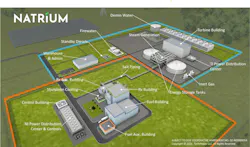
Most American commercial reactors today are light-water reactors, using ordinary water as both coolant and moderator while operating at high pressure. TerraPower’s Natrium, by contrast, is a 345-megawatt electric, pool-type sodium-cooled fast reactor fueled by HALEU (high-assay low-enriched uranium) metal fuel. Instead of pressurized water, it uses liquid sodium to transfer heat from the core, enabling operation at high temperatures without the extreme pressures of conventional designs. The result is a fundamentally different thermal system than what has defined the U.S. nuclear fleet for decades.
That sodium-fast architecture is the core technical departure. Natrium operates at temperatures above 350°C while remaining well below sodium’s boiling point, allowing the system to function at near-atmospheric pressure. TerraPower argues this supports passive cooling through natural forces such as gravity and thermal convection, potentially reducing the complexity and volume of safety-related systems compared to traditional pressurized plants. GE Vernova Hitachi, whose PRISM sodium fast reactor lineage informs Natrium, similarly describes a system built around metallic fuel, pool-type sodium cooling, and natural circulation for heat removal.
A Reactor Designed for Flexibility, Not Just Baseload
But the more consequential distinction, particularly for modern power markets, is that Natrium is not just a reactor. It is a reactor-plus-storage system.
The design couples the sodium fast reactor to a molten-salt energy storage system capable of boosting output from 345 MW to 500 MW during periods of peak demand. Rather than forcing the reactor core itself to ramp aggressively, Natrium stores thermal energy and dispatches additional electricity when needed. The U.S. Department of Energy has said this configuration can improve grid reliability and support energy-intensive industrial loads, while TerraPower positions it as built-in, utility-scale storage for a grid increasingly shaped by intermittent renewables.
For data center developers, this is a critical shift. Traditional nuclear plants are optimized for steady baseload output. Natrium introduces a model in which nuclear generation can behave more like a dispatchable power asset, capable of aligning with variable demand profiles, including the increasingly dynamic load patterns associated with AI inference and large-scale compute clusters.
The storage system is central to that value proposition. According to American Nuclear Society reporting, Natrium’s thermal storage can sustain the elevated 500-MWe output for more than five and a half hours. In practical terms, this allows the plant to function less like a fixed-output generator and more like a flexible clean-energy hub, meaning one that can respond to peak demand, renewable intermittency, or large, time-sensitive industrial loads.
That flexibility addresses one of nuclear power’s longstanding commercial limitations. While conventional reactors excel at delivering firm capacity, they have not typically been designed to operate as grid-balancing resources. Natrium’s hybrid architecture is an attempt to reposition nuclear as both firm and flexible, a combination that is increasingly valuable as power systems absorb both renewable generation and high-density digital infrastructure.
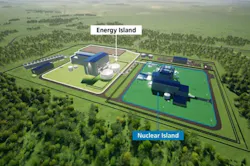
Another notable feature is how the plant is organized. Natrium separates the facility into a “nuclear island” and an “energy island,” with steam turbines and molten-salt storage systems physically and operationally decoupled from the nuclear core. This allows significant portions of the power generation system to sit outside the most tightly regulated nuclear zone.
That design choice may appear subtle, but it has meaningful project implications. By reducing the footprint of the highest-regulated areas, developers can simplify construction sequencing, expand the pool of eligible labor, and potentially lower both cost and regulatory complexity for non-nuclear components. For large-scale infrastructure projects - particularly those being evaluated alongside data center campuses - those factors can materially affect timelines, capital efficiency, and deployment risk.
Licensing as Infrastructure Precedent
The importance of the NRC approval extends beyond reactor design into something more foundational: licensing precedent.
According to American Nuclear Society reporting, TerraPower’s application is the first for a commercial power reactor to use a fully risk-informed, performance-based licensing basis under the industry-led Licensing Modernization Project methodology described in NEI 18-04. The NRC formally endorsed that framework in Regulatory Guide 1.233 in 2020 as an acceptable pathway for non-light-water reactors.
That may prove almost as consequential as the permit itself.
One of the central challenges for advanced nuclear has been forcing novel technologies into regulatory frameworks built around large light-water reactors. If Natrium demonstrates that a technology-inclusive, risk-informed pathway can work in practice, it provides something the sector has long lacked: a repeatable licensing playbook.
For data center developers and other large-load customers, this is not an abstract regulatory evolution. It is a question of whether new sources of firm, dispatchable power can be brought online on timelines that align with infrastructure demand. A licensing framework that is predictable, adaptable, and faster to execute is a prerequisite for nuclear to participate meaningfully in the emerging AI-era power market.
There is also a broader industrial policy dimension. The Natrium project is one of the flagship demonstrations under the U.S. Department of Energy’s Advanced Reactor Demonstration Program, which authorized up to $2 billion in federal support on a 50/50 cost-share basis. DOE has positioned Natrium as one of two major first-of-a-kind projects intended to catalyze a domestic advanced nuclear supply chain.
This means the permit is not simply a milestone for the Bill Gates-backed startup. It is a test of whether Washington’s strategy for jump-starting next-generation nuclear can produce a licensed, commercial-scale project. A failed or indefinitely delayed process would have undermined confidence not only in TerraPower, but in the broader federal demonstration model.
From Coal Sites to AI Campuses
The Wyoming location adds another layer of significance. The Kemmerer plant is being developed near an existing coal-fired power site, positioning it as a potential template for repowering fossil-energy communities with next-generation nuclear infrastructure. If successful, this model offers a pathway to reuse existing grid interconnections, industrial labor pools, and energy-friendly zoning environments.
For data center developers, those attributes are increasingly decisive. Sites with existing transmission access, permitting familiarity, and local political acceptance are among the most sought-after (and most constrained) inputs in large-scale campus development. Repurposed energy sites could emerge as one of the few scalable pathways to bring new capacity online without starting from scratch.
The Remaining Constraints: Fuel and Execution
Still, the approval does not eliminate the project’s risks.
Natrium relies on HALEU, a fuel category for which commercial supply remains limited in the United States. Reuters has reported that domestic enrichment capacity is still being built out, with DOE awarding contracts to accelerate that process. TerraPower has taken steps toward fuel commercialization, including uranium metallization work with Framatome and potential investments tied to HALEU production abroad. Oak Ridge National Laboratory is also advancing multiple fuel development initiatives aimed at next-generation reactors.
As a result, the path to commercial operation remains contingent on fuel availability, first-of-a-kind construction execution, and eventual operating license approval.
In that sense, the NRC’s decision is both symbolic and structural.
Symbolically, it signals that advanced nuclear in the United States is moving from concept to construction. Structurally, it demonstrates that a commercial-scale non-light-water reactor can navigate the licensing process, secure safety findings, and begin to establish real regulatory precedent.
If TerraPower can translate this permit into disciplined construction and, ultimately, operating approval, Natrium will stand as one of the first tangible proofs that advanced nuclear can be licensed, financed, and built in the United States on modern timelines.
For a sector that has spent years promising a breakthrough, the test has now shifted from theory to execution, and from regulatory possibility to infrastructure reality.
At Data Center Frontier, we talk the industry talk and walk the industry walk. In that spirit, DCF Staff members may occasionally use AI tools to assist with content. Elements of this article were created with help from OpenAI's GPT5.
Keep pace with the fast-moving world of data centers and cloud computing by connecting with Data Center Frontier on LinkedIn, following us on X/Twitter and Facebook, as well as on BlueSky, and signing up for our weekly newsletters using the form below.
About the Author
 David Chernicoff
David Chernicoff
Voices of the Industry
 Image courtesy of Bell & Gossett
 Source: Adobe Stock, courtesy of ebm-papst