Southern’s 17 GW Pipeline Puts AI Power Demand Into Utility Math
Key Highlights
- Data center electricity use at Southern has surged 55%, with over 1.2 GW of actual load now operational, signaling rapid growth ahead.
- Contracts for large data center loads have expanded to over 17 GW, with projects like OpenAI’s facility near Savannah set to begin in 2028.
- Southern is planning significant generation investments, including thermal, solar, and batteries, to meet future AI infrastructure demands, with potential spending exceeding $8 billion.
- Flexible demand response, such as OpenAI’s 1 GW arrangement, introduces new grid management strategies and enhances load flexibility for large AI campuses.
- The Southeast is becoming a key hub for hyperscale data centers, with Southern’s integrated utility model providing a competitive edge in fast-tracking infrastructure development.
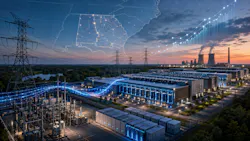
The headline number from Southern Company’s latest earnings report is hard to miss: electricity use by data centers across the utility’s system increased 55% in the second quarter compared with a year earlier.
But the more consequential numbers may be the ones sitting behind it.
Southern now has more than 1.2 GW of operating data center load, up by more than 500 MW from a year ago. At the same time, its electric utilities have signed contracts and large-load agreements totaling more than 17 GW by the mid-2030s, with another 8 GW in late-stage development and a prospective pipeline of large industrial and data center projects exceeding 75 GW.
That leaves an enormous gap between the data center megawatts consuming electricity today and the load Southern has contractually positioned itself to serve during the next decade.
For the data center industry, that gap may be the most important part of Southern’s second-quarter story.
It offers a look at how utilities are beginning to convert the AI infrastructure boom from forecasts and campus announcements into contracts, generation procurement, transmission investment and eventually energized capacity.
From Contracts to Megawatts
Southern added roughly 6 GW of contracted large load during the quarter alone.
Alabama Power signed three projects representing about 3 GW, while Georgia Power reached a 25-year agreement to serve OpenAI’s planned project in Effingham County near Savannah. That facility is expected to require approximately 3.2 GW and begin taking electric service in phases in 2028.
The numbers nevertheless require an important distinction.
Seventeen gigawatts contracted does not mean 17 GW will suddenly appear on Southern’s grid. Large data center campuses ramp gradually, often over several years, and Southern executives acknowledged that actual customer ramp schedules do not always match the assumptions made when projects are first approved.
CEO Chris Womack said the company has learned that it must work closely with customers because ramp rates “may not be what was projected” initially.
“The bottom line is the load is very real,” Womack said. “So we know it may not be there initially, but we know that it’s coming.”
That distinction is increasingly important for an industry trying to sort announced capacity from contracted power and contracted power from operating infrastructure.
Southern’s existing 1.2 GW of data center demand provides at least one useful benchmark: actual consumption is already accelerating sharply before most of the newly contracted AI load arrives.
The company said some projects now approaching final contracts would begin ramping in 2028 and continue into the next decade.
Generation Follows the Load
The other side of those contracts is the infrastructure required to serve them.
Southern has already secured approvals for approximately 10 GW of new company-owned generation resources, including thermal generation, batteries and solar, along with hundreds of miles of new transmission. But its latest large-load wins are beginning to push beyond that approved supply.
During the analyst Q&A, Southern CFO David Poroch said the company is now approximately 1 GW oversubscribed in Georgia relative to previously approved capacity, while the newly signed Alabama contracts represent another roughly 3 GW of load that will help determine future generation needs.
Asked whether investors could therefore think in terms of roughly 4 GW or more of additional generation requirements, Poroch said that approach was “directionally correct.”
He then supplied an unusually useful rule of thumb for the capital behind AI electricity demand: roughly $2 billion or slightly more per gigawatt of new generating capacity, depending on the generation resource.
That does not mean Southern has committed another $8 billion of generation spending. Projects must move through competitive RFPs, utility commissions must approve them, and Southern may not own every selected resource.
But the math illustrates the scale now beginning to accompany contracted AI demand.
Southern also emphasized that potential company-owned generation selected through current Georgia and Alabama RFP processes is not included in its existing capital forecast. If selected and approved, spending could begin appearing around 2028 for generation expected to enter service around 2031 and 2032.
In other words, the AI infrastructure capital cycle extends well beyond the construction of the data center itself.
The power contract can drive a second infrastructure cycle involving generating plants, battery systems, substations, transmission corridors, pipelines and financing that starts years before the associated load reaches full operation.
Making AI Load Bankable
Southern’s earnings call also offered a detailed look at how utilities are attempting to protect themselves against another risk: a customer reserving several gigawatts of capacity but ultimately consuming less electricity than expected.
The company’s large-load contracts include minimum bills designed to cover at least 100% of the incremental cost to serve the customer, along with termination payments and collateral requirements.
Poroch said Southern has approximately $21 billion of collateral supporting the full 17 GW contracted portfolio.
Those provisions matter because they change the economics of a delayed data center ramp.
Womack said minimum bills allow Southern to somewhat “decouple” revenue from the precise timing of customer consumption. A facility may take longer to reach its projected megawatt load, but the utility is not relying exclusively on electrons consumed during that ramp to recover the infrastructure costs incurred to serve it.
That makes the emerging large-load contract nearly as important to AI infrastructure deployment as the interconnection agreement itself.
Utilities increasingly need assurance that enormous load requests represent financeable projects rather than speculative queue positions. Data center developers, meanwhile, need enough contractual certainty around future power to finance campuses whose construction timelines may stretch across several years.
Southern is effectively building a financial bridge between those two requirements.
One Gigawatt of Flexibility
The OpenAI agreement adds another potentially important piece to that model.
Of the approximately 3.2 GW OpenAI expects to require in Effingham County, as much as 1 GW will be available as flexible demand response.
During periods of high system demand, Georgia Power will be able to reduce electricity delivered to the facility. Georgia Power says that flexibility can reduce the amount of additional generation the utility ultimately needs to build, producing longer-term savings for other customers.
Southern executives said it is the company’s first demand-response arrangement of this type with a data center, and Poroch indicated that load flexibility is now part of the discussion with other hyperscale customers as well.
The scale is notable.
One gigawatt represents nearly one-third of the OpenAI site’s projected maximum demand. That begins to recast a very large AI campus from a purely inflexible load into something that can participate, at least to a degree, in grid operations.
For utilities confronting unprecedented data center requests, flexibility at that scale could become another variable in the site-selection equation: not simply how much power a campus needs, but how much of that demand can be managed when the grid is stressed.
Georgia Power said OpenAI will pay the full infrastructure and electric-service costs associated with the facility under its 25-year agreement, while financial assurances are intended to protect other customers.
That framework also lands squarely in the growing national debate over whether households and small businesses should bear infrastructure costs created by AI data centers.
The Southeast Gains Gravity
Southern’s comments also reinforce the changing geography of hyperscale development.
Georgia has already emerged as one of the country's largest data center growth markets, but Womack said large-load momentum is increasingly moving west across Southern’s territory.
Alabama accounted for approximately 3 GW of Southern’s newly contracted load during the quarter, while Womack pointed to 500 MW-scale data center activity in Mississippi and said the company’s broader pipeline reflects increasing interest there as well.
Southern argues that its vertically integrated, state-regulated utility structure is becoming a competitive advantage in that race.
Rather than requiring developers to separately navigate generation, transmission and power procurement across multiple market structures, Southern’s operating utilities can coordinate generation, transmission and distribution through integrated planning and state regulatory proceedings.
Whether that produces faster delivery in every case will depend on generation availability, transmission construction and regulatory execution. But hyperscale development is increasingly following jurisdictions where utilities can provide a credible path not merely to an interconnection agreement, but to the generation required to support it.
Southern’s 75-plus-GW prospective pipeline should therefore not be read as 75 GW of inevitable data center construction. The figure includes industrial projects as well as data centers, and projects remain at different stages of maturity.
What it does show is the intensity of the competition now underway for future power capacity across Georgia, Alabama and Mississippi.
AI Expands the Energy Stack
There is another layer to Southern’s earnings call that extends beyond its regulated utilities.
Southern Power is discussing new long-term energy and capacity agreements as existing power contracts expire, including potential arrangements with hyperscalers. Management is also evaluating brownfield opportunities and uprates at existing assets.
Southern subsidiary PowerSecure, meanwhile, is seeing expansion in distributed generation, backup generation and bridge-power markets—an increasingly relevant business as data center developers search for ways to begin operations before permanent grid capacity becomes available.
Natural gas infrastructure could also grow alongside the load. Southern executives said the generation RFPs in Georgia and Alabama could create additional opportunities for FERC-regulated pipeline investment.
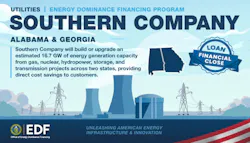
The federal government is already helping finance a substantial portion of Southern’s broader power buildout. In February, the Department of Energy closed a $26.5 billion loan package for Georgia Power and Alabama Power supporting more than 16 GW of firm power and grid improvements, including 5 GW of new gas generation, nuclear uprates and license renewals, battery storage, hydropower modernization and more than 1,300 miles of transmission and grid enhancements.
Seen together, these pieces show why AI infrastructure can no longer be viewed as a data center construction story alone.
AI demand is reaching backward through the entire energy supply chain.
Nuclear Remains Further Out
Even nuclear surfaced in the discussion.
Womack said he believes the United States will need additional nuclear units operating by the mid-2030s, although he was explicit that Southern does not intend to be the next utility to build one.
More interesting for the data center industry was his acknowledgement that Southern is discussing with hyperscalers what role they could play in assuming some of the financial risk associated with future AP1000 projects, including potential construction cost overruns.
Those conversations remain preliminary.
But they illustrate how far the hyperscaler-power relationship is expanding. What began as the procurement of renewable energy and then moved into utility interconnection, nuclear PPAs and behind-the-meter generation is increasingly reaching into questions of who finances and bears risk for the next generation of power infrastructure.
When AI Demand Gets Real
Southern’s second-quarter numbers do not eliminate the uncertainty surrounding data center power forecasts.
Seventeen gigawatts of contracts will take years to materialize. Ramp schedules will change. Some prospective projects will never reach construction. Generation projects still face regulatory, permitting, supply-chain and construction constraints.
But Southern is providing something increasingly valuable in the AI infrastructure conversation: evidence of conversion.
Operating data center load has climbed above 1.2 GW. Another 500 MW-plus has appeared on the system in roughly a year. Six additional gigawatts were contracted in a single quarter. Generation procurement is following. Capital spending could follow that. Contract structures are being redesigned around gigawatt-scale customers. And one of the largest AI projects announced to date is giving the grid access to as much as 1 GW of flexible load.
That is a substantially different stage of development from the first wave of enormous AI power forecasts.
The question is no longer simply whether AI will require tens of gigawatts of additional electricity.
Across Southern Company’s territory, the harder work has begun: deciding which loads are real, what generation will serve them, who will finance it, who assumes the risk, and how quickly contracted megawatts can become operating infrastructure.
At Data Center Frontier, we talk the industry talk and walk the industry walk. In that spirit, DCF Staff members may occasionally use AI tools to assist with content.
Keep pace with the fast-moving world of data centers and cloud computing by connecting with Data Center Frontier on LinkedIn, following us on X/Twitter and Facebook, as well as on BlueSky, and signing up for our weekly newsletters using the form below.
About the Author
 Matt Vincent
Matt Vincent
Matt Vincent is Editor in Chief of Data Center Frontier, where he leads editorial strategy and coverage focused on the infrastructure powering cloud computing, artificial intelligence, and the digital economy. A veteran B2B technology journalist with more than two decades of experience, Vincent specializes in the intersection of data centers, power, cooling, and emerging AI-era infrastructure. Since assuming the EIC role in 2023, he has helped guide Data Center Frontier’s coverage of the industry’s transition into the gigawatt-scale AI era, with a focus on hyperscale development, behind-the-meter power strategies, liquid cooling architectures, and the evolving energy demands of high-density compute, while working closely with the Digital Infrastructure Group at Endeavor Business Media to expand the brand’s analytical and multimedia footprint. Vincent also hosts The Data Center Frontier Show podcast, where he interviews industry leaders across hyperscale, colocation, utilities, and the data center supply chain to examine the technologies and business models reshaping digital infrastructure. Since its inception he serves as Head of Content for the Data Center Frontier Trends Summit. Before becoming Editor in Chief, he served in multiple senior editorial roles across Endeavor Business Media’s digital infrastructure portfolio, with coverage spanning data centers and hyperscale infrastructure, structured cabling and networking, telecom and datacom, IP physical security, and wireless and Pro AV markets. He began his career in 2005 within PennWell’s Advanced Technology Division and later held senior editorial positions supporting brands such as Cabling Installation & Maintenance, Lightwave Online, Broadband Technology Report, and Smart Buildings Technology. Vincent is a frequent moderator, interviewer, and keynote speaker at industry events including the HPC Forum, where he delivers forward-looking analysis on how AI and high-performance computing are reshaping digital infrastructure. He graduated with honors from Indiana University Bloomington with a B.A. in English Literature and Creative Writing and lives in southern New Hampshire with his family, remaining an active musician in his spare time.
Voices of the Industry
 Source: Nimbus Advanced Process Cooling
 Image courtesy of Bell & Gossett