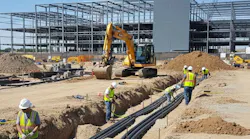
Executive Roundtable: The Coordination Imperative

For the second installment of our Executive Roundtable for the First Quarter of 2026, Data Center Frontier turns to what may be the defining operational challenge of the AI infrastructure era: coordination.
As data center development accelerates into multi-hundred-megawatt and gigawatt-scale campuses, the complexity of delivering capacity has expanded far beyond the boundaries of any single organization. What was once a relatively linear development process involving site selection, utility engagement, construction, and commissioning has evolved into a deeply interdependent system requiring synchronized execution across utilities, power providers, engineering firms, equipment suppliers, and operators.
The shift reflects a broader transformation in the industry. AI infrastructure is no longer simply being built; it is being orchestrated. Power availability, turbine procurement, transmission planning, supply chain logistics, and construction timelines must now align with unprecedented precision. Delays or disconnects in any one segment can cascade across the entire project lifecycle, amplifying risk and extending time to market.
Yet despite this growing interdependence, the industry remains structurally fragmented. Utilities, developers, and suppliers often operate on different timelines, incentives, and planning assumptions. The result is an execution environment where coordination is both more critical than ever, and still unevenly achieved.
In this roundtable, our panel of industry leaders examines where those gaps persist, and where new models of collaboration are beginning to take hold as the data center industry adapts to the demands of building AI infrastructure at industrial scale.

Our distinguished panelists for the First Quarter of 2026 include:
- Christopher Gorthy, Advanced Technology Core Market Co-Leader - Mission Critical, DPR Construction
- Miranda Gardiner, Executive Director, iMasons Climate Accord
- Miles Whitling, Marketing Director, Maddox Industrial Transformer
- Mike Connaughton, Senior Product Manager, Leviton Network Solutions
And now onto our second Executive Roundtable question for Q1 of 2026.
Data Center Frontier: As AI campuses scale into multi-hundred-megawatt and gigawatt territory, successful delivery increasingly depends on tight coordination across utilities, suppliers, builders, and operators. Where is the industry still too fragmented, and what models of collaboration are proving most effective?

Christopher Gorthy, DPR Construction: Early collaboration of key stakeholders has become the baseline to deliver these complex projects. The teams that are successful in these environments are the ones who combine effective meeting structures with enough in‑person interaction to build real trust. Pairing those relationships with the right tools can help track key decision making, document reasoning, and keep everyone aligned on "The Why," creating more predictable outcomes.
Where the industry continues to feel fragmented is around liability, risk, and comfort with sharing design and model data. Achieving the speed these projects demand requires the entire team to understand each partner’s constraints and then working together to solve problems, communicating clearly and documenting decisions as they go.
All of our partnerships are solving equations with multiple variables. Our teams must provide early feedback and solutions when faced with impacts or delays outside our control, and even earlier communications of impacts that cannot be mitigated. Open communication channels, whether through shared digital platforms or recurring working sessions, are critical to staying ahead of risk.
As projects get bigger, alignment with financial institutions, insurance entities and private equity partners also have become essential.
The number of trade partners capable of taking on contracts of this size is limited, so making sure we are setting up our partners for success while also working to expand the network of qualified trade partners is a key strategy.
From a tactical standpoint, the most effective projects operate from a single integrated schedule that ties together the owner, vendors, general contractor, trades, commissioning teams, and all other stakeholders.
Reinforcing this with consistent two‑ to three‑week look‑ahead reviews and onsite schedule coordination meetings regardless of contractual structure significantly increases alignment and efficiency at the project level.

Miranda Gardiner, iMasons Climate Accord: Tight coordination across utilities, suppliers, builders, and operators is paramount. I believe the issue is less that we are fragmented and more that we must move from commitments to execution. Many companies have set ambitious climate targets, issued sustainability reports, and signed emissions-reduction pledges.
The challenge now is aligning those commitments with the realities of rapid buildout, coordination of grid interconnections, renewable energy procurement, construction supply chains, and operational efficiency. We can scale quickly and still deliver on climate goals.
The most effective collaboration models are when owner-operators, policymakers, communities, and other key stakeholders plan together and early. This is how we approach our initiatives at the iMasons Climate Accord.
Let’s use sustainability as the example to answer this question as it can be embedded in ways that also generate economic benefit: coordinating with utilities to accelerate renewable energy projects and grid upgrades that create regional jobs, investing in energy efficiency, advanced cooling, and heat-recovery systems can reduce facility’s operating costs and emissions, and water stewardship and habitat protection protect local resources.
These are all critical to the future of a healthy planet and important to our concerned communities.
Equally important is community and workforce investment, so we can continue partnering with local governments, schools, and training programs to prepare workers for construction, electrical, mechanical, and operations roles tied to digital infrastructure growth.

Miles Whitling, Maddox Industrial Transformer: Historically, utilities, suppliers, contractors, and operators have tended to work in silos. That model breaks down when projects are moving at the pace required for AI infrastructure. Many EPC teams are still engineering custom specs and then discovering supply constraints. All parties are also often concerned with “stepping on each other's toes,” crossing wires, and overstepping commercial boundaries, which can slow down processes and create problems due to miscommunication. The projects executing well have made coordination intentional: weekly or biweekly calls with all key parties, integrated master scheduling, and suppliers brought in during design rather than after. Strategic supplier partnerships are replacing transactional bids, shifting from a one-off supplier model to a relationship model.

Mike Connaughton, Leviton Network Solutions: This question really highlights how quickly multiple technology domains are evolving at once—optics, cooling methods, power distribution, and high density interconnects are all changing in parallel.
That pace creates fragmentation, because suppliers and builders are innovating on different timelines and sometimes different design assumptions.
Right now the most effective coordination is happening at the hyperscale end user level.
Large operators are driving cross vendor alignment by defining clearer solution requirements and pushing suppliers to ensure interoperability across power, thermal, and networking systems.
In several areas, this collaboration is being formalized through communities like the Open Compute Project (OCP), which provides a neutral forum for developing specifications and accelerating adoption.
Over time, the best practices emerging from these hyperscale led efforts are likely to be codified into more broadly adopted standards—such as updates to TIA 942 and related frameworks—so that the wider market can implement AI campuses with less friction and fewer custom integrations.
NEXT: Designing for an Uncertain Demand Curve
About the Author
 Matt Vincent
Matt Vincent
Matt Vincent is Editor in Chief of Data Center Frontier, where he leads editorial strategy and coverage focused on the infrastructure powering cloud computing, artificial intelligence, and the digital economy. A veteran B2B technology journalist with more than two decades of experience, Vincent specializes in the intersection of data centers, power, cooling, and emerging AI-era infrastructure. Since assuming the EIC role in 2023, he has helped guide Data Center Frontier’s coverage of the industry’s transition into the gigawatt-scale AI era, with a focus on hyperscale development, behind-the-meter power strategies, liquid cooling architectures, and the evolving energy demands of high-density compute, while working closely with the Digital Infrastructure Group at Endeavor Business Media to expand the brand’s analytical and multimedia footprint. Vincent also hosts The Data Center Frontier Show podcast, where he interviews industry leaders across hyperscale, colocation, utilities, and the data center supply chain to examine the technologies and business models reshaping digital infrastructure. Since its inception he serves as Head of Content for the Data Center Frontier Trends Summit. Before becoming Editor in Chief, he served in multiple senior editorial roles across Endeavor Business Media’s digital infrastructure portfolio, with coverage spanning data centers and hyperscale infrastructure, structured cabling and networking, telecom and datacom, IP physical security, and wireless and Pro AV markets. He began his career in 2005 within PennWell’s Advanced Technology Division and later held senior editorial positions supporting brands such as Cabling Installation & Maintenance, Lightwave Online, Broadband Technology Report, and Smart Buildings Technology. Vincent is a frequent moderator, interviewer, and keynote speaker at industry events including the HPC Forum, where he delivers forward-looking analysis on how AI and high-performance computing are reshaping digital infrastructure. He graduated with honors from Indiana University Bloomington with a B.A. in English Literature and Creative Writing and lives in southern New Hampshire with his family, remaining an active musician in his spare time.