Executive Roundtable: Scaling Beyond the Prototype Phase
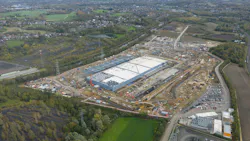
The data center industry has demonstrated that it can design extraordinary AI infrastructure. The next test is whether it can manufacture and operate that infrastructure at scale.
As deployments grow from isolated high-density installations into standardized fleets spanning multiple campuses and regions, the governing constraints shift from technology to execution. Commissioning, supply chains, workforce readiness, maintainability, lifecycle management, and operational consistency all become first-order considerations.
In many respects, the industry's biggest challenge is no longer inventing new architectures but making them repeatable under the pressures of compressed schedules and unprecedented capital investment. The transition from bespoke engineering to industrialized delivery may ultimately prove as consequential as the introduction of liquid cooling or accelerated computing itself.
Against that backdrop, we asked our panel what changes once AI infrastructure leaves the lab and enters the far more demanding world of live production at industrial scale.

Our distinguished Executive Roundtable panelists for Q2 of 2026 includes:
- Steve Altizer, President and CEO, Compu Dynamics
- Joe Capes, VP, Trane Technologies and Head of LiquidStack
- Robert Danforth, Director–Engineering, Simulation, and Advanced Development, Rehlko
And now onto the third question of the series for Q2 of 2026.
Data Center Frontier: The industry is moving from prototype AI environments toward industrialized deployment at scale. What becomes materially harder once AI infrastructure moves into live production?

Steve Altizer, Compu Dynamics: The defining challenge is keeping pace with the rate of change in the IT environment. It takes time to design, permit, build, and commission a data center. AI hardware operates on a completely different timeline.
New GPU families are being introduced every 12 to 18 months, and from one generation to the next, rack power densities can double or even triple. At prototype scale, you can design around a single cluster or a specific density profile. At production scale, that approach becomes a real liability.
The facility has to support today’s deployment while remaining adaptable for the next compute profile. We are not just talking about adding more power. We are preparing for major architectural shifts, including the move toward DC power delivery or cooling systems that may rely on two-phase liquid to remove heat at scale.
That is what becomes materially harder. You are no longer solving for a single, static deployment. You are solving for a moving target inside a live operating environment.
This is where strategic modularity proves its value. It helps decouple the lifecycle of the building from the lifecycle of the IT hardware. Instead of treating the data center as one monolithic design, modularity creates a more agile framework that can absorb new power and cooling architectures without requiring a full facility retrofit every time the IT roadmap shifts.
At Compu Dynamics Modular, we are seeing this play out in real time. The value of a turnkey modular approach is not simply speed. It is the agility owners need to keep pace with ever-evolving rack densities, power delivery requirements, and cooling architectures.

Joe Capes, Trane/LiquidStack: Getting one deployment right is hard. Doing it repeatedly is harder.
Most organizations can make a pilot project successful. The challenge starts when you need to deliver the same results across multiple sites while keeping performance, reliability, and timelines on track.
That's where things like standardization of infrastructure, installation, commissioning, and day-to-day operations become much more important. Small issues that don't seem significant in a single deployment can become major problems when you're building at scale.
The companies that will stand-out and prosper over the next few years won't just be the ones that build AI infrastructure, they will be the ones that can scale it, support it and repeat a positive user experience consistently, and do it globally.

Robert Danforth, Rehlko: The real test begins when AI infrastructure moves from pilot environments into full-scale production.
A pilot can demonstrate that a system supports AI workloads under controlled conditions. Production environments introduce a different set of challenges. Operators must maintain performance and reliability across multiple facilities while supporting rapidly evolving workloads and growing capacity requirements.
As deployments expand, the focus shifts to consistency. Infrastructure needs to be deployed, operated, and maintained through repeatable processes across an entire portfolio of sites. That requires close coordination across design, construction, operations, maintenance, and supply chain teams. Challenges that can be addressed relatively easily in a single deployment become far more significant when they affect multiple facilities.
At the same time, expectations for reliability don't change. Operators still need to deliver uptime and performance while managing increasingly dense compute environments, growing power demands, and more complex power architectures. Every decision becomes more consequential because organizations are supporting critical infrastructure at scale.
Ultimately, success in the next phase of AI growth will depend on the ability to execute consistently, operate efficiently, and maintain performance over the long term. The organizations that succeed will be the ones that build repeatable operating models while maintaining the reliability that mission-critical environments demand.
NEXT: Roundtable Recap
About the Author
 Matt Vincent
Matt Vincent
Matt Vincent is Editor in Chief of Data Center Frontier, where he leads editorial strategy and coverage focused on the infrastructure powering cloud computing, artificial intelligence, and the digital economy. A veteran B2B technology journalist with more than two decades of experience, Vincent specializes in the intersection of data centers, power, cooling, and emerging AI-era infrastructure. Since assuming the EIC role in 2023, he has helped guide Data Center Frontier’s coverage of the industry’s transition into the gigawatt-scale AI era, with a focus on hyperscale development, behind-the-meter power strategies, liquid cooling architectures, and the evolving energy demands of high-density compute, while working closely with the Digital Infrastructure Group at Endeavor Business Media to expand the brand’s analytical and multimedia footprint. Vincent also hosts The Data Center Frontier Show podcast, where he interviews industry leaders across hyperscale, colocation, utilities, and the data center supply chain to examine the technologies and business models reshaping digital infrastructure. Since its inception he serves as Head of Content for the Data Center Frontier Trends Summit. Before becoming Editor in Chief, he served in multiple senior editorial roles across Endeavor Business Media’s digital infrastructure portfolio, with coverage spanning data centers and hyperscale infrastructure, structured cabling and networking, telecom and datacom, IP physical security, and wireless and Pro AV markets. He began his career in 2005 within PennWell’s Advanced Technology Division and later held senior editorial positions supporting brands such as Cabling Installation & Maintenance, Lightwave Online, Broadband Technology Report, and Smart Buildings Technology. Vincent is a frequent moderator, interviewer, and keynote speaker at industry events including the HPC Forum, where he delivers forward-looking analysis on how AI and high-performance computing are reshaping digital infrastructure. He graduated with honors from Indiana University Bloomington with a B.A. in English Literature and Creative Writing and lives in southern New Hampshire with his family, remaining an active musician in his spare time.
Voices of the Industry
 Source: Nimbus Advanced Process Cooling
 Image courtesy of Bell & Gossett