Emergence Water and Nimbus: Water Joins Power as AI Infrastructure's Next Critical Constraint
Key Highlights
- Water is increasingly influencing site selection and operational efficiency in AI data centers due to its role in advanced cooling technologies.
- Long-term water planning now considers future regional changes, regulatory shifts, and climate impacts, similar to power infrastructure planning.
- Innovative solutions like atmospheric water generation and adiabatic cooling are reducing dependence on municipal water supplies and improving sustainability.
- Construction phases demand significant water volumes, highlighting the importance of early water sourcing and logistics planning.
- Future AI infrastructure will integrate water, power, and intelligent controls into a unified, climate-aware system tailored to regional needs.
For much of the past decade, the conversation surrounding AI infrastructure has been dominated by one resource above all others: power.
Utilities have become strategic partners. Natural gas generation, small modular reactors, microgrids and behind-the-meter power have become central themes across virtually every major data center conference. Developers increasingly speak about securing megawatts years before they discuss servers.
But another infrastructure constraint is quietly following the same trajectory: Water.
According to executives from Emergence Water and Nimbus Advanced Process Cooling Systems, water is rapidly evolving beyond its traditional role as a sustainability metric and becoming one of the primary determinants of where AI campuses can be built, how they are cooled, and how efficiently they will operate over the coming decade.
Speaking with Data Center Frontier Editor in Chief Matt Vincent on the latest DCF Show podcast, Emergence Water Chief Product Officer Leif Percifield and Nimbus Technical Director Vamsi Mokkapati described an industry where water has effectively joined power and fiber as foundational infrastructure for AI development.
"From a community perspective, water is absolutely the number one priority about where and why a data center gets built," Percifield said. "From the developer, it's pretty binary. They either have water available to them—or they don't."
Water Is Becoming a Site Selection Constraint
The shift reflects the changing realities of AI infrastructure.
Traditional enterprise data centers often viewed water primarily through sustainability reporting or Power Usage Effectiveness (PUE) discussions. AI facilities operating at unprecedented rack densities have fundamentally altered that equation.
Liquid cooling, hybrid cooling architectures and increasingly sophisticated thermal management strategies all place new emphasis on reliable long-term water availability.
Equally important, communities are beginning to scrutinize water usage with the same intensity previously reserved for electrical demand.
Percifield says those conversations are increasingly determining whether projects move forward at all.
"It's becoming a primary discussion on not only where a facility gets built, but how it gets built and what technology is used in building it," he explained. "Ultimately it affects how efficiently that data center can operate because if you don't have access to water, you have to move to a totally different cooling strategy."
Mokkapati noted that developers are now evaluating water availability not simply for today's operations, but over the entire expected life of an AI campus.
Rather than asking whether sufficient water exists today, planning increasingly extends 10 to 15 years into the future as operators attempt to anticipate population growth, regulatory changes and climate impacts that could reshape regional water supplies.
Regulation Is Beginning to Shift
Those long-term concerns are already translating into policy.
Percifield pointed to Southern Nevada's prohibition on evaporative cooling for new building construction as an early example of what may become a broader regulatory trend affecting AI infrastructure.
While individual jurisdictions will pursue different approaches, he expects increasing limitations on water-intensive cooling methods as communities seek to preserve scarce resources.
Mokkapati cautioned against framing the discussion as a choice between water and electricity.
Instead, he argues the industry should focus on eliminating waste rather than eliminating water.
"I don't think the future should be zero water," Mokkapati said. "It should probably be more like zero waste because stopping water is going to increase power usage. It's not one or the other—it's a balance."
That balancing act increasingly defines AI infrastructure design.
Water Is Following the Same Path as Power
The comparison with electrical infrastructure is becoming difficult to ignore.
Just as developers have spent the past several years pursuing on-site generation through natural gas turbines, cogeneration systems and other distributed energy strategies, Emergence Water envisions water eventually being planned with similar independence.
Percifield describes the company's objective as providing "on-site water" in much the same way developers increasingly pursue on-site power generation.
"We're trying to be early partners to these developers," he said. "Developers are looking at on-site power...and we want to be that on-site water infrastructure in the same way as the power."
That reflects an important philosophical shift.
Rather than viewing water simply as a municipal utility, developers are beginning to consider it part of the infrastructure stack itself.
Consumption Is Only Half the Equation
The discussion also highlighted an important distinction frequently overlooked in public conversations about water sustainability.
Efficiency isn't solely about consuming less water.
It's also about obtaining water from the appropriate source.
Mokkapati argues there is unlikely to be a universal answer.
Some regions may prioritize minimizing consumption through highly efficient dry cooling.
Others may benefit from reclaimed water, recycled water or alternative sourcing strategies.
"The future is a combination of smarter consumption and smarter sourcing," he said. "The industry is moving toward using the right source in the right way for a specific environment rather than chasing one perfect solution."
Percifield added that reuse and recycling remain essential—but only after an initial water source exists.
"If you don't have water to start from," he noted, "you don't have anything to reuse or recycle."
The Hidden Water Demand of AI Construction
Perhaps the most overlooked issue discussed during the podcast wasn't operational cooling at all.
It was construction.
According to Percifield, many developers underestimate the sheer volume of water required before a data center ever goes online.
Beyond concrete production and dust suppression, modern liquid-cooled facilities require substantial volumes simply to commission closed-loop cooling systems.
He described one Texas AI campus requiring approximately one million gallons of water per data hall merely to fill and flush liquid cooling loops.
With local supplies constrained, water reportedly had to be trucked to the construction site from as far as four hours away.
The example illustrates how water availability increasingly affects project schedules—not merely operating costs.
As AI campuses continue growing toward gigawatt scale, construction logistics themselves may become another dimension of water planning.
Pairing Atmospheric Water Generation with Adiabatic Cooling
Those realities form the basis for the partnership between Emergence Water and Nimbus.
Emergence has developed a modular, containerized atmospheric water generation (AWG) platform designed to produce water directly from ambient air.
Each unit produces roughly 1,200 gallons per day on average, although output varies significantly based on local climate.
For example, the company estimates a single installation in Wichita Falls, Texas could generate approximately 410,000 gallons annually.
Rather than functioning as a standalone product, the system is intended to integrate with Nimbus' highly water-efficient adiabatic cooling technology.
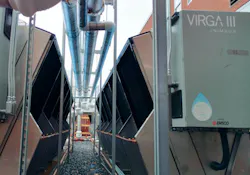
Nimbus' systems operate primarily in dry mode, consuming no water during most operating conditions.
Only during periods of elevated ambient temperatures does the system transition into adiabatic operation, using relatively small quantities of water to achieve significantly higher cooling performance.
According to Mokkapati, that modest water usage can reduce electrical consumption by 50% to 60% compared with purely dry cooling while also enabling smaller equipment footprints and eliminating dependence on municipal water supplies when paired with atmospheric generation.
The objective is not maximizing water usage, but maximizing total infrastructure efficiency.
Intelligent Controls Become Increasingly Important
Both companies also see software becoming an increasingly important component of cooling optimization.
Mokkapati believes future cooling systems will shift from reactive operation toward predictive control.
Instead of waiting for equipment temperatures to rise before responding, intelligent control systems will increasingly anticipate changing IT loads and proactively move cooling equipment toward optimal operating conditions.
That capability becomes increasingly valuable as AI workloads fluctuate dramatically within seconds rather than minutes.
Emergence sees similar opportunities from the water generation perspective.
By forecasting atmospheric conditions, future systems may be able to predict periods of maximum water production, generate additional reserves ahead of anticipated demand, pre-cool equipment or strategically increase cooling capacity during expected peak IT loads.
Both executives cautioned, however, that software can only optimize within the limits imposed by physics.
Intelligent controls improve efficiency around the margins, but they cannot fundamentally increase cooling capacity beyond the capabilities of the underlying infrastructure.
Water Is Becoming Infrastructure
Looking several years ahead, neither executive expects water's importance to diminish.
Instead, they anticipate increasingly integrated approaches where water generation, cooling infrastructure, power systems and intelligent controls operate as coordinated components of a unified AI infrastructure platform.
Future designs, they suggest, will become simultaneously climate-aware, workload-aware and resource-aware.
Rather than converging on a single universal cooling architecture, the industry appears headed toward increasingly specialized solutions tailored to regional environmental conditions, available resources and evolving regulatory requirements.
The underlying principle, however, appears increasingly settled.
Water is no longer merely an environmental consideration for AI infrastructure.
It is becoming infrastructure itself.
As developers race toward ever-larger AI campuses measured not in megawatts but gigawatts, questions surrounding water availability, sourcing, efficiency and long-term resilience are likely to become just as consequential as the electrical capacity that has dominated industry conversations over the past several years.
At Data Center Frontier, we talk the industry talk and walk the industry walk. In that spirit, DCF Staff members may occasionally use AI tools to assist with content. Elements of this article were created with help from OpenAI's GPT5.
Keep pace with the fast-moving world of data centers and cloud computing by connecting with Data Center Frontier on LinkedIn, following us on X/Twitter and Facebook, as well as on BlueSky, and signing up for our weekly newsletters using the form below.
About the Author
 Matt Vincent
Matt Vincent
Matt Vincent is Editor in Chief of Data Center Frontier, where he leads editorial strategy and coverage focused on the infrastructure powering cloud computing, artificial intelligence, and the digital economy. A veteran B2B technology journalist with more than two decades of experience, Vincent specializes in the intersection of data centers, power, cooling, and emerging AI-era infrastructure. Since assuming the EIC role in 2023, he has helped guide Data Center Frontier’s coverage of the industry’s transition into the gigawatt-scale AI era, with a focus on hyperscale development, behind-the-meter power strategies, liquid cooling architectures, and the evolving energy demands of high-density compute, while working closely with the Digital Infrastructure Group at Endeavor Business Media to expand the brand’s analytical and multimedia footprint. Vincent also hosts The Data Center Frontier Show podcast, where he interviews industry leaders across hyperscale, colocation, utilities, and the data center supply chain to examine the technologies and business models reshaping digital infrastructure. Since its inception he serves as Head of Content for the Data Center Frontier Trends Summit. Before becoming Editor in Chief, he served in multiple senior editorial roles across Endeavor Business Media’s digital infrastructure portfolio, with coverage spanning data centers and hyperscale infrastructure, structured cabling and networking, telecom and datacom, IP physical security, and wireless and Pro AV markets. He began his career in 2005 within PennWell’s Advanced Technology Division and later held senior editorial positions supporting brands such as Cabling Installation & Maintenance, Lightwave Online, Broadband Technology Report, and Smart Buildings Technology. Vincent is a frequent moderator, interviewer, and keynote speaker at industry events including the HPC Forum, where he delivers forward-looking analysis on how AI and high-performance computing are reshaping digital infrastructure. He graduated with honors from Indiana University Bloomington with a B.A. in English Literature and Creative Writing and lives in southern New Hampshire with his family, remaining an active musician in his spare time.
Voices of the Industry
 Image courtesy of Bell & Gossett
 Source: Adobe Stock, courtesy of ebm-papst