Vertiv’s AI Infrastructure Surge: Record Orders, Liquid Cooling Expansion, and Grid-Scale Power Reflect Data Center Growth
Key Highlights
- Vertiv reported a 23% increase in Q4 2025 net sales, driven by a 19% organic growth, with backlog reaching $15 billion and orders up 252% year over year.
- The company is shifting away from quarterly order reporting due to market volatility, focusing instead on annual backlog and qualitative insights into large, system-level contracts.
- Geographically, growth is strongest in the Americas, with Europe and Asia showing signs of recovery, supported by government and industry investments in digital infrastructure.
- Vertiv’s product innovations include prefabricated high-density AI cooling solutions, hybrid thermal architectures, and edge cooling systems designed for rapid deployment and operational efficiency.
- Strategic acquisitions like PurgeRite and new energy storage systems enhance Vertiv’s ability to deliver end-to-end lifecycle support and grid flexibility for AI data centers.

Vertiv’s latest earnings report confirms what many data center developers and operators already suspected: AI infrastructure demand has moved beyond cyclical expansion and into industrial-scale deployment.
Orders are accelerating. Projects are getting larger. Delivery schedules now stretch well beyond a year. And vendors capable of delivering integrated power, cooling, and lifecycle services at scale are increasingly separating themselves from component suppliers.
On Feb. 11, Vertiv reported fourth-quarter 2025 net sales of $2.88 billion, up 23% year over year, driven by 19% organic sales growth. Operating profit rose 27%, while adjusted operating margin reached 23.2%, up 170 basis points.
Cash generation surged, with $1.005 billion in operating cash flow and $910 million in adjusted free cash flow, increases of 136% and 151%, respectively. Vertiv exited the quarter with ~0.5x net leverage and $2.6 billion in liquidity, even after deploying roughly $1 billion toward strategic acquisitions.
But the figure reverberating across the infrastructure ecosystem is orders: organic orders rose approximately 252% year over year, pushing backlog to $15 billion, with a 2.9x book-to-bill ratio.
CEO Giordano Albertazzi framed the quarter as validation of Vertiv’s ability to scale with discipline as AI infrastructure demand accelerates.
“Significant growth in orders, sales, margins and cash reflects our ability to scale while maintaining a sharp focus on operational execution,” Albertazzi said, adding that Vertiv’s differentiator is “our ability to anticipate and shape the industry direction.”
He pointed to “deep collaborations with semiconductor industry leaders” and a “technology-rich portfolio” that lets Vertiv “architect systems that deliver superior outcomes today and position our customers well to meet tomorrow’s challenges.”
Executive Chairman Dave Cote emphasized the long game: “This technology leadership isn’t just about winning today, it’s about driving sustainable, long-term growth by continuously redefining what’s possible for our customers and the industry.”
The Pipeline Didn’t Shrink; It Expanded
The natural investor question following such a dramatic orders spike is whether demand was merely pulled forward.
Albertazzi rejected that interpretation.
“The pipeline has not depleted. If anything… we are seeing the pipeline grow quarter to quarter. It’s not just the market. It’s the visibility of the market.”
Large customers are now placing longer-duration, larger-scope orders, often with deliveries scheduled 12 to 18 months out, sometimes staged over multiple delivery windows. The Q4 surge effectively pushed portions of backlog into 2027 while leaving 2026 largely covered.
Importantly, Vertiv clarified that backlog reflects binding purchase orders, often accompanied by advance payments, one factor boosting Q4 working capital and cash flow performance.
Orders Volatility Leads to Disclosure Change
In a notable shift, Vertiv announced it will stop reporting quarterly orders, orders forecasts, and backlog figures, citing excessive volatility in quarterly comparisons. Annual backlog and sales disclosures will continue through regulatory filings, with qualitative market commentary provided during earnings calls.
In practical terms, Vertiv is signaling that quarterly order comparisons are becoming less meaningful as procurement shifts toward large, system-level contracts.
Regional Performance Still Uneven
Growth remains geographically skewed.
-
Americas: Organic sales grew 46%, with segment operating profit up 77% and margins expanding sharply.
-
APAC: Sales declined 9% organically, largely reflecting weak conditions in China, though India and broader Asia are accelerating.
-
EMEA: Organic sales fell 14%, though management sees improving sentiment and expects growth to resume in the second half of 2026.
Albertazzi described Europe as a market where the “coiled spring is uncoiling,” as governments, utilities, and operators recognize the urgency of expanding digital infrastructure capacity.
Guidance Signals Industrial-Scale Growth
Vertiv’s 2026 outlook reflects management’s confidence that demand will remain robust:
-
Net sales: $13.25–$13.75 billion
-
Organic sales growth: 27–29%
-
Adjusted operating profit: $2.98–$3.10 billion
-
Adjusted operating margin: 22–23%
-
Adjusted EPS: $5.97–$6.07
-
Adjusted free cash flow: $2.1–$2.3 billion
Capital expenditures will rise to 3–4% of sales in 2026, above historical norms, as Vertiv expands manufacturing and technology capacity to convert backlog into shipments.
Albertazzi emphasized that capacity expansion is incremental and continuous rather than episodic, involving both facility expansion and productivity improvements across existing operations.
System-level Infrastructure Is Becoming the Purchase Order
A key theme tying Vertiv’s earnings commentary to its recent product announcements is the shift toward system-level procurement.
Albertazzi described the transformation succinctly:
“With hundreds of kilowatts per rack… mechanical, electrical infrastructure, and the IT stack are so intimately connected that they need to be thought of as one system.”
Vertiv’s January product announcements reinforce that message. That “one system” posture shows up in multiple places:
1) Prefab at AI density: MegaMod HDX (Jan. 14)
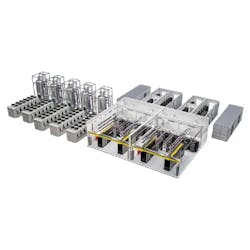
Vertiv introduced new configurations of Vertiv MegaMod HDX, a prefabricated power and liquid cooling infrastructure solution for high-density AI/HPC deployments.
- Combo configuration: Up to 10 MW, up to 144 racks.
- Compact configuration: Up to 1.25 MW, up to 13 racks.
- Rack densities: 50 kW to 100+ kW per rack
- Hybrid architecture combining direct-to-chip liquid cooling with air cooling
Features include distributed redundant power architecture and a buffer-tank thermal backup system designed to keep GPU clusters stable during maintenance or load transitions.
SVP Viktor Petik framed the platform in operator terms: reliable performance, operational efficiency, and scalable deployment speed as factory-integrated and tested, backed by Vertiv’s service network.
MegaMod HDX also serves as a portfolio billboard, pulling in Vertiv’s UPS, busway, monitoring, CDUs, and rack ecosystem; exactly the “system-level” pitch investors heard on the call.
2) “Units of compute”: OneCore and SmartRun
On the earnings call, Albertazzi highlighted Vertiv OneCore, an end-to-end data center solution designed to accelerate “time to token,” scaling in 12.5 MW building blocks; and Vertiv SmartRun, a prefabricated white space infrastructure solution aimed at rapidly accelerating fit-out and readiness.
He pointed to collaborations (including Hut 8 and Compass Data Centers) as proof points of adoption, emphasizing that SmartRun can stand alone or plug into OneCore.
3) Cooling evolution: hybrid thermal chains and the “trim cooler”
Asked how cooling architectures may change (amid industry chatter about warmer-temperature operations and shifting mixes of chillers, CDUs, and other components) Albertazzi leaned into complexity as a feature, not a bug.
He argued heat rejection doesn’t disappear, even if some GPU loads can run at higher temperatures. Instead, the future looks hybrid, with mixed loads and resiliency requirements forcing more nuanced thermal chains.
Vertiv’s strategic product anchor here is its “trim cooler” concept: a chiller optimized for higher-temperature operation while retaining flexibility for lower-temperature requirements in the same facility, maximizing free cooling where climate and design allow.
And importantly, Albertazzi dismissed the idea that CDUs are going away:
“We are pretty sure that CDUs in various shapes and forms are a long-term element of the thermal chain.”
4) Edge densification: CoolPhase Ceiling + CoolPhase Row (Feb. 3)
Vertiv also expanded its thermal portfolio for edge and small IT environments with the:
- Vertiv CoolPhase Ceiling (launching Q2 2026): ceiling-mounted, 3.5 kW to 28 kW, designed to preserve floor space.
- Vertiv CoolPhase Row (available now in North America) for row-based cooling up to 30 kW (300 mm width) or 40 kW (600 mm width).
Vertiv Director of Edge Thermal Michal Podmaka tied the products directly to AI-driven edge densification and management consistency, saying the new systems “integrate seamlessly into Vertiv’s broader thermal chain” and are built on standardized controls and monitoring platforms for consistent visibility across diverse edge environments.
The details matter: with AHRI certification, variable-speed components, R32 refrigerant, a wide operating range (-31°F to 118°F), and features like teamwork connectivity and BMS integration, this is Vertiv standardizing edge cooling as part of the same portfolio logic it’s pushing into hyperscale.
Services: The Differentiator Increasingly Hiding in Plain Sight
Perhaps the most consequential synergy across Vertiv’s recent announcements is in lifecycle services, an area increasingly critical as AI infrastructure grows denser, more complex, and more operationally sensitive.
In January, Vertiv introduced Vertiv Next Predict, an AI-driven predictive maintenance platform that continuously analyzes infrastructure performance to anticipate failures before they occur. Instead of relying on calendar-based service intervals, operators gain condition-based maintenance driven by anomaly detection, predictive risk scoring, and root-cause analysis, with corrective actions executed through Vertiv’s global services organization.
At the same time, Vertiv significantly expanded its liquid cooling lifecycle capabilities through acquisition.
PurgeRite Acquisition Strengthens Liquid Cooling Lifecycle Services
In December, Vertiv completed its approximately $1.0 billion acquisition of PurgeRite, a Houston-based specialist in mechanical flushing, purging, and filtration services for mission-critical facilities.
The acquisition strengthens Vertiv’s ability to support liquid cooling infrastructure across its entire lifecycle, from commissioning through decades of operation.
As AI and HPC environments increasingly depend on liquid cooling, maintaining ultra-clean, air-free, chemically stable coolant loops becomes mission critical. Improperly conditioned fluid systems can degrade heat transfer efficiency, increase corrosion or fouling risk, and ultimately threaten uptime in facilities where individual racks may support millions of dollars in compute.
Vertiv CEO Giordano Albertazzi said the acquisition expands the company’s ability to provide end-to-end support for high-density computing environments:
“PurgeRite’s specialized expertise in fluid management services complements our existing portfolio and enhances our ability to provide end-to-end product and service support for customers’ high-density computing and AI applications where efficient thermal management is critical to performance and reliability.”
PurgeRite brings proprietary technologies and engineering expertise supporting complex liquid cooling deployments across the thermal chain, from chillers and plant loops to coolant distribution units and rack-level systems. Its established relationships with hyperscalers and major colocation providers also reinforce Vertiv’s ability to scale services globally.
Integrated with Vertiv’s broader service network, the acquisition positions the company to deliver lifecycle thermal management services at global scale, reducing downtime risk while improving cooling performance and equipment efficiency.
EnergyCore Grid: Power Flexibility Becomes Infrastructure Strategy
Cooling and modular deployment may dominate infrastructure headlines, but power availability increasingly defines where and how quickly AI capacity can be deployed.
In early December, Vertiv introduced Vertiv EnergyCore Grid, a modular, utility-grade battery energy storage system (BESS) platform designed to help data centers accelerate interconnection while supporting grid resilience.
The system addresses a growing constraint across North America and Europe: AI data center demand is often arriving faster than utilities can deliver transmission and substation upgrades.
EnergyCore Grid integrates:
• Lithium iron phosphate (LFP) battery systems
• Power conversion systems (PCS)
• Factory-integrated energy management systems (EMS)
All within modular, skid-based deployments supporting projects from 1 MW to more than 200 MW.
This architecture allows operators to:
• Shift loads away from grid peak periods
• Support interconnection approvals
• Provide ancillary grid services
• Enable black-start capabilities
• Integrate renewable energy sources
• Smooth power demand while awaiting utility upgrades
Chris Thompson, Vertiv’s global vice president of microgrid solutions, framed the urgency directly:
“With datacenters needing more power to support AI growth, getting a grid interconnection has unfortunately never been more difficult. The Vertiv EnergyCore Grid enables datacenters to provide grid flexibility as well as critical grid ancillary services. This accelerates grid interconnection in an environment where time to first token is paramount.”
The platform uses UL 1973-listed and UL 9540A-tested battery systems housed in liquid-cooled, IP55-rated outdoor enclosures, while factory-integrated EMS software provides real-time control of distributed energy resources, enabling participation in energy markets and coordinated management of on-site generation.
EnergyCore Grid extends Vertiv’s “grid-to-chip” positioning, complementing UPS, power distribution, and energy management systems already embedded across hyperscale deployments.
For operators, the implication is increasingly clear: grid flexibility and on-site energy management are becoming as critical to AI deployment timelines as power density and cooling efficiency.
AI Infrastructure Is An Integrated System
Vertiv’s quarter ultimately highlights a broader industry shift: AI infrastructure is no longer assembled component by component; it is increasingly procured and operated as an integrated system.
Operators are buying prefabricated capacity, hybrid cooling architectures, lifecycle services, and grid-interactive energy solutions designed to function together at unprecedented density and scale. Deployment speed, operational reliability, and lifecycle performance now determine competitive advantage as much as hardware capability.
Albertazzi closed the earnings call with measured confidence:
“We continue to strengthen our position as an industry thought leader… I have never been more excited about Vertiv’s future.”
As AI infrastructure investment moves from experimentation to execution, the competitive battleground is shifting from equipment supply to full-system delivery and operational performance. Vertiv’s recent results suggest the company intends not merely to participate in that shift, but to help define how AI data centers are built and run in the gigawatt era.
At Data Center Frontier, we talk the industry talk and walk the industry walk. In that spirit, DCF Staff members may occasionally use AI tools to assist with content. Elements of this article were created with help from OpenAI's GPT5.
Keep pace with the fast-moving world of data centers and cloud computing by connecting with Data Center Frontier on LinkedIn, following us on X/Twitter and Facebook, as well as on BlueSky, and signing up for our weekly newsletters using the form below.
About the Author
 Matt Vincent
Matt Vincent
Matt Vincent is Editor in Chief of Data Center Frontier, where he leads editorial strategy and coverage focused on the infrastructure powering cloud computing, artificial intelligence, and the digital economy. A veteran B2B technology journalist with more than two decades of experience, Vincent specializes in the intersection of data centers, power, cooling, and emerging AI-era infrastructure. Since assuming the EIC role in 2023, he has helped guide Data Center Frontier’s coverage of the industry’s transition into the gigawatt-scale AI era, with a focus on hyperscale development, behind-the-meter power strategies, liquid cooling architectures, and the evolving energy demands of high-density compute, while working closely with the Digital Infrastructure Group at Endeavor Business Media to expand the brand’s analytical and multimedia footprint. Vincent also hosts The Data Center Frontier Show podcast, where he interviews industry leaders across hyperscale, colocation, utilities, and the data center supply chain to examine the technologies and business models reshaping digital infrastructure. Since its inception he serves as Head of Content for the Data Center Frontier Trends Summit. Before becoming Editor in Chief, he served in multiple senior editorial roles across Endeavor Business Media’s digital infrastructure portfolio, with coverage spanning data centers and hyperscale infrastructure, structured cabling and networking, telecom and datacom, IP physical security, and wireless and Pro AV markets. He began his career in 2005 within PennWell’s Advanced Technology Division and later held senior editorial positions supporting brands such as Cabling Installation & Maintenance, Lightwave Online, Broadband Technology Report, and Smart Buildings Technology. Vincent is a frequent moderator, interviewer, and keynote speaker at industry events including the HPC Forum, where he delivers forward-looking analysis on how AI and high-performance computing are reshaping digital infrastructure. He graduated with honors from Indiana University Bloomington with a B.A. in English Literature and Creative Writing and lives in southern New Hampshire with his family, remaining an active musician in his spare time.