Nscale Expands AI Factory Strategy With Power, Platform, and Scale
Key Highlights
- Nscale has secured over $2 billion in funding and is valued at approximately $14.6 billion, reflecting strong investor confidence in its integrated AI infrastructure approach.
- The company's acquisition of AIPCorp enables it to develop large-scale energy microgrids, such as the Monarch Compute Campus, designed to deliver up to 8 gigawatts of power, bypassing utility constraints.
- Nscale is establishing a multi-regional campus network, including sites in the US, UK, Norway, Portugal, and Finland, each tailored to regional energy, regulatory, and political advantages.
- Partnerships with industry leaders like Microsoft and Nvidia are central to Nscale’s strategy, ensuring demand-driven development aligned with next-generation AI hardware and software platforms.
- The company's focus on energy certainty, through on-site generation and microgrids, aims to reduce deployment delays and create a reliable supply chain for hyperscale AI workloads.
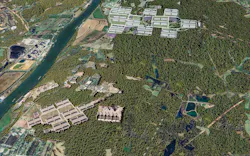
Nscale has moved quickly from startup to serious contender in the race to build infrastructure for the AI era. Founded in 2024, the company has positioned itself as a vertically integrated “neocloud” operator, combining data center development, GPU fleet ownership, and a software stack designed to deliver large-scale AI compute. That model has helped it attract backing from investors including Nvidia, and in early March 2026 the company raised another $2 billion at a reported $14.6 billion valuation. Reuters has described Nscale’s approach as owning and operating its own data centers, GPUs, and software stack to support major customers including Microsoft and OpenAI.
What makes Nscale especially relevant now is that it is no longer content to operate as a cloud intermediary or capacity provider. Over the past year, the company has increasingly framed itself as an AI hyperscaler and AI factory builder, seeking to combine land, power, data center shells, GPU procurement, customer offtake, and software services into a single integrated platform. Its acquisition of American Intelligence & Power Corporation, or AIPCorp, is the clearest signal yet of that shift, bringing energy infrastructure directly into the center of Nscale’s business model.
The AIPCorp transaction is significant because it gives Nscale more than additional development capacity. The company said the deal includes the Monarch Compute Campus in Mason County, West Virginia, a site of up to 2,250 acres with a state-certified AI microgrid and a power runway it says can scale beyond 8 gigawatts. Nscale also said the acquisition establishes a new division, Nscale Energy & Power, headquartered in Houston, extending its platform further into power development.
That positioning reflects a broader shift in the AI infrastructure market. The central bottleneck is no longer simply access to GPUs. It is the ability to assemble power, cooling, land, permits, data center design, chip allocation, financing, and long-term customer demand into a synchronized delivery model. Nscale’s acquisition of AIPCorp is an attempt to bring more of that stack under unified control.
From Strategy to Execution
It is also occurring alongside a broader set of announcements that show how Nscale intends to execute. In mid-March, the company said it plans to deploy NVIDIA Vera Rubin systems beginning in 2027, including Vera Rubin NVL72, across sites in the UK, Norway, and other locations. Nscale also announced a letter of intent with Microsoft for up to 1.35 gigawatts of AI compute capacity at the Monarch campus, with deliveries expected to begin in late 2027 in multiple tranches. Together, those announcements link the company’s power strategy directly to the next generation of AI compute infrastructure and to hyperscale demand.
Understanding AIPCorp helps clarify why this matters. American Intelligence & Power was launched in January 2026 by Fidelis New Energy and 8090 Industries as a platform to develop, own, and operate integrated AI computing campuses and onsite power microgrids. Its flagship project, the Monarch Compute Campus, was conceived as a behind-the-meter system in Mason County designed to support hyperscale and enterprise users with up to 8 gigawatts of power generation over multiple phases. Local reporting has indicated the site would combine natural gas generation with battery energy storage, drawing on Appalachian Basin gas and multiple pipeline connections, while leveraging fiber, rail, industrial water, and logistics infrastructure.
That is a fundamentally different proposition from the standard colocation or wholesale data center model. AIPCorp was not offering a powered shell in a conventional utility-served market. It was offering an energy-to-compute development model designed to bypass one of the biggest constraints on large AI deployments: interconnection delays and limited utility capacity.
West Virginia’s 2025 House Bill 2014, the Power Generation and Consumption Act, provides the policy backdrop. The legislation created a framework for certified microgrids and high-impact data centers, with Governor Patrick Morrisey explicitly positioning the law as a way to accelerate development tied to the state’s energy resources. The bill was signed near the future Monarch site, underscoring how closely projects like this align with the state’s strategy.
In practical terms, that framework compresses what has become one of the industry’s most persistent constraints: time to power. Developers that can secure and control energy delivery timelines are increasingly advantaged over projects dependent on traditional interconnection processes. That dynamic is driving the rise of AI factory campuses designed around dedicated or semi-dedicated power rather than purely utility-served capacity.
Nscale’s acquisition of AIPCorp fits squarely within that trend. It signals a belief that the next generation of AI infrastructure will be defined by developers who can integrate the stack from fuel supply and generation through to GPU clusters and cloud service delivery.
The scale and timing Nscale is proposing at Monarch reflect that ambition. The company said the campus is expected to reach 2 gigawatts of capacity by the first half of 2028, with expansion to roughly 8 gigawatts planned by 2031. If delivered as outlined, the project would rank among the largest dedicated AI compute deployments announced to date, and one of the more direct attempts to align power, platform architecture, and hyperscale demand from the outset.
Building a Firm Customer and Campus Portfolio
Anchor customers are a critical component of AI campuses at this scale, and Nscale’s letter of intent with Microsoft provides the clearest window into how the company is structuring its development strategy. Rather than pursuing speculative land positions or merchant data center builds, Nscale is attempting to align hyperscale demand with site development early in the lifecycle, using Microsoft as a demand anchor across multiple regions.
That approach is not limited to West Virginia. In October 2025, Nscale said it would provide Microsoft with roughly 104,000 NVIDIA GB300 GPUs at a Texas campus initially sized at approximately 240 megawatts and leased from Ionic Digital, with the potential to scale to 1.2 gigawatts over time. The same announcement included plans to deploy 12,600 GB300 GPUs at Start Campus in Sines, Portugal, alongside additional development activity at the Loughton AI Campus in the UK and a large-scale deployment in Narvik, Norway.
More recent announcements extend that strategy into the next compute cycle. Nscale has said it plans to deploy NVIDIA Vera Rubin NVL72 systems beginning in 2027 across sites in the UK, Norway, and other locations, with Microsoft as a primary customer. That continuity suggests the company is not simply scaling capacity, but attempting to align its campus portfolio with successive generations of AI infrastructure.
Taken together, these projects outline a deliberate portfolio strategy. Nscale is not building a single flagship campus. It is assembling a network of AI factory sites, each tied to a distinct combination of power availability, regulatory environment, and customer demand.
In Texas, the emphasis is rapid deployment and access to U.S. hyperscale demand, with a campus designed to scale alongside Microsoft’s requirements. In Portugal, the advantage is an established European data center hub capable of supporting sovereign AI workloads. In Norway, the focus is renewable energy and long-term power cost stability for European compute. In West Virginia, the strategy centers on behind-the-meter natural gas generation and a policy framework designed to accelerate large-scale development. In the UK, the positioning carries political visibility and aligns with national ambitions around sovereign AI infrastructure.
Nscale’s April 2026 announcement of a planned data center in Harjavalta, Finland adds another dimension to that portfolio. The project remains in early development, with total capacity yet to be determined, but the structure of the agreement is consistent with Nscale’s broader approach. Fortum is acting as a site development partner, supporting grid connection design and permitting, while Nscale and the Town of Harjavalta have begun steps toward a land transaction in the Sievari industrial area.
Finland reinforces the company’s Nordic strategy, where the emphasis shifts toward low-carbon energy, grid coordination, and regional sovereignty rather than behind-the-meter gas generation. Together with Norway, it suggests Nscale is building a European footprint optimized for regulatory alignment and sustainable power, complementing its U.S. push for speed and dispatchable energy at scale.
What emerges from this portfolio is not just geographic diversification, but a form of infrastructure specialization. Each site is being positioned around a specific advantage, whether that is power certainty, regulatory alignment, latency, or political narrative. Nscale’s role, in that context, is less that of a traditional developer and more that of an orchestrator, aligning customer demand, compute architecture, and energy strategy across multiple regions.
Maximizing the Global Approach
That portfolio strategy helps explain why Nscale has attracted attention so quickly. The company is positioning itself not as a regional operator, but as a new class of AI infrastructure orchestrator, coordinating power, compute, and customer demand across multiple geographies. Reuters reported that Nscale’s latest funding round was aimed at expanding capacity to meet demand from customers including Microsoft and OpenAI, while DatacenterDynamics has described a growing pipeline of projects across the UK, Texas, Portugal, and Norway.
The Norway project is especially revealing in how Nscale wants to be perceived. In July 2025, Nscale, Aker, and OpenAI announced Stargate Norway, a 100,000-GPU AI gigafactory outside Narvik powered by renewable energy, with 230 megawatts planned initially and ambitions to add another 290 megawatts. Nscale framed the facility as secure, scalable, and aligned with European regulatory requirements for sovereign workloads.
That positioning now sits alongside its U.S. strategy in West Virginia, where the emphasis shifts from renewable energy to dispatchable, behind-the-meter natural gas generation and accelerated development timelines. The contrast is instructive. In Europe, the narrative centers on sovereignty, sustainability, and regulatory alignment. In the United States, it centers on speed, scale, and control over power delivery.
Nscale’s planned expansion into Finland further reinforces that pattern. The Harjavalta project, developed in partnership with Fortum, remains in early stages, but follows the same Nordic logic: low-carbon energy, strong grid integration, and a permitting environment aligned with industrial electrification. Together, Norway and Finland suggest a regional strategy built around long-term energy stability and sovereign compute capacity, complementing Nscale’s more aggressive, power-first positioning in the U.S.
What emerges is a company attempting to match infrastructure design to regional advantage rather than applying a single development model globally. That approach may prove critical as AI infrastructure becomes more tightly coupled to local energy systems, regulatory frameworks, and political expectations.
At the same time, Nscale is being valued and promoted on the basis of its ability to execute projects that remain largely forward-looking. The Financial Times has raised questions about whether the company’s tangible infrastructure footprint matches its valuation, even as it highlighted backing from Nvidia and high-profile board additions including Sheryl Sandberg and Nick Clegg. Reuters has confirmed both the valuation increase and the company’s IPO preparations.
The central question, however, is no longer whether Nscale can raise capital. It is whether the company can convert announcements, land positions, leases, and letters of intent into operating AI factories at the scale and timelines it is now proposing.
Caterpillar and the Shift Toward Execution
In that context, the AIPCorp acquisition begins to look less like a strategic extension and more like an early test of whether Nscale’s model can translate into real infrastructure. What the deal provides is something many AI campus developers still lack: a power-originated development platform anchored in a specific site, shaped by local policy, and tied to defined generation equipment.
At Monarch, that shift is already taking form. Nscale said it will work with Caterpillar to deploy G3500 series natural gas generator sets at sufficient scale to reach 2 gigawatts of power generation by the first half of 2028. Local reporting has indicated that equipment for the first phase has already been ordered, with deliveries expected between September 2026 and August 2027.
That level of specificity matters. Much of the current AI infrastructure pipeline remains conceptual, defined by land positions, renderings, and power ambitions that depend on uncertain interconnection timelines. By contrast, named equipment, a phased deployment plan, and a defined generation target move Monarch closer to executable infrastructure.
It also reinforces a broader trend across the market. As interconnection delays persist and utility capacity tightens, developers are increasingly turning to dispatchable, on-site generation as primary infrastructure rather than interim bridge power. In that sense, Monarch is not just a single project. It is an example of how AI factory campuses are being restructured around energy certainty.
For the broader AI infrastructure market, that is the real significance of Nscale’s move. The company is betting that the next generation of AI campuses will be defined by the ability to integrate three elements simultaneously: hyperscale customer demand, secured compute supply aligned with evolving platform architectures, and dedicated energy infrastructure delivered on predictable timelines.
As that model takes shape, traditional boundaries between cloud provider, data center developer, and independent power producer are beginning to blur. Nscale is attempting to operate across all three layers, or more precisely, to orchestrate them into a single system designed to produce AI capacity at industrial scale.
Execution Will Define the Outcome
Whether that model succeeds will ultimately depend on execution. Nscale has assembled an ambitious platform in a remarkably short period of time, bringing together capital, hyperscale customer relationships, high-profile board backing, a growing campus pipeline, and now a direct foothold in power development. But as with much of the AI infrastructure sector, the gap between announced capacity and operational delivery remains substantial.
That gap is where the next phase of competition will be decided. Nscale’s role in the market is already significant, not because it has completed these campuses, but because it is helping define what they are becoming. AI factory developments are increasingly emerging as multi-gigawatt, vertically integrated systems shaped as much by energy strategy and policy alignment as by compute density and facility design.
The acquisition of American Intelligence & Power Corporation is the clearest signal yet of how Nscale views that future. The company is betting that success in the AI infrastructure era will not be determined by access to GPUs alone, but by the ability to integrate power, land, permitting, platform architecture, and customer demand into a single, deliverable system.
If that bet proves correct, it will prove that the winners in the next cycle of AI infrastructure will not simply be the companies with the largest compute fleets, but those that can reliably bring entire AI factories online at scale.
The AI infrastructure race is no longer about who can promise the most capacity, but who can deliver it.
At Data Center Frontier, we talk the industry talk and walk the industry walk. In that spirit, DCF Staff members may occasionally use AI tools to assist with content. Elements of this article were created with help from OpenAI's GPT5.
Keep pace with the fast-moving world of data centers and cloud computing by connecting with Data Center Frontier on LinkedIn, following us on X/Twitter and Facebook, as well as on BlueSky, and signing up for our weekly newsletters using the form below.
About the Author
 David Chernicoff
David Chernicoff
 Matt Vincent
Matt Vincent
Matt Vincent is Editor in Chief of Data Center Frontier, where he leads editorial strategy and coverage focused on the infrastructure powering cloud computing, artificial intelligence, and the digital economy. A veteran B2B technology journalist with more than two decades of experience, Vincent specializes in the intersection of data centers, power, cooling, and emerging AI-era infrastructure. Since assuming the EIC role in 2023, he has helped guide Data Center Frontier’s coverage of the industry’s transition into the gigawatt-scale AI era, with a focus on hyperscale development, behind-the-meter power strategies, liquid cooling architectures, and the evolving energy demands of high-density compute, while working closely with the Digital Infrastructure Group at Endeavor Business Media to expand the brand’s analytical and multimedia footprint. Vincent also hosts The Data Center Frontier Show podcast, where he interviews industry leaders across hyperscale, colocation, utilities, and the data center supply chain to examine the technologies and business models reshaping digital infrastructure. Since its inception he serves as Head of Content for the Data Center Frontier Trends Summit. Before becoming Editor in Chief, he served in multiple senior editorial roles across Endeavor Business Media’s digital infrastructure portfolio, with coverage spanning data centers and hyperscale infrastructure, structured cabling and networking, telecom and datacom, IP physical security, and wireless and Pro AV markets. He began his career in 2005 within PennWell’s Advanced Technology Division and later held senior editorial positions supporting brands such as Cabling Installation & Maintenance, Lightwave Online, Broadband Technology Report, and Smart Buildings Technology. Vincent is a frequent moderator, interviewer, and keynote speaker at industry events including the HPC Forum, where he delivers forward-looking analysis on how AI and high-performance computing are reshaping digital infrastructure. He graduated with honors from Indiana University Bloomington with a B.A. in English Literature and Creative Writing and lives in southern New Hampshire with his family, remaining an active musician in his spare time.
Related
Voices of the Industry
 Source: SNEHIT PHOTO/Shutterstock.com
 Source: Matthew G Eddy/Shutterstock.com