Supermicro’s New AI Campus Embodies the Industrialization of AI Infrastructure
Key Highlights
- Supermicro's San Jose campus spans over 714,000 sq ft, supporting AI system design, manufacturing, testing, and global distribution with a focus on liquid-cooled rack-scale infrastructure.
- The facility enhances Supermicro's ability to deliver integrated, validated AI racks rapidly, reducing deployment time and supporting large-scale AI projects like NVIDIA's Colossus supercomputer.
- The expansion underscores the importance of domestic manufacturing in Silicon Valley for supply chain control, geopolitical resilience, and high-value AI infrastructure deployment.
- Liquid cooling is positioned as a core technology, enabling higher power densities, reducing operating costs, and improving performance for AI workloads.
- Supermicro's global footprint includes manufacturing in Taiwan, Malaysia, and the Netherlands, with San Jose serving as the high-control, domestic innovation hub for AI infrastructure.

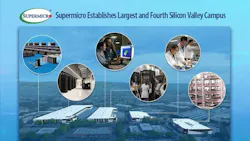
On April 27, 2026, Supermicro announced what it described as its largest U.S. location: a new Data Center Building Block Solutions campus near its San Jose headquarters. Spanning roughly 32.8 acres and more than 714,000 square feet, the site becomes Supermicro’s fourth Bay Area location and expands the company’s regional footprint to nearly 4 million square feet. The facility will support advanced system design, domestic manufacturing, testing, service, and global distribution for Supermicro’s growing AI infrastructure portfolio.
The larger significance lies in the acronym Supermicro is now emphasizing: DCBBS, or Data Center Building Block Solutions. In the AI era, the company is no longer positioning itself simply as a server manufacturer. Instead, Supermicro is increasingly framing itself as a provider of pre-engineered, rack-scale, liquid-cooled AI infrastructure designed to compress the time between GPU allocation and production deployment.
According to Charles Liang, president and CEO of Supermicro:
This new DCBBS campus, which becomes our largest in the U.S., is a direct investment in American innovation and manufacturing leadership. By growing our Silicon Valley footprint and deepening our U.S. roots in San Jose where we are creating high-quality professional roles, we are able to advance domestic innovation, solution value, and production capacity. Our team will continue to drive the next wave of data center innovation, Time-to-Online (TTO) and build out efficiency, strengthening our ability to deliver new-generation AI infrastructure at scale.
That positioning places the new San Jose campus at the intersection of three major industry shifts: the localization of critical AI infrastructure manufacturing, the move from server-level integration to rack- and cluster-scale deployment, and the growing importance of liquid cooling as AI systems push beyond conventional enterprise power densities.
From Server Manufacturing to AI Infrastructure Integration
Supermicro’s historic advantage has been speed. The company built its reputation on a modular “building block” approach, rapidly combining motherboards, chassis, power supplies, processors, GPUs, storage, networking, and cooling into workload-specific systems. That model worked well in the cloud era, when customers prioritized rapid customization. In the AI era, the challenge is larger: integrating scarce GPUs, high-speed networking, liquid cooling, power distribution, and software validation into deployable rack-scale infrastructure.
The new campus extends that model beyond individual servers and into the data center itself. Supermicro says the facility will support the full operational chain, including design, manufacturing, testing, service, and global distribution. The result is less a traditional factory than an AI infrastructure staging and validation environment, where liquid-cooled racks can be assembled, tested, and shipped as integrated systems rather than collections of discrete components.
According to Supermicro, the San Jose DCBBS campus enables closer collaboration with major customers and suppliers while reducing shipping time and keeping engineering and manufacturing teams tightly aligned. The facility also includes 10 MW of on-campus power capacity, an increasingly important detail as AI rack integration itself becomes power- and cooling-intensive before systems ever reach a customer deployment.
That operational shift matters. Traditional server manufacturing relied on factory lines, burn-in rooms, and standardized test environments. AI infrastructure integration increasingly requires something closer to a live data center floor: full-rack validation, coolant loop testing, leak detection, network verification, power sequencing, and thermal performance testing under real operational conditions.
In that sense, the campus is designed to address a growing chokepoint in the AI infrastructure economy: not simply access to GPUs, but the ability to transform those GPUs into deployable, liquid-cooled production infrastructure.
Why Silicon Valley Still Matters
At first glance, expanding manufacturing capacity in San Jose may seem counterintuitive. Silicon Valley is expensive, labor costs are high, and much of the global hardware supply chain has shifted overseas. Supermicro itself has been aggressively expanding operations across Taiwan, Malaysia, and the Netherlands as it scales manufacturing and logistics capacity worldwide.
The growing San Jose footprint reflects a different strategic calculation. For advanced AI infrastructure, proximity to engineering talent, suppliers, ecosystem partners, and major customers can outweigh pure labor-cost economics. Supermicro says it manufactures the majority of its systems in San Jose and describes itself as the only major server, storage, and accelerated computing platform provider that designs, develops, and manufactures a significant portion of its systems in the United States.
That positioning has become increasingly important as domestic manufacturing and supply-chain control evolve into competitive differentiators. Hyperscalers, federal agencies, sovereign AI operators, and regulated enterprises are increasingly evaluating not only what infrastructure they can buy, but where it is built, how quickly it can be deployed, and how resilient the supporting supply chain may be.
The campus also gives Supermicro a domestic answer to the shifting industrial-policy environment surrounding AI infrastructure. The United States is attempting to localize larger portions of the semiconductor and AI supply chain, while customers are paying closer attention to export controls, tariffs, geopolitical risk, and infrastructure provenance.
San Jose is not the company’s lowest-cost manufacturing location. It may be its highest-control location.
For AI infrastructure supporting sovereign workloads, federal deployments, defense-adjacent environments, or other sensitive use cases, that distinction matters.
Liquid Cooling Now Informs AI Infrastructure Manufacturing
The immediate technical driver behind Supermicro’s campus expansion is liquid cooling. Two years earlier, the company announced three new manufacturing facilities in Silicon Valley and internationally to support AI and enterprise rack-scale liquid-cooled systems. At the time, Supermicro said the expansion was intended to more than double its liquid-cooled rack capacity from a base of roughly 1,000 AI SuperClusters shipped per month.
That announcement positioned liquid cooling as no niche thermal technology, but as a foundational element of AI factory design. Supermicro said the facilities would focus on delivering plug-and-play liquid-cooled infrastructure spanning systems, racks, and cooling plant components. The company also argued that liquid cooling could reduce operating costs by up to 40% compared with traditional air-cooled environments while improving compute performance per watt.
Supermicro’s strategy is deliberately end-to-end. The company says it provides optimized cold plates, coolant distribution manifolds, redundant coolant distribution units (CDUs), and external cooling towers, with the full stack designed and validated together.
That approach addresses one of the central challenges of high-density AI infrastructure: system-level integration. Customers deploying large GPU clusters need confidence that cold plates, manifolds, CDUs, facility water loops, controls, sensors, serviceability, and failure management have been engineered as a unified operational system rather than assembled piecemeal.
The broader production model also aligns with the industry’s transition from air-cooled GPU servers to high-density rack-scale AI infrastructure. NVIDIA Blackwell-generation systems, including rack-scale NVL architectures, are forcing operators to think increasingly in terms of power shelves, liquid loops, and fully integrated rack deployments rather than discrete servers.
In that environment, companies capable of pre-integrating, validating, and shipping liquid-cooled AI racks as production-ready infrastructure gain a significant deployment advantage.
A Global Manufacturing Footprint for AI Infrastructure
The new San Jose campus is not a standalone expansion. It is part of a broader global manufacturing and integration network spanning Silicon Valley, Taiwan, the Netherlands, and Malaysia, with each location serving a distinct operational role in Supermicro’s AI infrastructure strategy.
San Jose functions as the company’s flagship engineering, integration, and domestic manufacturing hub. It sits closest to Supermicro’s headquarters, Silicon Valley engineering talent, NVIDIA and other ecosystem partners, major hyperscale and AI customers, and evolving U.S. industrial-policy priorities. The new campus further strengthens San Jose’s role in advanced design, liquid-cooled rack integration, validation, and higher-value domestic production.
Taiwan remains central to manufacturing scale and component ecosystem access. Its proximity to the broader electronics and server supply chain gives Supermicro access to the dense manufacturing networks that continue to underpin global compute infrastructure production.
The Netherlands serves as the company’s European integration and logistics base. That regional presence is increasingly important for enterprise, hyperscale, and sovereign AI customers facing growing requirements around data residency, local support, and supply-chain resilience.
Malaysia represents the company’s newer scale and cost-optimization layer. Supermicro says the facility expands manufacturing capacity while lowering overall production costs, providing a lower-cost Southeast Asian manufacturing node while also diversifying geographic risk beyond Taiwan and China-adjacent supply chains.
The structure reflects a broader shift underway across the AI infrastructure industry: balancing scale, deployment speed, supply-chain resilience, and geopolitical control simultaneously.
San Jose is not intended to be Supermicro’s lowest-cost manufacturing site. It is intended to be its most strategic one — a high-control integration hub where the company can co-develop new AI infrastructure designs with customers and suppliers, validate liquid-cooled rack-scale systems, and operationalize deployment models that can later be replicated across global facilities.
Deployment Proof at AI Scale
Supermicro’s campus expansion is also tied to its growing presence in some of the industry’s highest-profile AI deployments. The company’s most visible reference point is xAI’s Colossus cluster, which Supermicro describes as the world’s largest AI supercomputer, built around a liquid-cooled Supermicro SuperCluster connecting 100,000 NVIDIA Hopper GPUs through NVIDIA Spectrum-X Ethernet.
For Supermicro, Colossus serves as a large-scale proof point for rapid deployment under extreme infrastructure demands. Regardless of whether most enterprise customers ever approach that scale, the project reinforces the company’s claim that it can operate at the speed, density, and operational complexity increasingly required by frontier AI builders.
At the same time, sovereign AI has emerged as another important growth vector. In March 2026, Supermicro highlighted deployments including Telenor’s AI Factory initiative in Norway and SK Telecom’s Haein Cluster in South Korea. The SK Telecom deployment includes more than 1,000 Supermicro AI servers equipped with NVIDIA Blackwell GPUs at the company’s Gasan AI Data Center, supporting GPU-as-a-Service, model training, inference, and AI development workloads.
Taken together, the deployments illustrate the widening range of Supermicro’s AI infrastructure positioning.
Colossus represents the frontier-scale AI buildout. Telenor and SK Telecom reflect the rise of sovereign and regional AI infrastructure initiatives. Meanwhile, the company’s earlier partnership with DataVolt points toward another emerging category: hyperscale AI campus development.
The new Silicon Valley campus supports all three trajectories simultaneously. It expands Supermicro’s ability to deliver large-scale rack integration for frontier AI deployments, strengthens domestic manufacturing credibility for sovereign and regulated customers, and increases throughput for the next generation of high-density AI campuses.
Competing in the AI Infrastructure Race
Supermicro’s expansion comes as competition across the AI infrastructure market intensifies. Dell, HPE, Lenovo, Foxconn, Quanta, Wistron, Inventec, Gigabyte, and other manufacturers are all pursuing the same accelerating wave of AI demand. Some competitors have deeper enterprise relationships. Others possess larger contract manufacturing footprints or stronger positioning within hyperscale ODM supply chains.
Supermicro’s differentiation strategy centers on deployment speed, configurability, liquid-cooling integration, and close proximity to the Silicon Valley AI ecosystem. The company is positioning itself as a vendor capable of moving rapidly from next-generation silicon platforms to deployable rack-scale AI infrastructure. Its broader portfolio spans GPU systems, storage, networking, edge infrastructure, and full rack integration services designed to accelerate deployment timelines.
Financially, the AI buildout has already transformed the company’s scale. Supermicro reported fiscal 2025 net sales of $22 billion, up from $15 billion the previous year, and projected fiscal 2026 revenue of at least $33 billion. Liang attributed the company’s 47% annual growth to demand from neocloud providers, cloud service providers, enterprises, and sovereign AI deployments, while highlighting DCBBS as a mechanism for improving deployment velocity and reducing time-to-online.
But rapid expansion also introduces pressure. AI infrastructure margins can tighten, customer concentration can increase, GPU allocation timing can influence revenue recognition, and larger competitors retain significant advantages in global fulfillment and service scale. Supermicro itself has acknowledged that larger customer engagements may increase revenue concentration and reduce predictability over time.
The new San Jose campus is therefore both an opportunity and an operational necessity. To remain competitive at the highest levels of AI infrastructure deployment, Supermicro needs sufficient integration capacity for large rack-scale orders, enough validation capability to reduce deployment risk, and enough domestic manufacturing presence to satisfy customers increasingly focused on supply-chain control and infrastructure provenance.
The Campus as a Deployment Acceleration Platform
For AI infrastructure developers, time-to-online is increasingly becoming as important as cost per megawatt. Hardware that sits idle represents stranded capital, delayed model deployment, and lost competitive time.
Supermicro’s new campus is designed to address that bottleneck directly. The company says entire AI clusters and data center systems can be assembled, validated, and tested within a single facility before deployment. That reframes manufacturing itself as part of deployment acceleration rather than simply hardware production.
The approach does not eliminate the broader complexity of AI data center construction. Operators still require utility interconnections, substations, backup generation, mechanical systems, liquid-cooling infrastructure, controls integration, and operations teams. But pre-integrating and validating rack-scale infrastructure upstream can reduce the time spent debugging and stabilizing the IT environment once a facility is energized.
AI Infrastructure Becomes an Industrial System
Supermicro’s campus strategy ultimately reflects a broader transition underway across the AI infrastructure economy.
Its facilities in Taiwan, Malaysia, and the Netherlands provide manufacturing scale, regional logistics, and supply-chain diversification. Deployments ranging from xAI’s Colossus cluster to sovereign AI initiatives in Europe and Asia demonstrate its ability to support both frontier-scale and regional AI infrastructure projects.
But the new Silicon Valley campus increasingly serves as the operational center of that strategy: a domestic, engineering-intensive integration hub designed around liquid-cooled rack-scale infrastructure, deployment velocity, and large-scale AI system validation.
The larger shift is that AI infrastructure is no longer being treated as a collection of individual hardware components. It is increasingly being engineered, integrated, tested, and deployed as an industrial-scale operational system.
From Rack Integration to Energy Integration
Supermicro’s evolving strategy may also be moving beyond compute infrastructure itself and into one of the defining constraints of the AI era: power availability.
On May 6, NANO Nuclear announced a strategic memorandum of understanding (MOU) with Supermicro focused on exploring the integration of advanced microreactor technology with Supermicro’s AI server and data center platforms. The companies said the collaboration would examine potential deployments pairing dedicated on-site nuclear generation with liquid-cooled AI infrastructure for hyperscale, enterprise, and edge environments.
While the agreement remains non-binding and commercial deployment timelines for advanced microreactors remain uncertain, the announcement is significant for what it signals about the direction of AI infrastructure strategy.
The partnership frames AI infrastructure not simply as a compute problem, but increasingly as an energy orchestration problem.
Under the proposed framework, the companies would explore integrating Supermicro’s AI systems, rack infrastructure, and cooling platforms with NANO Nuclear’s developing microreactor technologies, including its KRONOS micro modular reactor platform. The stated objective is a future class of “self-powered” AI infrastructure capable of operating with dedicated baseload energy independent of broader grid constraints.
That positioning aligns with a broader evolution already underway across the data center industry. As AI workloads drive unprecedented increases in power density and overall electricity demand, infrastructure providers are increasingly evaluating on-site generation, microgrids, fuel cells, small modular reactors, and other forms of dedicated energy infrastructure alongside the compute environment itself.
In that context, the Supermicro-NANO Nuclear announcement is less about near-term reactor deployment than about the growing convergence of compute, cooling, and power architecture within AI infrastructure planning.
The same rack-scale integration philosophy Supermicro applies to liquid cooling and AI deployment is beginning to extend upstream into energy strategy itself.
Scaling for the Next Phase of the AI Buildout
The timing of Supermicro’s expansion also reflects the extraordinary scale of the current AI infrastructure cycle.
In early May, the company projected quarterly revenue between $11 billion and $12.5 billion, above Wall Street expectations, while continuing to cite strong demand for AI systems and accelerated infrastructure deployments. Supermicro also said its manufacturing operations across Taiwan, Malaysia, and the Netherlands were “ramping up aggressively” to support continued growth.
The broader market backdrop remains equally aggressive. Combined AI infrastructure spending from hyperscalers including Amazon, Microsoft, Alphabet, and Meta is projected to exceed hundreds of billions of dollars annually as cloud providers race to deploy next-generation AI capacity.
That spending surge is reshaping expectations not only for compute performance, but for how quickly infrastructure can move from silicon allocation to operational deployment.
For Supermicro, the San Jose campus represents an attempt to position itself at the center of that transition: not merely as a hardware supplier, but as an integrated AI infrastructure deployment platform built around rack-scale systems, liquid cooling, manufacturing control, and deployment velocity.
The larger implication is that AI infrastructure manufacturing itself is changing. The competitive advantage may no longer belong solely to the companies that can design the fastest chips or ship the most servers. Increasingly, it may belong to the companies capable of integrating compute, cooling, power, and deployment into operational infrastructure at industrial scale.
At Data Center Frontier, we talk the industry talk and walk the industry walk. In that spirit, DCF Staff members may occasionally use AI tools to assist with content. Elements of this article were created with help from OpenAI's GPT5.
Keep pace with the fast-moving world of data centers and cloud computing by connecting with Data Center Frontier on LinkedIn, following us on X/Twitter and Facebook, as well as on BlueSky, and signing up for our weekly newsletters using the form below.
About the Author
 David Chernicoff
David Chernicoff
 Matt Vincent
Matt Vincent
Matt Vincent is Editor in Chief of Data Center Frontier, where he leads editorial strategy and coverage focused on the infrastructure powering cloud computing, artificial intelligence, and the digital economy. A veteran B2B technology journalist with more than two decades of experience, Vincent specializes in the intersection of data centers, power, cooling, and emerging AI-era infrastructure. Since assuming the EIC role in 2023, he has helped guide Data Center Frontier’s coverage of the industry’s transition into the gigawatt-scale AI era, with a focus on hyperscale development, behind-the-meter power strategies, liquid cooling architectures, and the evolving energy demands of high-density compute, while working closely with the Digital Infrastructure Group at Endeavor Business Media to expand the brand’s analytical and multimedia footprint. Vincent also hosts The Data Center Frontier Show podcast, where he interviews industry leaders across hyperscale, colocation, utilities, and the data center supply chain to examine the technologies and business models reshaping digital infrastructure. Since its inception he serves as Head of Content for the Data Center Frontier Trends Summit. Before becoming Editor in Chief, he served in multiple senior editorial roles across Endeavor Business Media’s digital infrastructure portfolio, with coverage spanning data centers and hyperscale infrastructure, structured cabling and networking, telecom and datacom, IP physical security, and wireless and Pro AV markets. He began his career in 2005 within PennWell’s Advanced Technology Division and later held senior editorial positions supporting brands such as Cabling Installation & Maintenance, Lightwave Online, Broadband Technology Report, and Smart Buildings Technology. Vincent is a frequent moderator, interviewer, and keynote speaker at industry events including the HPC Forum, where he delivers forward-looking analysis on how AI and high-performance computing are reshaping digital infrastructure. He graduated with honors from Indiana University Bloomington with a B.A. in English Literature and Creative Writing and lives in southern New Hampshire with his family, remaining an active musician in his spare time.
Voices of the Industry
 Source: Adobe Stock, courtesy of ebm-papst
 Source: Champion Fiberglass