Reports: Data Center Expansion Finds Its Contours
Key Highlights
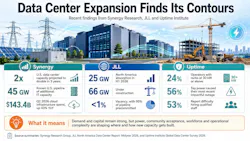
- Data center capacity in the U.S. is expected to double within three years, with nearly 45 GW of additional capacity planned, driven by AI and cloud growth.
- Record demand has led to nearly zero vacancy rates through 2028, with tenants contracting for future deliveries well in advance, intensifying buildout pressures.
- Power availability, grid reliability, and community opposition are increasingly constraining new data center projects, prompting shifts to frontier markets.
- AI infrastructure is becoming more dense, with some racks exceeding 100 kW, and AI inference workloads now matching training in deployment density.
- Workforce shortages, especially in electrical and operational roles, are intensifying as gigawatts of new infrastructure are built and operated globally.
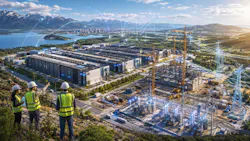
The demand question is becoming the easy one. Three major pieces of industry research released in recent weeks point to a data center market still expanding at extraordinary speed, with AI and cloud growth driving record absorption, construction and capital deployment across North America.
The harder questions concern how much of that demand can actually be translated into operating capacity, where it can be built and whether the power systems, communities, workforce and operating practices surrounding the industry can keep up.
Taken together, new findings from Synergy Research Group, JLL and Uptime Institute describe an industry entering a different phase of the AI infrastructure buildout. Demand remains exceptionally strong. Capital remains available. Capacity is largely spoken for years before delivery.
Execution is becoming the constraint.
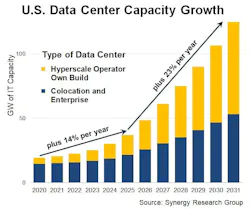
Synergy expects total U.S. data center capacity to double within three years, while hyperscale operators’ owned operational capacity is projected to double in only two. Its identified pipeline includes nearly 1,500 future large data centers worldwide, almost half of them in the United States, representing roughly 45 GW of additional U.S. IT capacity.
JLL, meanwhile, says North America already has 66 GW under construction, with 95% of that pipeline precommitted and vacancy remaining below 1%.
Uptime Institute finds the operators responsible for running all of that infrastructure facing increasingly intertwined challenges involving power availability, grid reliability, cost, supply chains, staffing and the technical demands of higher-density AI infrastructure.
The picture is less one of an infrastructure boom approaching an obvious ceiling than of a buildout being forced to negotiate a growing number of ceilings at once.
Cloud Demand Keeps Accelerating
The fundamental demand signal remains difficult to miss.
Synergy estimates that enterprise spending on cloud infrastructure services reached $143.4 billion in the second quarter of 2026, an increase of more than $43 billion from a year earlier. Year-over-year growth reached 43%, its fastest rate in eight years and the 11th consecutive quarter in which the growth rate increased.
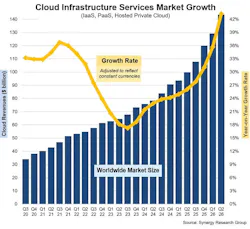
Over those 11 quarters, Synergy says, the cloud infrastructure market doubled in size.
Generative AI remains the primary accelerant. GenAI-specific cloud services grew 165% year over year, while public IaaS and PaaS grew 47%. Trailing 12-month cloud infrastructure revenue reached $500 billion.
Amazon continued to lead the worldwide cloud infrastructure market with a 28% share in Q2, followed by Microsoft at 20% and Google at 15%. But some of the more consequential movement is occurring below the top tier.
Synergy identified CoreWeave, OpenAI, Oracle, Crusoe, Nebius, Anthropic and Nscale among the faster-growing providers and said nine neocloud companies now rank among the world's 40 largest cloud infrastructure providers by revenue.
That emerging demand class is becoming visible in physical infrastructure as well.
JLL says hyperscalers remain the dominant source of North American data center demand, accounting for 59% of its 2026 tenant mix. Neoclouds represent another 11%, followed by pure-play AI companies at 7%. JLL has identified more than 5 GW of neocloud capacity online or under development, while OpenAI and Anthropic alone are associated with roughly 11 GW of capacity operating or under construction.
The relationships between those groups are also becoming less tidy.
AI companies are leasing capacity from hyperscalers. Neocloud providers are supplying capacity to hyperscalers. Operators are increasingly securing infrastructure wherever it can be made available.
JLL views those arrangements primarily as evidence of scarcity and urgency rather than systemic weakness: the opportunity cost of waiting for compute has become too high.
25 GW of Demand in Six Months
That urgency is showing up directly in absorption.
JLL recorded 25 GW of net new data center demand in North America during the first half of 2026, roughly twice the level of a year earlier and five times the total from two years ago.
The market has maintained roughly 1% vacancy for three consecutive years despite unprecedented construction. Available capacity generally consists of smaller, fragmented blocks, while tenants securing major commitments today are often contracting for 2028 deliveries.
With 95% of the current development pipeline already committed, JLL expects vacancy to remain near zero through 2028.
Those conditions also complicate recurrent questions about an AI infrastructure bubble.
JLL continues to model downside scenarios and sees the possibility that demand growth could begin normalizing around 2030. But its downside case looks more like a period of digestion and portfolio optimization than a collapse in occupancy or pricing. Continued demand acceleration remains another plausible outcome.
Rents offer another indication of scarcity. JLL says North American data center rent growth has averaged roughly 9% annually since 2020, with comparable rents now about 70% higher than six years ago. Most current leases include annual escalators of at least 3% and little or no concession activity.
The Buildout Moves to the Frontier
Scarcity is also changing the map.
JLL says 77% of North American capacity currently under construction is now located in frontier markets, with West Texas among the largest beneficiaries and significant growth also moving into Ohio, Louisiana, Indiana and the Carolinas. Many of these markets had almost no meaningful data center footprint a decade ago.
Synergy arrives at a similar conclusion from a different direction.
The research firm expects the United States to continue accounting for well over half of worldwide operational data center capacity during the next five years. Seven hyperscale companies are driving much of the expansion through large AI campuses, but Synergy also tracks another 67 companies developing major U.S. data centers or campuses.
Power scarcity and community opposition are clearly affecting project decisions. Synergy Chief Analyst John Dinsdale acknowledged that constrained power availability and rising local concerns are already “crimping many new plans for data centers.”
Yet Synergy's forecast assumes developers will continue finding paths around those constraints.
Increasingly, that means following power, land and permitting into markets far beyond the industry's traditional clusters.
The constraints are therefore affecting the location and form of growth even when they have yet to meaningfully reduce aggregate demand.
Community Acceptance Becomes a Capacity Issue
JLL places another constraint unusually high on the list.
Its Midyear 2026 report declares community acceptance the data center industry's greatest challenge, arguing that continued expansion depends on earlier engagement and greater transparency around electricity, water and noise, alongside clearer local benefits involving jobs, investment and tax revenue.
JLL's “data center acceptance paradox” puts numbers around the problem.
Citing JLL Research, Gallup and Reuters data, the report says 79% of respondents support U.S. leadership in artificial intelligence, while only 14% support data center development in their own community — a 65-point gap.
That matters increasingly because developers can solve only so many infrastructure problems inside the property line.
Utilities, interconnection processes, local governments and host communities now influence delivery schedules nearly as directly as construction crews and equipment suppliers. A technically viable project with financing and a committed customer can still lose years to power constraints, permitting problems or political opposition.
Uptime's findings show operators responding to some of that scrutiny at the facility level.
Collection of sustainability data resumed its gradual upward trend in 2026, with some of the largest increases occurring in water use, e-waste and carbon-emissions measurement. Uptime links the rise in water tracking in part to growing public pressure and regulation. Energy consumption and PUE remain the most commonly tracked sustainability metrics.
Community acceptance and facility operations are increasingly part of the same discussion.
AI Density Is Arriving Unevenly
Inside the data center, the AI transition remains equally uneven.
Uptime's 2026 survey found the average modal, or most common, rack density across respondents exceeding 11 kW for the first time, up from 9 kW in 2025.
But that number requires context.
A relatively small group of very high-density facilities pulls the average upward. Without those facilities, Uptime puts average modal rack density at 7.8 kW, only modestly higher than 7.5 kW in 2025.
The industry therefore continues to operate two realities at once: a vast installed base running conventional rack densities and a rapidly emerging class of AI facilities pushing far beyond them.
The latter is becoming more visible. Some 24% of Uptime respondents now report racks at 30 kW or higher, up from 19% last year. Much of the increase occurred above 50 kW, and some operators reported deployments exceeding 100 kW. Still, most surveyed facilities have no racks at 30 kW or above.
AI inference is also moving up the density curve.
For the first time in Uptime's survey, generative AI inference matched AI training as a driver of respondents' highest-density deployments, with 21% citing each workload.
That matters because inference potentially pushes AI infrastructure requirements beyond a relatively concentrated population of model-training campuses and into a broader set of facilities and markets.
Power Is Both Constraint and Risk
No issue connects the three reports more consistently than power.
It limits new site availability. It redirects development toward emerging markets. It shapes community debates. It affects density and cooling architecture. And once a facility is operating, it remains the largest source of outage risk.
Uptime says 56% of operators who experienced an impactful outage identified power as the primary cause of their most recent incident. The institute cautions against treating the increase from 2025 as evidence of a sudden decline in resiliency, noting that power has historically accounted for more than half of major incidents in several recent years.
But the boundaries of power risk are expanding.
Uptime points to utility capacity, interconnection timelines, grid congestion, fuel logistics and equipment supply chains as factors increasingly affecting data center resiliency, particularly as operators consider more on-site generation and increasingly power-intensive facilities.
At the same time, operators continue making incremental progress on outage frequency. Fewer than half of respondents reported an impactful outage during the prior three years.
The financial consequences, however, are getting larger. Among respondents reporting significant, serious or severe incidents, 71% said their most damaging outage cost at least $100,000 in 2026, up from 57% in 2025.
Greater digital dependence means even stable outage severity can carry larger business consequences.
And technology alone does not solve the problem.
Uptime found that 89% of respondents who experienced impactful downtime believed the incident could have been avoided through better management, processes or configuration, up from 80% in 2024.
For an industry deploying unprecedented amounts of redundant electrical equipment, that is an important reminder: resilience still depends heavily on operating discipline.
Who Operates 66 GW?
The workforce question may become equally difficult.
More than half of Uptime respondents — 53% — reported difficulty finding qualified candidates for open positions, up from 46% in 2025. A third reported retention problems, including 28% who had employees hired away by competitors.
Electrical skills are becoming particularly scarce.
Uptime found the largest reported skills gaps in electrical and junior/mid-level operations roles, both at 38%, followed by operations management at 35% and mechanical roles at 34%.
Reported electrical skills gaps have increased 13 percentage points since 2023.
Uptime connects that directly to the scale of construction underway: gigawatts of new electrical infrastructure must be built, commissioned, maintained and operated at a time when many regions already face shortages of experienced electrical workers.
Against JLL's 66 GW construction pipeline, the question becomes concrete.
The industry needs the land and power to build that capacity. It also needs the people capable of making it work.
Capital Continues to Find the Sector
For now, capital appears more accommodating than many of the physical constraints.
JLL estimates that North America's construction pipeline will require more than $700 billion in permanent debt financing through 2028. Project-finance liquidity remains available across credit tiers, although pricing and leverage differ considerably depending on tenant credit and project risk.
Data center CMBS and ABS issuance totaled $17 billion during the first half of 2026, up 29% year over year. AI-related transactions generated more than $32 billion of high-yield bond issuance during the period.
Institutional capital is also paying increasingly large prices for access to operating platforms, development pipelines, power and hyperscale relationships.
JLL points to the $40 billion Aligned Data Centers transaction, the STT GDC take-private, the atNorth acquisition and SoftBank's acquisition of DigitalBridge as evidence of deep investor conviction in digital infrastructure as a long-duration asset class.
Capital, in other words, is still trying to accelerate the buildout.
Much of the physical world surrounding data centers is applying the brakes.
The Execution Test
The combined findings from Synergy, JLL and Uptime suggest that 2026 may be remembered less as the year the industry discovered the size of AI demand than the year it began confronting what delivering that demand actually requires.
The numbers remain enormous.
Cloud infrastructure spending is accelerating. U.S. capacity is on course to double. North America has 66 GW under construction. Vacancy is effectively zero. Hyperscalers, neoclouds and AI companies are competing aggressively for capacity. Investors continue committing enormous pools of debt and equity.
None of those indicators point toward an industry preparing to stand still.
But the next phase will be governed increasingly by factors that do not scale as quickly as capital or compute demand.
Grid infrastructure takes years. Equipment supply chains remain constrained. Skilled operators and electricians cannot be created overnight. Communities are demanding a clearer account of local costs and benefits. Existing facilities must accommodate new density profiles without sacrificing resiliency. And the consequences of operational failure rise as more of the economy depends on the infrastructure.
Synergy's capacity forecast, JLL's construction pipeline and Uptime's operator survey are therefore describing different parts of the same problem.
The opportunity is enormous.
So is the work required to deliver it.
At Data Center Frontier, we talk the industry talk and walk the industry walk. In that spirit, DCF Staff members may occasionally use AI tools to assist with content.
Keep pace with the fast-moving world of data centers and cloud computing by connecting with Data Center Frontier on LinkedIn, following us on X/Twitter and Facebook, as well as on BlueSky, and signing up for our weekly newsletters using the form below.
About the Author
 Matt Vincent
Matt Vincent
Matt Vincent is Editor in Chief of Data Center Frontier, where he leads editorial strategy and coverage focused on the infrastructure powering cloud computing, artificial intelligence, and the digital economy. A veteran B2B technology journalist with more than two decades of experience, Vincent specializes in the intersection of data centers, power, cooling, and emerging AI-era infrastructure. Since assuming the EIC role in 2023, he has helped guide Data Center Frontier’s coverage of the industry’s transition into the gigawatt-scale AI era, with a focus on hyperscale development, behind-the-meter power strategies, liquid cooling architectures, and the evolving energy demands of high-density compute, while working closely with the Digital Infrastructure Group at Endeavor Business Media to expand the brand’s analytical and multimedia footprint. Vincent also hosts The Data Center Frontier Show podcast, where he interviews industry leaders across hyperscale, colocation, utilities, and the data center supply chain to examine the technologies and business models reshaping digital infrastructure. Since its inception he serves as Head of Content for the Data Center Frontier Trends Summit. Before becoming Editor in Chief, he served in multiple senior editorial roles across Endeavor Business Media’s digital infrastructure portfolio, with coverage spanning data centers and hyperscale infrastructure, structured cabling and networking, telecom and datacom, IP physical security, and wireless and Pro AV markets. He began his career in 2005 within PennWell’s Advanced Technology Division and later held senior editorial positions supporting brands such as Cabling Installation & Maintenance, Lightwave Online, Broadband Technology Report, and Smart Buildings Technology. Vincent is a frequent moderator, interviewer, and keynote speaker at industry events including the HPC Forum, where he delivers forward-looking analysis on how AI and high-performance computing are reshaping digital infrastructure. He graduated with honors from Indiana University Bloomington with a B.A. in English Literature and Creative Writing and lives in southern New Hampshire with his family, remaining an active musician in his spare time.
Voices of the Industry
 Image courtesy of Bell & Gossett
 Source: Adobe Stock, courtesy of ebm-papst