NVIDIA Pushes the AI Factory From Rack to Asset Class
Key Highlights
- NVIDIA has partnered with major financial institutions to mobilize over $500 billion in third-party capital for AI infrastructure development.
- The company advocates for treating AI compute as an infrastructure asset, emphasizing its revenue-generating potential and software-driven longevity.
- Innovations in 800 VDC power distribution enable existing data centers to upgrade without complete redesign, supporting higher density AI systems.
- NVIDIA is developing an open ecosystem for 800 VDC components, reducing reliance on proprietary supply chains and encouraging vendor diversity.
- The DSX platform acts as a comprehensive blueprint, integrating compute, power, cooling, and facility design to support scalable AI factory deployment.
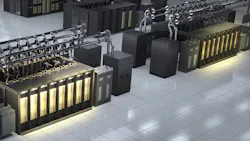
NVIDIA’s latest AI infrastructure announcements are beginning to define the AI factory as something considerably larger than a collection of high-performance GPU systems.
Across a tightly connected series of releases Aug. 10 and 11, the company laid out a strategy that reaches from the electrical architecture delivering power to increasingly dense racks to the institutional capital that could finance AI infrastructure at global scale.
The pieces are distinct, but the logic connecting them is increasingly difficult to miss.
NVIDIA is working with Apollo, BlackRock, Blackstone, Brookfield, Goldman Sachs and KKR on independent financing platforms designed to mobilize more than $500 billion of third-party capital for AI infrastructure over time. CEO Jensen Huang followed that announcement with a detailed case for treating AI factory compute as an investable infrastructure asset rather than simply depreciating IT equipment.
At almost the same moment, NVIDIA expanded its guidance around 800-volt direct-current power distribution, positioning the architecture as a practical route from today’s AC-powered data centers to AI factories capable of supporting much denser generations of accelerated computing.
Taken together, the announcements amount to a top-to-bottom infrastructure proposition.
NVIDIA is not merely defining what goes into the AI factory. It is increasingly defining how the factory is powered, how its compute is organized and valued, how existing facilities can migrate toward much higher density, and how the capital required to build the next generation of infrastructure might be assembled.
For the data center industry, that makes the August announcements less a collection of product updates than another step in NVIDIA’s effort to establish the operating model for AI infrastructure itself.
More Than $500 Billion of Potential Capital
The most eye-catching number came first.
NVIDIA said Aug. 10 that it had signed memorandums of understanding with Apollo, BlackRock, Blackstone, Brookfield, Goldman Sachs and KKR to establish independent compute-financing platforms intended to mobilize more than $500 billion in third-party capital.
The distinction between capital that could ultimately be mobilized and capital already committed is important.
The $500 billion is not a new NVIDIA fund, revenue booked by the company or money allocated to a particular collection of projects. NVIDIA describes it as aggregate third-party capital that the financing platforms are designed to marshal over time, subject to final agreements and independent underwriting of individual opportunities.
The prospective customers include frontier AI labs, enterprises, AI cloud providers and other users throughout NVIDIA’s ecosystem.
The financing initiative nevertheless represents a significant change in how NVIDIA wants the market to think about the capital requirements of accelerated computing.
Data centers have long been financed as infrastructure. The land, building, electrical systems, cooling plants and long-duration customer contracts all fit established infrastructure and real estate investment models.
The compute installed inside those buildings has traditionally occupied a different financial category.
Servers and accelerators depreciate quickly. Technology generations turn over. Utilization can fluctuate. Equipment may be tightly connected to a particular customer or workload.
NVIDIA is arguing that AI factory compute increasingly possesses different characteristics.
“In AI, compute is revenue,” Huang said in announcing the partnerships.
That short formulation sits near the center of NVIDIA’s investment thesis.
If accelerated compute can consistently produce revenue, remain useful across generations of software, move between customers and workloads, and retain meaningful residual value, the equipment begins to look less like conventional corporate IT and more like productive infrastructure.
That is precisely the proposition NVIDIA is taking to some of the world’s largest providers of long-duration institutional capital.
Making Compute Underwritable
Huang expanded the argument a day later in an NVIDIA blog describing AI factory compute as an emerging investable asset class.
NVIDIA’s case begins with a definition.
The company does not describe its compute platform simply as a GPU. It includes accelerated computing, networking, systems software, AI frameworks and the CUDA software ecosystem surrounding the hardware.
That wider platform matters to the financing thesis because NVIDIA argues it increases the number of potential users for an installed AI system.
An NVIDIA DSX AI factory could support language models, vision, speech, biological computing, robotics, physical AI and other workloads. The same infrastructure could potentially move among customers, clouds or operators as demand changes.
In financial terms, NVIDIA is arguing for fungibility.
That could become particularly important to lenders and infrastructure investors trying to determine what happens if an original customer disappears, a contract expires or the economics of a particular workload change.
A GPU cluster tied economically to one speculative tenant is one thing.
Compute that can be redeployed across a large global market of clouds, enterprises, AI developers and model providers is a different risk proposition.
NVIDIA contends that this breadth of potential offtakers helps protect residual value.
Whether institutional markets ultimately price that risk the way NVIDIA hopes remains to be seen. But the company is now explicitly trying to establish a financial framework around that premise.
Challenging the Traditional Depreciation Curve
NVIDIA’s second argument is that software can extend the economic life of installed hardware.
CUDA is central to that case.
The company maintains that successive software improvements can increase the performance and efficiency of systems that have already been deployed, allowing the same hardware to produce more useful work at lower cost over time.
That does not eliminate hardware obsolescence. New GPU generations continue to arrive at a rapid cadence.
But NVIDIA is arguing that the useful economic life of an AI accelerator may be longer than a conventional IT depreciation schedule suggests.
The company points to its Ampere-generation A100 as evidence.
Introduced in 2020, A100 systems remain in commercial use six years later across AI training, fine-tuning, inference and high-performance computing. NVIDIA says customers continue to commit A100 capacity to multiyear deployments, pushing the potential economic life of some systems toward a decade.
Rental pricing provides another piece of NVIDIA’s argument.
The company said one-year H100 rental pricing increased from approximately $1.70 per GPU-hour in October 2025 to about $2.35 in March 2026.
Across providers, NVIDIA cited median on-demand pricing that rose from roughly $2 per GPU-hour in October 2025 to $2.70 by June 2026.
Newer Blackwell B200 capacity commands considerably more, with NVIDIA citing reported cloud pricing between approximately $5.30 and $7.05 per GPU-hour.
Those figures do not guarantee future residual values, utilization rates or investment returns.
They do, however, illustrate what NVIDIA wants financing institutions to evaluate: not simply the acquisition cost of GPUs, but the productive life and revenue-generating potential of the installed compute.
Independent Underwriting — With an NVIDIA Backstop
NVIDIA also directly addressed one of the obvious questions surrounding the financing initiative: whether the arrangement risks creating a circular market in which capital is effectively being supplied to customers so they can purchase more NVIDIA equipment.
The company’s answer centers on independent underwriting.
Apollo, BlackRock, Blackstone, Brookfield, Goldman Sachs and KKR would evaluate individual opportunities based on customer credit, demand, expected utilization, cash flow and residual equipment value.
NVIDIA supplies the AI factory platform. The financial institutions decide where their capital goes.
That separation will be important if the financing model is to establish credibility beyond the current AI investment cycle.
But NVIDIA also disclosed that it could provide a limited residual-value support mechanism in some transactions.
The company said that support could amount to as much as 25% of an opportunity, evaluated on a project-by-project basis.
That detail deserves particular attention.
NVIDIA portrays the mechanism as a limited backstop designed to complement independent underwriting rather than substitute for it. The company argues that it can assume some residual-value exposure because its compute is widely adopted, software-upgradable and redeployable across a broad customer ecosystem.
Even so, the arrangement underscores how early this prospective asset class remains.
A mature market for AI compute finance will ultimately depend on real utilization, durable customer demand, recoverable residual values and observable secondary markets — not merely on expectations for continued AI growth.
Goldman Sachs CEO David Solomon pointed directly toward that next step, describing an opportunity to create a market for credit backed by NVIDIA compute.
If such a market develops at scale, it could begin to move GPU infrastructure into financial territory previously occupied primarily by the buildings and utility infrastructure around it.
Financing the Factory Is Only Half the Problem
The capital story arrived alongside another NVIDIA argument: that the physical architecture of the AI factory must change if the industry expects compute performance to continue scaling.
The issue is no longer simply obtaining enough megawatts.
It is getting those megawatts efficiently from the grid to the accelerator.
Traditional data center power distribution brings AC electricity into the facility and moves it through multiple conversion stages before it reaches the compute.
At conventional rack densities, the losses and equipment associated with those conversions have been manageable.
At the power levels envisioned for next-generation accelerated computing, NVIDIA argues that they become increasingly consequential.
The company’s answer is 800 VDC distribution.
Higher-voltage DC allows power to move through fewer conversion stages between the electrical source and the GPU. NVIDIA says the result is a more efficient and scalable path for delivering very high levels of power to dense AI systems.
The architecture is becoming a core component of NVIDIA’s DSX reference designs, which increasingly function as a system-level blueprint connecting the compute rack to the electrical and mechanical infrastructure around it.
A Migration Path, Not Just a Greenfield Design
One of the more consequential elements of NVIDIA’s 800 VDC strategy is that the company is not limiting it to future greenfield AI campuses.
Most existing data centers were built around AC distribution.
NVIDIA’s near-term answer is an MGX-compatible 800 VDC power rack, scheduled to arrive in the second half of 2026.
The system is intended to sit inside existing AC facilities and convert power locally for delivery to 800 VDC compute racks within the row.
According to NVIDIA, that means operators could introduce next-generation rack-scale systems without first redesigning the electrical architecture of the entire building.
For an industry struggling simultaneously with long utility queues, scarce powered land and rapidly changing equipment requirements, that distinction could be substantial.
The hybrid model effectively attempts to preserve the value of existing land, interconnection rights and building infrastructure while creating an on-ramp to significantly higher compute density.
In other words, NVIDIA is trying to prevent the transition to higher-voltage DC from becoming a greenfield-only proposition.
From the Rack to 2 MW Per Row
The roadmap then moves outward.
For larger deployments, NVIDIA plans a row power center that centralizes power conversion for an entire rack row and distributes 800 VDC through overhead busway.
The architecture is expected in 2027 and is designed to support up to 2 megawatts per row.
That number illustrates the scale of the density transition underway.
Rack power has already moved well beyond the conventional enterprise data center range, and infrastructure designers are now preparing for hundreds of kilowatts per rack and potentially much higher configurations around future AI systems.
At those levels, row-level electrical architecture becomes a first-order design consideration rather than simply a supporting subsystem.
Beyond the row power center, NVIDIA’s roadmap extends to what it calls the DC power block.
Designed for new facilities, the architecture would convert medium-voltage grid power directly to 800 VDC at facility scale in a single step.
That represents the long-term version of the idea: not an AC data center adapted to accommodate DC-powered compute, but a facility whose electrical architecture is designed around high-density AI systems from the outset.
The progression is deliberate.
Existing AC facility.
Hybrid 800 VDC power rack.
800 VDC row distribution.
Native facility-scale DC architecture.
It gives operators different entry points depending on where they are in the development cycle.
Building an Ecosystem Around 800 VDC
NVIDIA is also working to make sure the architecture does not depend on a proprietary supply chain.
The company has been developing the 800 VDC approach with Google and Microsoft through the Open Compute Project.
The companies published a joint low-voltage DC white paper in March, followed in July by version 0.3 of an OCP solid-state transformer specification.
NVIDIA says more than 80 equipment manufacturers and infrastructure companies are now developing products around the specifications.
That ecosystem could prove as important as the electrical theory behind 800 VDC.
A facility-scale transition in power architecture requires far more than GPUs. Power conversion equipment, protection systems, busway, connectors, controls, cooling integration and other infrastructure components all have to be available at scale.
Common interfaces give multiple vendors a target around which to design products, potentially reducing the risk that operators are forced into a single-source electrical architecture.
It is another example of NVIDIA pushing farther beyond the accelerator itself.
The company increasingly needs the surrounding infrastructure industry to move in synchronization with its compute roadmap.
NVIDIA’s AI Factory Insider offers a look inside the company’s own enterprise AI factory, including its validated software stack, security model, on-premises economics and operating scale. NVIDIA says the environment now handles roughly 4 trillion tokens per month and 200 million inference requests per day, providing a real-world example of the utilization and workload diversity underpinning its broader argument for AI factories as productive infrastructure.
DSX Becomes the Connecting Layer
Across both the financing and power announcements, NVIDIA DSX appears repeatedly.
That is significant.
DSX is becoming less a conventional data center reference design than the connective architecture through which NVIDIA can describe the AI factory as a complete system.
The compute platform sits at the center.
Networking connects the accelerators.
Power architecture feeds increasingly dense racks.
Cooling must remove the resulting heat.
Facility design organizes those systems at row, building and campus scale.
And the financing model attempts to turn that integrated infrastructure into something institutional investors can repeatedly underwrite.
The pieces reinforce one another.
There is little value in mobilizing vast amounts of capital for AI infrastructure if the underlying facilities cannot physically support the next generations of compute.
Likewise, there is limited value in designing megawatt-scale rows if customers cannot obtain affordable capital to deploy the equipment that fills them.
NVIDIA is trying to address both problems simultaneously.
From Depreciating Equipment to Productive Infrastructure
That may be the most consequential aspect of the August announcements.
For most of the data center industry’s history, the distinction between IT equipment and physical infrastructure has been fairly clear.
Servers went inside the facility.
The facility provided power, cooling, space and connectivity.
Investors could underwrite the building and its contractual cash flows while customers carried much of the technology risk.
AI infrastructure is beginning to blur those boundaries.
When a rack approaches the power consumption once associated with a small data hall, the relationship between compute and building infrastructure changes.
When an AI system requires specialized liquid cooling, high-voltage DC distribution, purpose-built networking and potentially megawatts of row-level power, the IT stack becomes inseparable from the facility supporting it.
NVIDIA is now extending that argument to finance.
If the compute itself can be continuously improved through software, redeployed among customers, rented through a deep market of potential users and used to generate durable revenue, then NVIDIA believes it can be financed as infrastructure too.
That proposition remains to be proven through a full technology and credit cycle.
The six financing partnerships are still subject to final agreements. The $500 billion represents capital the platforms intend to mobilize, not capital already deployed. Individual projects will still have to clear underwriting based on demand, utilization, cash flow and residual value. And NVIDIA itself may provide limited residual-value support in some transactions.
Those caveats are not peripheral to the story.
They are the test of whether an AI factory becomes a genuine institutional asset class or remains primarily the product of extraordinary near-term demand for scarce compute.
But NVIDIA is now putting a structure around the idea.
KKR co-CEOs Joe Bae and Scott Nuttall captured the practical challenge in their statement accompanying the financing announcement: delivery, not ambition, is the hard part.
That observation applies well beyond capital.
The industry has AI demand. It has enormous announced development pipelines. It has increasingly powerful accelerators and ambitious projections for the next generation of AI systems.
The harder work is translating those inputs into usable capacity.
NVIDIA’s August infrastructure push attacks that problem from both ends.
At the rack and row, it is establishing an 800 VDC architecture intended to move power efficiently into a new density regime.
At the facility level, DSX provides an increasingly integrated blueprint connecting compute with the infrastructure required to support it.
And at the capital-market level, NVIDIA is working with some of the world’s largest investors to establish financing structures around the compute itself.
NVIDIA began the AI boom as the dominant supplier of the accelerators going inside the data center.
Its ambitions now extend considerably farther.
The company is increasingly trying to define the architecture of the AI factory from the GPU rack to the power block — and, ultimately, the financial machinery that determines how many of those factories can actually get built.
NVIDIA’s GTC Taipei 2026 data center partner recap highlights the infrastructure ecosystem forming around its next-generation AI factory architecture, including Vera Rubin, the Vera CPU and DSX, alongside systems and manufacturing partners Foxconn, Quanta, Wistron, ASUS, GIGABYTE, Pegatron and Wiwynn. The July 1 video provides useful context for NVIDIA’s broader push to extend its influence from rack-scale compute to the power, facility and campus infrastructure surrounding it.
At Data Center Frontier, we talk the industry talk and walk the industry walk. In that spirit, DCF Staff members may occasionally use AI tools to assist with content.
Keep pace with the fast-moving world of data centers and cloud computing by connecting with Data Center Frontier on LinkedIn, following us on X/Twitter and Facebook, as well as on BlueSky, and signing up for our weekly newsletters using the form below.
About the Author
 Matt Vincent
Matt Vincent
Matt Vincent is Editor in Chief of Data Center Frontier, where he leads editorial strategy and coverage focused on the infrastructure powering cloud computing, artificial intelligence, and the digital economy. A veteran B2B technology journalist with more than two decades of experience, Vincent specializes in the intersection of data centers, power, cooling, and emerging AI-era infrastructure. Since assuming the EIC role in 2023, he has helped guide Data Center Frontier’s coverage of the industry’s transition into the gigawatt-scale AI era, with a focus on hyperscale development, behind-the-meter power strategies, liquid cooling architectures, and the evolving energy demands of high-density compute, while working closely with the Digital Infrastructure Group at Endeavor Business Media to expand the brand’s analytical and multimedia footprint. Vincent also hosts The Data Center Frontier Show podcast, where he interviews industry leaders across hyperscale, colocation, utilities, and the data center supply chain to examine the technologies and business models reshaping digital infrastructure. Since its inception he serves as Head of Content for the Data Center Frontier Trends Summit. Before becoming Editor in Chief, he served in multiple senior editorial roles across Endeavor Business Media’s digital infrastructure portfolio, with coverage spanning data centers and hyperscale infrastructure, structured cabling and networking, telecom and datacom, IP physical security, and wireless and Pro AV markets. He began his career in 2005 within PennWell’s Advanced Technology Division and later held senior editorial positions supporting brands such as Cabling Installation & Maintenance, Lightwave Online, Broadband Technology Report, and Smart Buildings Technology. Vincent is a frequent moderator, interviewer, and keynote speaker at industry events including the HPC Forum, where he delivers forward-looking analysis on how AI and high-performance computing are reshaping digital infrastructure. He graduated with honors from Indiana University Bloomington with a B.A. in English Literature and Creative Writing and lives in southern New Hampshire with his family, remaining an active musician in his spare time.
Voices of the Industry
 Image courtesy of Bell & Gossett
 Source: Adobe Stock, courtesy of ebm-papst