Applied Digital CEO Wes Cummins On the Hard Part of the AI Boom: Execution
Key Highlights
- Applied Digital advocates for flexible data center designs that can adapt to future density, voltage, and cooling requirements without major retrofits.
- Early locking in of supply chains provides a competitive edge, helping mitigate delays caused by procurement bottlenecks in high-demand components.
- The company’s scalable approach has expanded from 100 MW to over 700 MW, emphasizing repeatable, off-site assembly to reduce on-site labor risks.
- Power delivery strategies are tailored to site-specific conditions, considering regulatory, geographic, and infrastructure constraints.
- Partnerships with ABB and Corintis enhance power distribution and liquid cooling capabilities, supporting high-density AI workloads and reliability goals.
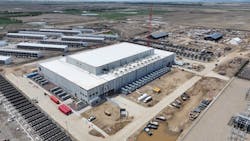





By the time AI became the default design condition for modern data centers, Applied Digital had already committed to a strategy that assumed volatility not just in power density, but in technology direction, customer mix, and execution risk.
That conviction came through clearly in a wide-ranging episode of the Data Center Frontier Show Podcast, where Editor-in-Chief Matt Vincent sat down with Applied Digital Chairman and CEO Wes Cummins to unpack what it actually takes to build AI factories at scale, and on schedule.
Cummins’ message was consistent and unusually grounded for a market still awash in headline-chasing megacampus announcements: design for flexibility, lock in supply chains early, and prepare for an execution gauntlet that will separate real operators from aspirational ones over the next two years.
Designing for What Comes After the Current AI Cycle
Applied Digital’s design philosophy starts with a premise many developers still resist: today’s density assumptions may not hold.
“We’re designing for maximum flexibility for the future—higher density power, lower density power, higher voltage delivery, and more floor space,” Cummins said. “It’s counterintuitive because densities are going up, but we don’t know what comes next.”
That choice - to allocate more floor space even as rack densities climb - signals a long-view approach. Facilities are engineered to accommodate shifts in voltage, cooling topology, and customer requirements without forcing wholesale retrofits. Higher-voltage delivery, mixed cooling configurations, and adaptable data halls are baked in from the start.
The goal is not to predict the future perfectly, Cummins stressed, but to avoid painting infrastructure into a corner.
Supply Chain as Competitive Advantage
If flexibility is the design thesis, supply chain control is the execution weapon.
“It’s a huge advantage that we locked in our MEP supply chain 18 to 24 months ago,” Cummins said. “It’s a tight environment, and more timelines are going to get missed in 2026 because of it.”
Applied Digital moved early to secure long-lead mechanical, electrical, and plumbing components; well before demand pressure fully rippled through transformers, switchgear, chillers, generators, and breakers. That foresight now underpins the company’s ability to make credible delivery commitments while competitors confront procurement bottlenecks.
Cummins was blunt: many delays won’t stem from poor planning, but from simple unavailability.
From 100 MW to 700 MW Without Losing Control
The past year marked a structural pivot for Applied Digital. What began as a single, 100-megawatt “field of dreams” facility in North Dakota has become more than 700 MW under construction, with expansion still ahead.
“A hundred megawatts used to be considered scale,” Cummins said. “Now we’re at 700 megawatts under construction. And we need to go bigger.”
That leap required more than capital. It demanded a repeatable delivery model. Applied Digital’s answer is a fourth-generation data center design optimized for speed, cost, and labor efficiency, anchored by extensive off-site assembly.
“The buildings aren’t modular,” Cummins clarified. “What’s modular is the MEP: think LEGO bricks assembled off-site and slid into place.”
By shifting electrical and mechanical complexity into controlled factory environments, Applied Digital reduces on-site labor risk and accelerates schedules, an increasingly decisive advantage as skilled trades grow scarcer.
Power Delivery: All of the Above and Then Some
When it comes to high-density power, Cummins offered no silver bullets.
“It’s all of the above,” he said—utilities, transformers, transmission, breakers—“and it’s very site-specific.”
Congested markets like Texas are becoming harder to navigate, not just because of volume but due to evolving regulatory frameworks such as ERCOT proposals. Voltage levels at the site dictate transformer availability, which in turn drives lead times and design constraints. Even inside the building, long waits persist for high-voltage switchgear and backup generation.
The implication is that power strategy is now inseparable from geography, procurement timing, and regulatory literacy.
Liquid Cooling: Complex Systems, Simple Operations
Applied Digital was an early mover on direct-to-chip liquid cooling, and its Ellendale facility is now operating at scale.
“It’s working extraordinarily well so far,” Cummins said—“but the complexity is something people underestimate.”
Liquid cooling shifts the reliability equation. Beyond UPS and generators, operators must account for pumps, chillers, coolant loops, and fluid storage.
“You can’t burn these chips up,” Cummins said. “So we’ve built massive storage tanks and multiple layers of redundancy.”
The paradox, he noted, is designing a system that is highly complex architecturally but simple to operate and repair. Applied Digital targets “five nines” reliability, even as vendor ecosystems for CDUs and liquid infrastructure continue to mature.
Designing to the Nvidia Roadmap and Beyond
Since 2023, Applied Digital has aligned infrastructure planning with NVIDIA’s roadmap, anticipating shifts from 400/415V to 800V distribution and eventually toward DC power inside the data hall.
“We design to where the Nvidia ecosystem is going, not just where it is today,” Cummins said.
Facilities are built for 100% liquid cooling, with the flexibility to tap chilled water loops for air-cooled environments where customers require mixed configurations. Over time, Cummins expects even network racks to transition to liquid—ushering in a future of nearly silent data halls.
“That’s going to be eerie,” he said. “Dark, quiet, blinking lights.”
A Narrow Customer Focus and Surging Demand
Despite widespread AI demand, Applied Digital remains tightly focused on six customers: five investment-grade hyperscalers—Microsoft, Amazon, Oracle, Meta, and Google—plus CoreWeave, which anchors Ellendale.
“Those hyperscalers are still the vast majority of the market,” Cummins said.
At the same time, demand from frontier model developers, AI labs, and neo-cloud providers is accelerating. Momentum jumped sharply in mid-summer, with 2026 power largely spoken for and 2027 capacity rapidly tightening.
“We’re going to see a lot of fire drills through 2026,” Cummins said, predicting urgent calls as delayed projects elsewhere force customers to scramble for capacity.
Partnerships That Shape the Stack
Applied Digital’s partnerships reflect its ambition to lead on power and cooling, not just real estate.
ABB is a core collaborator on next-generation power distribution.
Corintis brings a differentiated direct-to-chip approach capable of cooling chips from 1 kW to 5 kW with consistent flow—an operator’s dream as densities escalate.
“Not having to change liquid flows as power densities increase is incredibly important,” Cummins said.
Applied Digital is also exploring partnerships around gallium nitride and silicon carbide, borrowing from electric-vehicle power electronics to rethink data-center-scale distribution.
The Real Risk: Execution
When asked what keeps him up at night, Cummins didn’t hesitate.
“2026 and 2027 are execution years,” he said. “A lot of announcements are never going to turn into operating facilities.”
He likened the industry’s current moment to the quiet first night home with a newborn, after the excitement fades and responsibility sets in. Construction, labor availability, weather, and supply chains all converge here. Many projects, he warned, will falter.
Applied Digital’s confidence rests on mitigation: locked-in supply chains, favorable labor dynamics in North Dakota, and a proven record of delivering Ellendale’s first building on time and on budget.
“If we continue to execute,” Cummins said, “demand will be there for us. Reliability is going to matter more than anything over the next 12 months.”
The Bottom Line
In a market intoxicated by scale, Applied Digital is betting that discipline wins. Flexible design, early procurement, operational realism, and relentless execution may not generate the flashiest headlines but as the AI buildout enters its hardest phase, they may prove decisive.
At Data Center Frontier, we talk the industry talk and walk the industry walk. In that spirit, DCF Staff members may occasionally use AI tools to assist with content. Elements of this article were created with help from OpenAI's GPT5.
Keep pace with the fast-moving world of data centers and cloud computing by connecting with Data Center Frontier on LinkedIn, following us on X/Twitter and Facebook, as well as on BlueSky, and signing up for our weekly newsletters using the form below.
About the Author
 Matt Vincent
Matt Vincent
Matt Vincent is Editor in Chief of Data Center Frontier, where he leads editorial strategy and coverage focused on the infrastructure powering cloud computing, artificial intelligence, and the digital economy. A veteran B2B technology journalist with more than two decades of experience, Vincent specializes in the intersection of data centers, power, cooling, and emerging AI-era infrastructure. Since assuming the EIC role in 2023, he has helped guide Data Center Frontier’s coverage of the industry’s transition into the gigawatt-scale AI era, with a focus on hyperscale development, behind-the-meter power strategies, liquid cooling architectures, and the evolving energy demands of high-density compute, while working closely with the Digital Infrastructure Group at Endeavor Business Media to expand the brand’s analytical and multimedia footprint. Vincent also hosts The Data Center Frontier Show podcast, where he interviews industry leaders across hyperscale, colocation, utilities, and the data center supply chain to examine the technologies and business models reshaping digital infrastructure. Since its inception he serves as Head of Content for the Data Center Frontier Trends Summit. Before becoming Editor in Chief, he served in multiple senior editorial roles across Endeavor Business Media’s digital infrastructure portfolio, with coverage spanning data centers and hyperscale infrastructure, structured cabling and networking, telecom and datacom, IP physical security, and wireless and Pro AV markets. He began his career in 2005 within PennWell’s Advanced Technology Division and later held senior editorial positions supporting brands such as Cabling Installation & Maintenance, Lightwave Online, Broadband Technology Report, and Smart Buildings Technology. Vincent is a frequent moderator, interviewer, and keynote speaker at industry events including the HPC Forum, where he delivers forward-looking analysis on how AI and high-performance computing are reshaping digital infrastructure. He graduated with honors from Indiana University Bloomington with a B.A. in English Literature and Creative Writing and lives in southern New Hampshire with his family, remaining an active musician in his spare time.
Voices of the Industry
 Image courtesy of Bell & Gossett
 Source: Adobe Stock, courtesy of ebm-papst