DCF Trends Summit 2025: Bridging the Data Center Power Gap - Utilities, On-Site Power, and the AI Buildout
Key Highlights
- Northern Virginia's AI-driven demand has rapidly outpaced existing power infrastructure, prompting a shift toward on-site generation and modular power solutions.
- Utilities and developers are increasingly collaborating early in planning, fostering flexible partnership models to expand transmission and generation capacity.
- Natural gas remains the primary bridge fuel, but discussions highlight future roles for nuclear, geothermal, and carbon capture technologies in a diversified energy mix.
- Demand response faces hurdles due to tenant SLAs and community concerns, with batteries and fuel cells emerging as cleaner alternatives.
- Workforce recruitment is shifting focus toward mission-driven narratives, emphasizing the societal impact of data center innovations to attract young engineering talent.
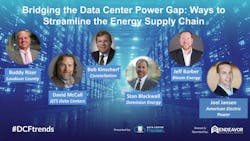
The second installment in our recap series from the 2025 Data Center Frontier Trends Summit highlights a panel that brought unusual candor—and welcome urgency—to one of the defining constraints of the AI era: power availability.
Moderated by Buddy Rizer, Executive Director of Economic Development for Loudoun County, Bridging the Data Center Power Gap: Ways to Streamline the Energy Supply Chain convened a powerhouse group of energy and data center executives representing on-site generation, independent power markets, regulated utilities, and hyperscale operators:
-
Jeff Barber, VP of Global Data Centers, Bloom Energy
-
Bob Kinscherf, VP of National Accounts, Constellation
-
Stan Blackwell, Director, Data Center Practice, Dominion Energy
-
Joel Jansen, SVP Regulated Commercial Operations, American Electric Power
-
David McCall, VP of Innovation, QTS Data Centers
As presented on September 26, 2025 in Reston, Virginia, the discussion quickly revealed that while no single answer exists to the industry’s power crunch, a more collaborative, multi-path playbook is now emerging—and evolving faster than many realize.
A Grid Designed for Yesterday Meets AI-Era Demand Curves
Rizer opened with context familiar to anyone operating in Northern Virginia: this region sits at the epicenter of globally scaled digital infrastructure, but its once-ample headroom has evaporated under the weight of AI scaling cycles.
Across the panel, the message was consistent: demand curves have shifted permanently, and the step-changes in load growth require new thinking across the entire energy supply chain.
Joel Jansen (AEP) underscored the pace of change. A decade ago, utilities faced flat or declining load growth. Now, “our load curve is going straight up,” driven by hyperscale and AI training clusters that are large, high-density, and intolerant of slow development cycles. AEP’s 40,000 miles of transmission and 225,000 miles of distribution infrastructure give it perspective: generation is challenging, but transmission and interconnection timelines are becoming decisive gating factors.
David McCall (QTS) reinforced this point from the operator side. For many campuses, “it’s not a generation problem—it’s a transmission problem.” In some markets, developers may be able to secure ample future generation, but 12 years for transmission buildouts effectively makes those locations unavailable for AI infrastructure.
This reality is pushing operators toward alternatives they once avoided—particularly natural-gas-based on-site power or modular power islands that bypass long-haul transmission.
On-Site Power Matures From Bridge Strategy to Strategic Necessity
No shift exemplifies the new playbook more than the market’s embrace of distributed on-site generation.
Jeff Barber (Bloom Energy) described how demand has reshaped Bloom’s own roadmap. With fully domestic manufacturing and few tariff exposures, Bloom can deliver fuel cell systems in roughly 90 days—though Barber was quick to stress that the bottleneck is rarely the box, but transformers, gas interconnections, medium-voltage gear, and permitting.
Still, the appeal of near-term, dispatchable power is clear. Bloom is scaling to 4 GW of annual manufacturing by 2027, having anticipated this structural shift several years ago.
Bob Kinscherf (Constellation) noted a parallel evolution among IPPs. Once focused primarily on large-scale generation and retail supply, Constellation is now increasingly asked to solve for “bridge power”—structures that can give data center operators capacity years before the grid can.
In regions with resource constraints—whether electrical or natural gas—developers are now analyzing gas transmission capacity maps during site selection. “Fifteen years ago I avoided gas lines,” Kinscherf said. “Now developers call asking for gas line maps.”
The shift is so pronounced that adjacency to gas infrastructure has become a premium feature, not a disqualifier—a complete reversal of the past decade’s development heuristics.
Transmission as the Defining Bottleneck—and the Rise of Partnership Models
The industry’s growing willingness to co-plan with utilities marks one of the most significant cultural shifts noted during the discussion.
Stan Blackwell (Dominion Energy) described Dominion’s continuing commitment to offshore wind, solar, and long-term SMR development. But he emphasized an emerging consensus: generation alone will not feed AI’s growth curve without aggressive transmission expansion.
McCall noted that when developers engage early and collaboratively, utilities and regulators often respond with surprising flexibility. “When we get aligned on resilience, redundancy, and long-term planning,” he said, “partners who once seemed hesitant suddenly become extremely collaborative.”
Utilities echoed that sentiment. “We don’t build speculative,” Jansen said. “But when visibility is good and partnership is strong, we can move.”
This has triggered a wave of new partnership structures:
-
Joint grid + on-site power planning to provide early capacity while long-term grid upgrades catch up
-
Behind-the-meter microgrids designed to integrate future SMRs or geothermal
-
Early-stage “beachhead” agreements that allow hyperscalers to commit to regions earlier with shared risk
What Comes After Natural Gas? A Realistic Debate About the Next 10 Years
Rizer challenged the panel to address the broader landscape: if natural gas is the bridge, what comes next?
The responses painted a nuanced roadmap rather than a single destination.
Nuclear: Inevitable—but not Imminent
All panelists agreed that SMRs will be deployed in the 2030s, but opinions diverged on when they become commercially viable at scale.
-
Constellation’s Kinscherf emphasized community acceptance and early deployment at existing nuclear sites.
-
Dominion’s Blackwell projected operational SMRs in the mid-2030s, but not at mass scale.
-
QTS’s McCall cautioned against “sacred cows,” arguing for a diversified approach that prioritizes energy sovereignty and resilience above hype cycles.
Geothermal Re-enters the Conversation
Several panelists pointed to next-gen geothermal—especially enhanced geothermal systems (EGS)—as a potentially scalable mid-2030s solution.
Carbon Capture Becomes Real for Distributed Generation
Jansen noted Bloom–AEP collaborations that integrate on-site carbon capture, shifting the emissions calculus for gas-based distributed resources.
Fusion Remains Promising—but Appropriately Caveated
Kinscherf referenced Constellation’s work with Microsoft and Helion but grounded expectations: “The first wave will be expensive and hyperscaler-driven.”
Demand Response: A Tool, a Risk, and a Reputation Challenge
An audience question surfaced one of the AI era’s thorniest issues: demand response participation at scale.
While PJM and other RTOs increasingly expect large users to deliver multi-hour call capabilities, the panel was blunt about the barriers:
-
Data centers rarely have curtailable load, especially in inference-heavy regions like Northern Virginia.
-
Tenant SLAs generally prohibit curtailment, locking operators out of DR markets.
-
Traditional diesel-based DR introduces particulate emissions and noise, posing community relations risks that operators want to avoid.
As McCall put it: “If we already have a reputational challenge, proliferating diesel-based DR will make it unmanageable.”
Panelists agreed that batteries, fuel cells, and load-flexible training clusters will eventually form a cleaner DR toolkit—but the industry is early in that transition.
Curtailments, Firm Gas, and the New Contingency Models
A question on gas curtailments opened another window into shifting operational assumptions.
Utilities noted that firm gas contracts—mirroring those used for power plants—are becoming essential for any data center relying on gas-based generation.
Jansen explained AEP’s model: secure firm gas for normal operation, supplement with CNG during pipeline maintenance, and avoid interruptible gas entirely.
Operators are also beginning to view redundant gas suppliers the way they once viewed diverse fiber routes: as essential for resilience.
The Workforce Question: How to Bring the Next Generation In
The discussion took a human turn when an audience member—parent of an MIT senior—asked how the industry can attract young engineering talent.
Utilities acknowledged that the “flat load growth” era made the sector seem unexciting. But with demand surging, the hiring environment has transformed.
McCall reframed the question in human terms:
“If we just make it about electrons and molecules, we miss the point. We enable human flourishing. AI that helps detect cancer, climate analytics, medical imaging, financial security—these all run through our systems. When young people see that, they want in.”
Recruitment, the panel agreed, must pivot to mission narratives, not just technical ones.
Will Things Be Better in a Year?
Rizer closed with a simple question: If this panel reconvenes next year, will the situation be better?
Every panelist said yes, though for different reasons:
-
Constellation: Communication among operators, utilities, and tenants is improving rapidly.
-
Bloom: Jurisdictions like Texas (via SB6) are introducing flexible frameworks that will accelerate solutions.
-
AEP: Collaborative innovation will separate successful players from those who stall.
-
Dominion: Bridging technologies—fuel cells, alternately fueled turbines, modular power—will become clearer and more widely adopted.
-
QTS: The industry will gain clarity not only on power but on fiber constraints, the next major bottleneck already emerging at metro chokepoints.
The overall sentiment: the roadmap won’t be smooth, but it will accelerate, driven by urgent economic necessity and national competitiveness.
Conclusion: The Power Gap Is Real—But So Is the Momentum
The 2025 Trends Summit panel revealed an industry grappling directly with its most existential constraint. But beneath the surface friction lies a striking degree of convergence. Operators and utilities are now:
-
Co-designing power solutions earlier,
-
Embracing on-site generation as strategic, not temporary,
-
Planning for geothermal and nuclear futures,
-
And confronting public perception and workforce challenges head-on.
AI’s power gap may define the decade—but as this panel demonstrated, the sector’s most powerful advantage is the speed at which collaboration is becoming the new norm.
This feature is the second in Data Center Frontier’s series recapping key sessions from the DCF Trends Summit 2025.
At Data Center Frontier, we talk the industry talk and walk the industry walk. In that spirit, DCF Staff members may occasionally use AI tools to assist with content. Elements of this article were created with help from OpenAI's GPT5.
Keep pace with the fast-moving world of data centers and cloud computing by connecting with Data Center Frontier on LinkedIn, following us on X/Twitter and Facebook, as well as on BlueSky, and signing up for our weekly newsletters using the form below.
About the Author
 Matt Vincent
Matt Vincent
Matt Vincent is Editor in Chief of Data Center Frontier, where he leads editorial strategy and coverage focused on the infrastructure powering cloud computing, artificial intelligence, and the digital economy. A veteran B2B technology journalist with more than two decades of experience, Vincent specializes in the intersection of data centers, power, cooling, and emerging AI-era infrastructure. Since assuming the EIC role in 2023, he has helped guide Data Center Frontier’s coverage of the industry’s transition into the gigawatt-scale AI era, with a focus on hyperscale development, behind-the-meter power strategies, liquid cooling architectures, and the evolving energy demands of high-density compute, while working closely with the Digital Infrastructure Group at Endeavor Business Media to expand the brand’s analytical and multimedia footprint. Vincent also hosts The Data Center Frontier Show podcast, where he interviews industry leaders across hyperscale, colocation, utilities, and the data center supply chain to examine the technologies and business models reshaping digital infrastructure. Since its inception he serves as Head of Content for the Data Center Frontier Trends Summit. Before becoming Editor in Chief, he served in multiple senior editorial roles across Endeavor Business Media’s digital infrastructure portfolio, with coverage spanning data centers and hyperscale infrastructure, structured cabling and networking, telecom and datacom, IP physical security, and wireless and Pro AV markets. He began his career in 2005 within PennWell’s Advanced Technology Division and later held senior editorial positions supporting brands such as Cabling Installation & Maintenance, Lightwave Online, Broadband Technology Report, and Smart Buildings Technology. Vincent is a frequent moderator, interviewer, and keynote speaker at industry events including the HPC Forum, where he delivers forward-looking analysis on how AI and high-performance computing are reshaping digital infrastructure. He graduated with honors from Indiana University Bloomington with a B.A. in English Literature and Creative Writing and lives in southern New Hampshire with his family, remaining an active musician in his spare time.
Related
Voices of the Industry
 Source: SNEHIT PHOTO/Shutterstock.com
 Source: Matthew G Eddy/Shutterstock.com