Utah’s 4 GW AI Campus Tests the Limits of Speed-to-Power
Key Highlights
- The project involves converting agricultural land in Utah into a large industrial campus with on-site natural-gas generators supporting data centers.
- Community concerns focus on environmental impacts such as emissions, noise, water use, traffic, and land conversion, which could influence project scope and timeline.
- The development features a distributed generation model with hundreds of engines, requiring complex permitting, infrastructure, and environmental management strategies.
- On-site power generation aims to accelerate project delivery but introduces industrial risks related to emissions, noise, and construction logistics in a rural setting.
- Regulatory challenges include air permitting, emissions controls, water rights management, and ensuring community trust through transparent monitoring and mitigation commitments.
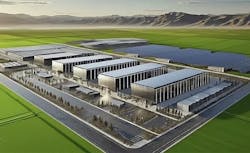
Back in September 2025, we examined an ambitious proposal from infrastructure developer Joule Capital Partners - often branding the effort as “Joule Power” - in partnership with Caterpillar. The concept is straightforward but consequential: acquire a vast rural tract in Millard County, Utah, and pair an AI-focused data center campus with large-scale, on-site “behind-the-meter” generation to bypass the interconnection queues, transmission constraints, and substation bottlenecks slowing projects nationwide.
The appeal is clear: speed-to-power and greater control over delivery timelines. But that speed shifts the project’s risk profile. Instead of navigating traditional utility procurement, the development begins to resemble a distributed power plant subject to industrial permitting, fuel supply logistics, air emissions scrutiny, noise controls, and groundwater governance. These are issues communities typically associate with generation facilities, not hyperscale data centers.
Our earlier coverage focused on the technical and strategic logic of pairing compute with on-site generation. Now the story has evolved. Community opposition is emerging as a material variable that could influence schedule and scope. Although groundbreaking was held in November 2025, final site plans and key conditional use permits remain pending at the time of publication.
What Is Actually Being Proposed?
Public records from Millard County show Joule pursuing a zone change for approximately 4,000 acres (about 6.25 square miles), converting agricultural land near 11000 N McCornick Road to Heavy Industrial use. At a July 2025 public meeting, residents raised familiar concerns that surface when a rural landscape is targeted for hyperscale development: labor influx and housing strain, water use, traffic, dust and wildfire risk, wildlife disruption, and the broader loss of farmland and local character.
What has proven less clear is the precise scale and sequencing of the buildout.
Local reporting describes an initial phase of six data center buildings, each supported by a substantial fleet of Caterpillar natural-gas generators, with construction beginning “this spring.” Other accounts reference a significantly larger first phase, with entitlement discussions including as many as 32 buildings of roughly one million square feet each, even if only a portion would be constructed in the near term.
These descriptions are not necessarily contradictory. Developers often seek entitlements for a maximum buildout while actual construction proceeds in phased increments based on financing and customer commitments. But the distinction matters. Community impact (particularly around noise, emissions, traffic, and water) will be evaluated based on what is permitted and installed in the near term, not on long-range conceptual buildout plans.
What is clear is that the project’s critical path is not simply data center construction. It is prime power generation.
The Salt Lake Tribune reported that early plans pair each of six buildings with 69 Caterpillar natural-gas generators. At that scale, the site would require hundreds of engines, with community members describing projected sound levels as comparable to “more than 400 semi-trucks idling.” Joule and Caterpillar’s own materials position the campus as a 4-gigawatt development featuring combined cooling, heat and power (CCHP), liquid cooling by design, and a fleet of Caterpillar G3520K generator sets.
This is not a conventional hyperscale construction program. It is the development of a distributed generation campus: foundations for large engine arrays, exhaust and aftertreatment systems, high-voltage switchyards, synchronization controls, fire and life-safety systems, fuel interconnections, and a commissioning process that resembles a utility-scale plant more than a colocation facility.
That shift introduces additional long-lead and integration risks, including:
-
Generator manufacturing capacity and delivery sequencing.
-
Emissions-control configuration and regulatory compliance.
-
Synchronization and islanding controls.
-
Black-start capability and ride-through design.
-
Commissioning under load, particularly before full tenant occupancy.
In short, the engineering challenge extends well beyond compute density. It centers on whether a modular, engine-based generation strategy can be permitted, delivered, and synchronized at multi-gigawatt scale without triggering schedule friction from the very industrial systems that make the project possible.
Construction Logistics: When Rural Scale Meets Industrial Volume
County proceedings reflect immediate concern about the practical realities of building at this scale. Residents raised questions about labor influx, temporary housing, traffic, and the strain placed on a rural road network not designed for sustained heavy industrial movement.
On a 4,000-acre site, construction logistics become a program of their own. Hundreds of large generator units, transformers, switchgear lineups, cooling systems, and potentially battery containers must be delivered, staged, installed, and commissioned. That translates into prolonged heavy trucking, haul-route coordination, road upgrades, laydown yards, pre-assembly zones, and ongoing dust management across miles of internal access roads.
Rural land availability is often cited as an advantage in hyperscale siting. But the same locations frequently lack depth in supporting infrastructure, from workforce housing and emergency response capacity to medical services and road maintenance budgets. That imbalance surfaced directly in public meetings, where residents asked whether the community is equipped to absorb the scale and duration of construction activity being proposed.
Dust and fire risk were raised explicitly in the record. In arid regions, dust affects more than local quality of life; it can degrade construction productivity and equipment reliability, increasing filtration and maintenance requirements for cooling and electrical systems. Fire risk, meanwhile, introduces questions about defensible space, fire-water supply, response times, and whether local emergency services would require expansion to support an industrial campus of this magnitude.
For a traditional data center, these concerns are manageable extensions of site work. For a multi-gigawatt campus anchored by engine-based generation, they become material schedule and community-relations variables.
Emissions Strategy Shapes the Site Plan
County meeting minutes note that the buildings are intentionally spread across the property “due to the emissions and not dispersing them all in one area.” That single comment reveals a great deal about the permitting strategy behind the layout.
At multi-gigawatt scale, particularly with engine-based generation, site geometry becomes an emissions-management tool. Distributing buildings and associated generator blocks across thousands of acres may help manage:
-
Localized pollutant concentration modeling results.
-
Noise contours and setback compliance.
-
Stack and exhaust dispersion dynamics.
-
Regulatory thresholds that can shift when large numbers of emission sources are co-located.
In other words, the physical layout is not driven solely by operational efficiency or campus aesthetics. It may also be structured to navigate air-quality modeling and permitting categories.
There is a trade-off. Spreading structures across a large footprint increases civil and electrical complexity: longer internal roads, extended medium-voltage distribution runs, more trenching, additional switchgear segmentation, and greater redundancy requirements. That raises both capital cost and coordination demands.
But concentration carries its own risk. Clustering large generator arrays can intensify modeled emission “hot spots,” tighten setback constraints, and elevate the regulatory classification of the project.
In this case, the master plan appears to reflect a calculated balance between construction efficiency and emissions dispersion; a reminder that, at this scale, environmental modeling is influencing not just equipment selection, but the geography of the campus itself.
Water Rights vs. Water Reality
Joule’s public case for the project emphasizes water independence. The company has reportedly secured rights to more than 10,000 acre-feet of groundwater annually (over 3 billion gallons) and has stressed that the campus will not rely on a municipal system.
Project materials also point to a closed-loop, direct-to-chip cooling architecture designed to minimize evaporative losses. According to Trellis, engineers estimate the data center would use significantly less water than the alfalfa farming currently supported on the land — potentially as much as 75% less on an annual basis.
In arid regions, however, possessing legal rights does not automatically resolve public concern.
Opposition tends to focus less on annual totals and more on long-term basin health: aquifer drawdown over time, impacts on neighboring wells, drought-cycle variability, and the transparency of monitoring and reporting regimes. There is also a precedent question. If one multi-gigawatt industrial campus can rely on privately controlled groundwater at this scale, others may attempt to follow.
At the state level, scrutiny is increasing. Utah lawmakers have signaled interest in expanding water-use reporting requirements for data centers, reflecting broader concern about transparency and sustainability in water-constrained regions.
The core issue is not simply consumption. It is governance, verification, and public trust in how withdrawals will be measured and managed over decades of operation.
Air Permitting: The Project’s Central Flashpoint
The defining feature of the Utah campus — large-scale, on-site gas-fired generation — is also its most direct environmental vulnerability.
According to Trellis, air permit applications filed with Utah regulators indicate that the initial six-building phase could emit approximately 4,380 tons per year of regulated pollutants (excluding CO₂), including roughly 1,380 tons annually of nitrogen oxides (NOx). Trellis further reports that the projected NOx rate is materially higher than that of Utah’s gas-fueled Lake Side Power Plant, based on EPA data comparisons.
Those figures shift the conversation. This is no longer simply a data center debate; it is an air-quality and industrial-generation discussion.
The Salt Lake Tribune has highlighted a broader concern emerging statewide: when utility interconnection timelines stretch too long, some data center developers are choosing to build generation on-site, effectively relocating power plant emissions closer to new industrial campuses. For environmental advocates, that raises questions about cumulative air-quality impacts and regulatory precedent.
From a construction and delivery standpoint, the risk becomes schedule-driven. Air permitting — including dispersion modeling and determinations around Best Available Control Technology (BACT) or, if triggered, Lowest Achievable Emissions Rate (LAER) requirements — can materially influence equipment configuration. If regulators tighten emissions controls or modeling assumptions late in the process, engine specifications, aftertreatment systems, or operating limits may need to be revised after procurement decisions have been made.
At multi-gigawatt scale, those revisions are not minor adjustments. They can mean redesign, additional capital expenditure, extended lead times, and commissioning delays.
In effect, the project’s speed-to-power advantage hinges on successfully navigating a regulatory pathway more commonly associated with utility-scale generation than with hyperscale data halls.
Noise: Operational Reality, Not Rhetoric
Noise concerns surfaced directly in county proceedings, including discussion of projected decibel levels. The Salt Lake Tribune characterized the anticipated generator output as comparable to “hundreds of idling semi-trucks,” a description vivid enough to resonate well beyond technical modeling.
At the scale proposed, acoustic mitigation becomes a core design requirement, not a secondary engineering detail. Engine enclosures, exhaust mufflers, sound walls, berming, building orientation, and setback distances all influence both compliance and community acceptance.
Noise also carries enforcement implications. Even where permitted limits are met on paper, persistent complaints can lead to additional monitoring, operational restrictions, or pressure to retrofit mitigation measures. For a campus built around continuous engine-based generation, acoustic performance becomes an operational variable with both regulatory and reputational consequences.
From Farmland to Industrial Power Campus
Beyond engineering metrics lies a broader land-use shift. Residents have voiced concern about the conversion of agricultural land, described by Trellis as a family alfalfa operation, into a multi-gigawatt industrial complex.
Even if the data center ultimately consumes less water than the existing agricultural activity, the transformation is not simply volumetric. It represents a permanent change in landscape function: new road networks, fencing, lighting, substations, and generation yards replacing open farmland.
That transition introduces habitat fragmentation, construction disturbance, and long-term industrialization of a rural corridor. For some in the community, the question is not only environmental impact but identity, i.e. whether the region is prepared to redefine itself from agricultural base to energy-intensive digital infrastructure hub.
Power at Utility Scale
Caterpillar’s announcement frames the project as a 4-gigawatt campus incorporating 1.1 GWh of grid-forming battery energy storage, combined cooling, heat and power (CCHP), and what it describes as “diverse fuel sources.” Our earlier coverage reflected those figures. Subsequent reporting from Trellis suggests the broader site could ultimately scale toward 12 gigawatts, depending on entitlement and demand.
Even at the lower bound, 4 GW is not simply a large substation. It is utility-scale generation.
If a meaningful portion of that capacity is installed in early phases, fuel logistics, emissions permitting, and operational oversight become regional planning issues rather than purely site-level considerations.
The design direction outlined publicly includes:
-
Large fleets of Caterpillar natural-gas generator sets.
-
A planned pipeline interconnection (with county minutes referencing the Kern River system and Trellis citing nearby gas infrastructure).
-
Battery storage positioned for load smoothing, firming, and grid-forming capability, with the system described as “permitted to accept cleaner electricity” in the future, including potential fuel cells, geothermal, or small modular reactors.
This approach reflects a broader pattern emerging in AI-oriented campus development: deploy modular gas generation and storage to secure immediate power availability, then pursue incremental decarbonization as alternative supply chains mature.
Trellis cites Utah Clean Energy describing the engine-based approach as less efficient than combined-cycle turbine plants, and therefore potentially more emissions-intensive, while acknowledging that reciprocating engines are deployable today.
That is the central trade-off.
Modular engines and battery systems offer speed, sequencing flexibility, and independence from grid interconnection timelines.
But they also anchor the project in an industrial permitting regime defined by air quality, fuel supply, noise, and long-term emissions intensity; considerations that diverge from the renewables-backed narrative often associated with hyperscale data center expansion.
What Must Be Resolved
For community support to solidify, several questions need clear, enforceable answers.
First, what precisely constitutes Phase I? Whether the near-term build is limited to six buildings or represents the leading edge of a much larger sequence materially changes projected impacts on traffic, emissions, water, and noise. Entitlement scale and construction scale must align transparently.
Second, what are the binding air-permit limits and monitoring protocols? The reported tonnage and NOx comparisons suggest the air program will sit at the center of regulatory scrutiny. Modeling assumptions, control technologies, and compliance verification will define both schedule and public confidence.
Third, what noise mitigation commitments are contractually embedded in the design, and how will compliance be validated over time? Acoustic performance is not theoretical at this scale; it is measurable and enforceable.
Fourth, how will groundwater withdrawals be metered, reported, and made publicly auditable? Legal rights alone do not guarantee community trust in a drought-sensitive basin.
Finally, who absorbs the cost of ancillary impacts, i.e. road upgrades, emergency-response expansion, workforce housing strain? County proceedings suggest these concerns are already embedded in local discourse.
A Test Case for the AI Power Model
In many respects, Joule’s 4,000-acre Utah campus represents more than a single development proposal. It is a case study in the next phase of AI-era infrastructure strategy.
When grid interconnection timelines stretch beyond acceptable delivery windows, developers are increasingly bringing the power plant to the servers.
That shift changes the development equation. The core question is no longer simply whether a data center can be constructed on time and on budget. It becomes whether a utility-scale distributed generation system can be entitled, financed, built, and operated without sustained opposition over air emissions, noise, water use, and land conversion.
Scale does not eliminate local scrutiny. Even in rural settings, multi-gigawatt projects introduce industrial impacts that communities recognize and evaluate accordingly. In that sense, the Utah proposal may foreshadow a broader industry reality: as AI campuses grow to industrial dimensions, they inherit industrial politics.
At Data Center Frontier, we talk the industry talk and walk the industry walk. In that spirit, DCF Staff members may occasionally use AI tools to assist with content. Elements of this article were created with help from OpenAI's GPT5.
Keep pace with the fast-moving world of data centers and cloud computing by connecting with Data Center Frontier on LinkedIn, following us on X/Twitter and Facebook, as well as on BlueSky, and signing up for our weekly newsletters using the form below.
About the Author
 David Chernicoff