Powering the AI Era: Why Data Centers Need a New Energy Strategy

Artificial intelligence is accelerating faster than the energy systems designed to support it. As organizations deploy increasingly complex AI-driven applications, data centers are being pushed into a new era – one defined by extreme power demand, unprecedented heat generation, and mounting sustainability pressure. Goldman Sachs projects that by 2030, data centers could consume up to 4% of the world’s electricity, doubling today’s footprint. This growth is reshaping not just compute strategy but the entire foundation of data‑center energy architecture.
The AI Acceleration Challenge
AI workloads don’t behave like traditional IT loads. High‑performance GPUs draw power in sharp, unpredictable pulses that can spike to as much as 15X their idle power within milliseconds. As GPU density increases, these pulses become more intense and more frequent.
At the same time:
- Cooling systems now account for roughly 40% of data‑center electricity use according to the International Energy Agency.
- Communities are opposing new builds due to water consumption, noise, and grid strain.
- Regulators worldwide are tightening sustainability rules and reporting requirements.
Traditional power architectures – built for smooth, predictable energy curves – cannot keep up. The most pressing challenge is volatility. AI Dynamic Loads aren’t a theoretical future concern; they’re already degrading power quality, destabilizing infrastructure, and stressing battery rooms in ways legacy systems were never designed to handle.
The industry now faces a fundamental shift. Power systems can no longer sit idle waiting for outages. They must actively participate in real‑time operation, smoothing spikes, stabilizing distribution, and supporting mission‑critical workloads.
Why Immediate Power Solutions (IPS) Matter
For years, data‑center backup strategy was dominated by long‑duration energy‑storage systems (ESS), optimized for energy density rather than power density. But AI has changed the requirements. Today, what matters most is instantaneous, high‑rate discharge – the ability to deliver large bursts of power in milliseconds.
This is the domain of Immediate Power Solutions (IPS).
IPS differ from ESS in one crucial way:
- ESS = energy over time
- IPS = power in an instant
AI, HPC, and next‑generation digital infrastructure all require IPS because they demand extremely high slew rates – the speed at which a battery can release power. While ESS technologies such as lithium‑ion may take several seconds to reach full output, IPS technologies can respond instantly, preventing outages, smoothing pulses, and protecting both equipment and the grid.
IPS is already used across industries, from EV charging to industrial automation, but nowhere is it more critical than inside the UPS systems of AI‑driven data centers.
Nickel‑Zinc: A Power Chemistry Designed for AI-Ready Data Centers
Battery chemistry is now a strategic decision. Lead‑acid, while familiar, is too large, too heavy, and degrades quickly under high‑rate cycling. Lithium‑ion offers high energy density but struggles with sustained power delivery, heat generation, and thermal‑runaway risk – especially under repetitive AI surges.
Nickel‑zinc (NiZn) offers a more suitable path forward for IPS applications:
- High power density: Up to 3× that of legacy chemistries.
- Fast pulse response: Ideal for smoothing AI Dynamic Loads.
- Safety: No thermal‑runaway risk at the cell level; wide temperature tolerance.
- Longevity: 3X the life of lead‑acid batteries under demanding conditions.
- Sustainability:
- 25–50% lower lifecycle emissions than lead‑acid and lithium‑ion (ZincFive lifecycle analysis).
- 96% recyclable materials.
- Uses abundant raw materials.
- Lower infrastructure burden: No need for complex fire‑suppression or temperature‑control systems.
As data centers race to meet increasingly strict Scope 3 emissions requirements and align with regulations such as the EU Battery Regulation, the choice of chemistry is becoming as important as the choice of compute platform.
BC 2 AI: IPS Purpose‑Built for AI Power Profiles
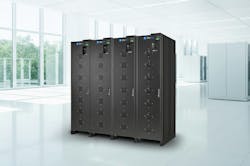
To meet the demands of this new era, ZincFive developed the BC 2 AI UPS Battery Cabinet, a nickel‑zinc battery cabinet engineered specifically for the millisecond‑scale volatility created by AI and GPU‑driven workloads.
Key capabilities include:
- AI Pulse-Power Intelligence with advanced telemetry and analytics designed for instant surge response.
- Dual‑use performance: fast pulse handling plus traditional runtime support.
- Purpose-built with nickel-zinc chemistry, which contains 2-4 times the cycle count of alternative chemistries when mitigating AI dynamic power.
- Designed to work alongside megawatt‑class UPS systems, ensuring system continuity, and preventing overload and bypass risks.
- Low total cost of ownership prevents overbuilding, replacing multiple systems with one, saving space, infrastructure and management costs.
BC 2 AI doesn’t just provide backup; it actively stabilizes AI power profiles in real time, helping data centers maintain reliability, lower operating costs, and support higher‑density compute clusters.
Like every evolution of the BC Series, BC 2 AI reflects ZincFive’s continuous improvement philosophy – using field-proven insights to advance both the chemistry and system-level engineering.
Sustainability as a Power Decision
According to the 2025 Data Center Energy Storage Industry Insights Report, 87% of operators now consider sustainability a top priority in power decisions, and 72% have already seen cost savings from sustainability initiatives. Choosing IPS solutions like NiZn offers measurable benefits:
- Lower embodied carbon footprint.
- Reduced water and energy use.
- Fewer replacements, lowering waste and Scope 3 emissions.
- Smaller footprint, freeing space for revenue‑generating racks.
As demand accelerates, sustainability and performance are no longer opposing forces. IPS and NiZn combine them.
Ready for What Comes Next
AI isn’t just reshaping workloads – it’s restructuring the entire energy architecture of the modern data center. The shift ahead isn’t incremental; it’s foundational. Power systems can no longer be passive insurance policies. They must serve as active participants in daily operations: smoothing spikes, stabilizing infrastructure, and enabling continuous growth.
NiZn technology and the BC 2 AI platform are designed for this new reality: fast, safe, scalable, and sustainable by design. As AI becomes the backbone of global digital infrastructure, real‑time power stability will determine who keeps up and who leads.
The future of data‑center power won’t be defined by compromise, rather by chemistry built for what comes next.
About the Author
 Tod Higinbotham
 Tod Higinbotham
Tod Higinbotham is CEO of ZincFive, a manufacturer of nickel-zinc batteries and power solutions. He has a strong track record of successfully growing advanced materials companies in the energy storage, semiconductor, and solar markets. He served as Executive VP/GM for ATMI and led the rapid growth of the company, which was sold for more than $1 billion. Tod was an executive member of the leadership team at Advanced Silicon Materials, a world leader in high-purity silicon materials, the business that was sold to REC to form their solar materials business. He was formerly the CEO of PowerGenix, the company that pioneered the novel nickel-zinc battery technology that has become the core of ZincFive’s solution portfolio.
Related
Voices of the Industry
 Source: Matthew G Eddy/Shutterstock.com
 Source: Getty Images, courtesy of Schneider Electric