When Gigawatt Construction Outpaces the Supply Chain
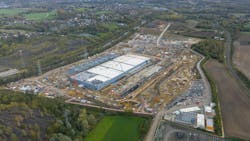

Data center construction is scaling at a pace the industry has never seen before. Gigawatt-scale campuses are becoming standard. AI-driven demand is compressing timelines. Multi-site deployments are unfolding simultaneously in markets once considered secondary.
Yet while facility design, power generation, and cooling systems are evolving to meet this moment, one critical component has not kept pace: the physical supply chain infrastructure that supports construction, or the willingness of owners and general contractors to devote time and resources to refining and improving supply chains.
The result is a growing mismatch between the scale of ambition and the execution systems behind it.
Scale Has Changed the Risk Profile
Gigawatt campuses are not simply larger versions of traditional builds. They introduce density. More generators. More transformers. More skids. More prefabricated systems moving at the same time, from multiple sources.
They also introduce geographic complexity. Large programs frequently span multiple regions, each with their own storage locations, permitting requirements, carrier networks, and site access constraints. Equipment may be staged across several warehouses to support different phases or campuses within the same portfolio.
At this scale, risk compounds quickly. Equipment sourced globally must be staged, sequenced, and deployed with precision. Deliveries must align not just with overall project schedules, but with specific installation windows and clear hall paths. A delayed shipment can disrupt crane scheduling and commissioning sequences. One released too early can create congestion, additional handling, and unnecessary risk.
At gigawatt scale, construction is no longer a simple progression of tasks. It involves overlapping scopes, distributed storage locations, and tightly coordinated installation windows. That level of coordination requires visibility that supports timing, sequencing, and accountability.
Visibility Is Becoming Operational Control
In many construction programs, “total visibility” still means receiving arbitrary updates: inventory summaries, shipping confirmations, and cost reports.
But at gigawatt scale, visibility must evolve beyond status reporting. It has become a tool for operational control. Operational visibility answers questions such as:
- What equipment is currently under management?
- Where is it physically located?
- What is scheduled to move — and when?
- How does release timing align with site readiness?
- What is the total handling and transportation cost exposure?
- How much capital is sitting in inventory across locations?
When inventory data, transportation activity, and cost reporting are connected, teams gain the ability to manage sequencing deliberately — not reactively. Visibility allows project leaders to:
- Adjust release schedules before sites become congested
- Identify storage duration trends that may affect cost exposure
- Track transportation density across multiple active projects
- Align logistics activity to commissioning milestones
- Shift equipment between sites based on site vs equipment readiness
The difference isn’t in the volume of reporting. It’s in how it’s used.
When inventory, transportation, and cost data are connected to construction milestones, visibility stops being informational and starts becoming operational.
Storage Is Now Strategic
Historically, warehousing in data center construction was seen as temporary overflow; a short-term solution between factory and job site.
Today, storage plays a strategic role.
AI-driven demand has accelerated early procurement. Long-lead equipment such as generators, transformers, switchgear, and prefabricated skids is often secured months before site readiness. Multi-campus programs further widen the gap between delivery and installation.
Without structure, extended staging increases exposure to environmental degradation, warranty disputes, cumulative holding costs, and sequencing misalignment. A generator stored for months without structured oversight and strategic project buffering becomes a risk variable rather than a buffer.
Strategic storage now requires environmental controls where necessary, serialized inventory tracking, quality documentation, insurance clarity, and disciplined release management tied to construction milestones.
Storage is no longer passive space. It is active infrastructure.
Transportation Density Is Rising
Regional build hubs outside traditional markets introduce additional complexity. Oversized equipment must navigate multi-state permitting regulations, infrastructure limitations, and rural access routes. At the same time, hyperscale density means multiple heavy loads moving simultaneously, increasing congestion risk both on public infrastructure and at storage facilities.
The challenge is not simply moving equipment. It is orchestrating movement at a program level.
Transportation planning must align with engineering, site readiness, storage sequencing, and equipment availability. If those layers aren’t coordinated, delays and rework follow. At gigawatt scale, that misalignment shows up quickly in cost and schedule impact.
Short-term or reactive last-minute scheduling is much more expensive.
The Next Phase of Industry Maturity
The data center industry has matured rapidly in design and capital deployment. The next phase of maturity will depend on how well physical construction supply chains are structured and managed.
That includes disciplined inventory management systems, integrated transportation visibility, milestone-driven release sequencing, and clearly defined ownership of risk at every handoff. None of these elements are individually new. But what is new is the density and scale at which they must now operate.
In today’s environment, success is no longer defined by simply delivering on time and on budget. It is increasingly defined by the ability to compress traditional construction timelines and remove avoidable cost through better coordination, sequencing, and supply chain visibility.
As campuses grow larger and timelines compress further, execution systems must evolve accordingly. The systems behind the build—storage, logistics coordination, strategic buffering, and visibility—will increasingly shape project outcomes as much as the design itself.
About the Author
 Jarrett Atkinson
Jarrett Atkinson
Jarrett Atkinson is Vice President of Supply Chain at BluePrint Supply Chain, a national supply chain solutions provider specializing in logistics, storage, and equipment management for mission-critical construction. Learn more at blueprintsupplychain.com.
Voices of the Industry
 Image courtesy of Midea Building Technologies
 Adobe Stock image courtesy of Hitachi Energy