Why Intelligent Rear Door Cooling Is the Pragmatic First Step Toward Unlocking Token Economics
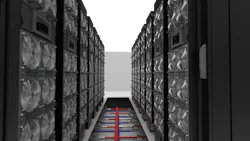

Liquid cooling has an adoption problem, and it isn't technical. The industry has spent the last two years framing the cooling conversation as a binary choice: keep running air or commit to a full direct-to-chip liquid cooling deployment. That framing makes for clean conference slides, but it ignores the reality facing most operators today.
The majority of data center environments are not greenfield builds with uniform rack densities and a single GPU architecture across every row. They are mixed environments with legacy air-cooled infrastructure running alongside new, high-density AI clusters. They host facilities teams learning liquid cooling operations for the first time while managing upgrade timelines that are measured in quarters, not weeks. For these operators, the question was never "air or liquid." The question is: what is the most intelligent path from where we are today to where the economics of AI compute demand we be in 18 months?
From Hardware to Strategy
Rear door heat exchangers have always been a natural bridge between air and liquid cooling. They bring liquid cooling to the rack while neutralizing hot air at the source, with no facility-wide liquid distribution infrastructure required. For operators managing live environments, that simplicity has real value.
But the latest generation of rear door technology changes the value proposition entirely. This is no longer passive heat rejection bolted onto the back of a rack. With embedded sensor networks, intelligent controls, and a scalable architecture that allows operators to move from passive to active cooling on their own timeline, the rear door becomes something different: an instrumented, controllable cooling asset that generates operational data while it removes heat. That combination of cooling performance and rack-level intelligence is what turns a bridge technology into a bridge strategy.
Intelligence Changes the Equation
What separates a cooling accessory from a cooling asset is the information it provides. The next generation of rear door heat exchangers is being built around that distinction, combining comprehensive sensor networks with intelligent controls that give operators precise visibility into airflow and temperature at the individual rack level rather than relying on facility-wide averages.
That rack-level data layer matters more than it might appear on the surface. In most data center environments, facilities teams and IT operations teams work from different dashboards, different priorities, and different definitions of "normal." Intelligent rear door cooling creates a shared reference point. When both teams can see what is happening thermally at every rack position in real time, capacity planning conversations get shorter and confusion during thermal events disappears.
Critically, intelligence has to be added without introducing new operational risk. The design principles that make this viable are fail-safe redundancy architectures, hot-swappable components serviceable without opening the unit, and scalable configurations that let operators move from passive to active cooling on their own timeline. nVent's RDHx Pro is one example of this approach in production today, but the broader signal is clear: the industry is moving toward rear door cooling that thinks, not just rear door cooling that dissipates heat. In a world where AI infrastructure performance is measured in tokens per watt, that rack-level intelligence becomes more than operational. It becomes economic.
Operational Advantages That Compound
As the industry converges on tokens per watt as the defining metric for AI infrastructure performance, every component in the data hall faces a new question: does this help produce more tokens, or does it get in the way? Intelligent rear door cooling answers on multiple fronts.
Pre-rack commissioning means cooling infrastructure is tested, validated, and running before servers arrive in the data hall. That sequencing compresses the deployment timeline, closing the gap between capital investment and revenue-generating compute. Rack-level thermal intelligence prevents the silent performance killer: thermal throttling that degrades GPU output without triggering an outage alert. And hot-swappable serviceability with the door closed eliminates planned maintenance windows that would otherwise take production racks offline. At competitive inference pricing, even a short cooling maintenance window against a high-density rack cluster is a measurable revenue event. Intelligent rear door cooling turns that event into a non-event.
The Pragmatic Path Forward
The smartest liquid cooling strategy is not about choosing between air and liquid. It is about building an intelligent bridge between them. Operators who start with an instrumented, controllable rear door gain three things at once: immediate cooling performance for today's AI workloads, a rack-level data layer that informs future infrastructure decisions, and a scalable upgrade path that does not require a forklift.
The industry will continue debating the best long-term architecture for high-density cooling. In the meantime, the operators who are solving the problem today are the ones who stopped waiting for the perfect answer and started building the bridge.
About the Author

Sam Dore
Sam Dore is nVent’s Product Manager for Liquid Cooling in Europe. He previously worked in local, national and European sales roles from the UK, as well as in Global Product Management. Primarily from the ventilation sector, Sam has spent the past 18 years within the building services and HVAC markets championing sustainability and energy efficiency.
Voices of the Industry