What “On-Time Delivery” Really Means in Data Center Construction

In construction environments, “on-time delivery” is a success metric. If equipment arrives when scheduled, the assumption is that the project is on track.
But in data center construction, especially at hyperscale, the definition of “on-time” is not always clear.
For some, it means hitting a delivery date.
For others, it means having equipment available ahead of schedule to reduce risk.
In practice, those interpretations don’t always align.
Because in this environment, on-time delivery isn’t just about when equipment arrives. It’s about whether the site is ready to do something with it when it does.
Defining “On-Time” in a Dynamic Build Environment
At a high level, on-time delivery should mean having equipment delivered to the right place, at the right time, when the site is ready to receive or employ it.
But that timing isn’t universal.
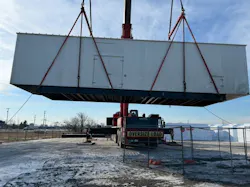
Some equipment needs to arrive days in advance for staging or inspection. Other pieces, especially large, crane-dependent assets, need to arrive within a tightly defined window tied to lift schedules and crew availability.
The challenge is that these timelines are not always clearly defined or consistently communicated across stakeholders.
As a result, “on-time” often becomes a broader window rather than a precise moment—and that’s where misalignment begins.
Delivery vs. Readiness
A generator can arrive exactly on schedule and still create problems. If the site isn’t ready to receive it, that delivery becomes a disruption rather than a milestone.
Equipment gets staged, moved again, or repositioned to make room for other trades. Crane picks get reshuffled. Crews wait or shift focus.
In many cases, what’s intended to be an “on-time delivery” turns into something else entirely.
Equipment is shipped according to the requested date, but upon arrival, it’s unloaded into a secondary staging area or warehouse rather than installed. Sometimes that staging is intentional—allowing for inspection, pre-commissioning steps, or preparation work.
But often, it’s simply the result of equipment arriving before the site is ready.
What was expected to reduce risk ends up recreating the same challenges, just in a different location.
The Reality of “Pulling” Equipment Early
In theory, projects aim to “pull” equipment when it’s needed.
In practice, many project teams request delivery earlier than required to avoid the risk of delays. That buffer may be a week, a month, or more.
The intent is understandable. No team wants to delay installation because equipment hasn’t arrived.
But pulling equipment early often leads to:
- Additional staging and rehandling, with each additional lift increasing operational risk and the potential for equipment damage
- Congested job sites or offsite storage areas
- Equipment being managed without structured tracking or systems
At that point, the project hasn’t eliminated risk; it has shifted it.
Instead of worrying about late delivery, teams are now managing early inventory without clear visibility or sequencing.
The Cost of Being Early
Early delivery is often treated as a safeguard. In practice, it introduces a different set of risks.
High-value equipment staged too soon can lead to:
- Increased handling and rehandling
- Greater exposure to environmental conditions
- Congested laydown areas
- Misalignment with installation sequencing
The longer equipment sits without a defined plan, the more likely it is to create downstream issues. In some cases, the cost to manage early deliveries outweighs the benefit of securing them ahead of schedule.
There is also a visibility challenge.
Without structured systems in place, equipment can effectively become “lost” within a site or storage location; not lost physically, but lost in the sense that teams don’t have clear, reliable insight into where it is, how long it has been there, or when it should move next.
The Cost of Being Late
Late delivery is more visible and easier to point to.
Missed delivery windows can delay crane picks, push installation sequencing, and impact commissioning timelines. At hyperscale, those delays don’t stay contained. They affect multiple trades and ripple across the project.
But both early and late deliveries often come back to the same issue: misalignment between logistics and site readiness.
Rethinking What “On-Time” Requires
If on-time delivery is going to be meaningful, it needs to be clearly defined and aligned across project stakeholders, with a shared understanding of what it means at each phase of the project.
That means understanding:
- When each piece of equipment is actually needed
- How much staging time is required (if any)
- What constraints exist around installation, access, and crane scheduling
It also means recognizing that not all equipment operates on the same timeline.
Some items can arrive early with minimal impact. Others require precise coordination down to the day or even the hour.
Without that level of alignment, “on-time” becomes subjective, and execution becomes inconsistent.
The Role of Project Buffering and Structured Storage
One of the core challenges in data center construction is that it doesn’t operate like traditional manufacturing supply chains.
In industries like automotive, suppliers are often located close to production facilities and can respond quickly to changes. Equipment can be delivered in tight windows because the system is built to support it.
Data center construction doesn’t have that same infrastructure.
Lead times are longer. Manufacturing is distributed. Sites are often in remote or developing regions. And once equipment ships, there’s limited flexibility.
That’s where structured storage and project buffering become critical.
Instead of relying on the job site to absorb early deliveries, equipment can be received, tracked, and staged in a controlled environment until it aligns with site readiness.
This creates an intermediary layer between manufacturing and installation, helping bridge the gap between when equipment is available and when it’s actually needed.
The Shift Ahead
As data center construction continues to scale, success will depend less on whether equipment arrives on a specific date and more on how well delivery aligns with execution.
Delivery still matters, but timing only has value when it supports what happens next.
Because in this environment, progress isn’t defined by when gear arrives.
It’s defined by whether the site is ready to employ it when it does.
About the Author
 Jarrett Atkinson
Jarrett Atkinson
Jarrett Atkinson is Vice President of Supply Chain at BluePrint Supply Chain, a national supply chain solutions provider specializing in logistics, storage, and equipment management for mission-critical construction. Learn more at blueprintsupplychain.com.
Voices of the Industry
 Image courtesy of Midea Building Technologies
 Adobe Stock image courtesy of Hitachi Energy