Redefining Hydronic Infrastructure for D2C Cooling
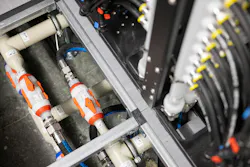

As data centers evolve to support artificial intelligence (AI) and high-performance computing, the demands placed on cooling infrastructure are changing fundamentally. Rack densities are rising beyond 100 kW, and with that, the need for more efficient, reliable, and scalable thermal management has never been greater. Direct-to-chip liquid cooling (DLC) is rapidly becoming the preferred solution, but unlocking its full potential requires more than just advanced cooling units and cold plates. It requires a rethinking of the entire hydronic infrastructure.
From component optimization to system thinking
Much of the current discourse around liquid cooling focuses on visible and high-impact components: cold plates, cooling distribution units (CDUs), and heat exchangers. While these elements are critical, they represent only part of a much larger system. DLC operates as a closed-loop hydronic network, connecting facility water systems (FWS) with technology cooling systems (TCS) and delivering coolant directly to the chip. Within this loop, piping is not simply a passive transport medium. It is a core enabler of system performance, governing flow behavior, influencing energy efficiency, and playing a decisive role in maintaining coolant purity.
As system complexity increases, the limitations of traditional approaches to hydronic design are becoming more apparent.
The hidden constraints of conventional piping
Historically, metal piping has been the standard choice for data center cooling systems. Its widespread use is largely based on familiarity and established practices. However, in the context of modern DLC environments, this approach presents several challenges.
One of the most significant is corrosion. Metal piping systems are inherently susceptible to corrosion over time, particularly when exposed to water-based coolants and additives. This process leads to the release of particles into the fluid, which can accumulate and create deposits. In direct-to-chip cooling systems, where cold plates rely on microchannels to transfer heat efficiently, even minimal contamination can lead to fouling, reduced performance, and increased maintenance requirements.
In addition to contamination risks, corrosion and scaling increase internal surface roughness, resulting in higher friction losses and reduced hydraulic efficiency. Over time, this can significantly impact system performance and energy consumption.
Installation challenges further compound these issues. Metal piping is heavy and typically requires welding and assembly on-site, extending project timelines and introducing variability. As data center construction faces increasing pressure to deliver faster and more efficiently, these constraints are becoming increasingly critical.
A shift toward engineered hydronic solutions
High-performance polymer piping systems are gaining traction as a viable and advantageous alternative. Unlike metal, polymers are inherently corrosion-free, eliminating the risk of internal degradation and particle release. This ensures consistent coolant purity, which is essential for protecting sensitive components such as cold plates.
Polymer piping also offers exceptionally smooth internal surfaces, supporting stable and predictable hydraulic performance. Without the risk of corrosion-induced roughness or scaling, systems can maintain optimal flow conditions over time.
From a construction standpoint, polymer systems provide significant advantages. Their lightweight nature simplifies handling and transport, while their compatibility with prefabrication enables large sections of piping to be assembled off-site. These prefabricated modules can be installed quickly and efficiently, reducing on-site labor and shortening project timelines.
Supporting scalability and sustainability
Sustainability considerations are also driving material selection. Polymer piping systems typically offer a lower embodied carbon footprint compared to traditional metal solutions, supporting environmental targets as data centers scale.
At the same time, engineered hydronic systems enable greater flexibility. Modular and prefabricated designs allow infrastructure to expand alongside demand, ensuring scalability without compromising reliability.
Ultimately, piping is no longer a secondary component, it is a critical foundation for performance, efficiency, and long-term operation in modern data center cooling.
Explore more about the material selection in direct-to-chip liquid cooling and discover real-world applications.
About the Author
 Charles Freda
Charles Freda
Charles Freda leads the global data center practice at Georg Fischer (GF), specializing in mechanical systems and liquid cooling for mission-critical facilities. With over 20 years of experience, he has focused on the data center sector since 2008, contributing to the delivery and operation of more than 10 million sq ft of data center builds. He is a Certified Energy Manager (CEM), Data Center Energy Practitioner (DCEP), and LEED Accredited Professional and is the co-author of many publications including a volume of the ASHRAE Datacom Series.
GF is a global leader in flow solutions, delivering mission-critical products and services for the safe and sustainable transport of water and other fluids. With more than 60 years of expertise in advanced polymer piping systems for high-tech industries, GF supports data center operators with reliable and efficient cooling infrastructure.
Founded in 1802 and headquartered in Switzerland, GF employs approximately 13,300 people across 46 countries. In 2025, GF generated sales of CHF 3 billion and is listed on the SIX Swiss Exchange.
Voices of the Industry
 Source: Nimbus Advanced Process Cooling
 Image courtesy of Bell & Gossett