Edged US Builds Waterless, High-Density AI Data Center Campuses at Scale
Key Highlights
- Edged US targets high-density, waterless cooling data centers with a focus on sustainability and community acceptance.
- The company’s campus-first strategy emphasizes multi-building, scalable deployments across major U.S. markets like Chicago and Dallas.
- Waterless cooling technology, supported by ThermalWorks, enables high-density AI workloads while addressing water scarcity concerns.
- Standardized operational models, including Tier III design and integrated monitoring, ensure reliable, repeatable project delivery.
- Recent projects demonstrate proof points for long-term capacity and rapid expansion, reinforcing Edged’s scalable growth approach.
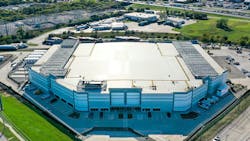
Edged US is targeting a narrow but increasingly valuable lane of the hyperscale AI infrastructure market: high-density compute delivered at speed, paired with a sustainability posture centered on waterless, closed-loop cooling and a portfolio-wide design PUE target of roughly 1.15.
Two recent announcements illustrate the model. In Aurora, Illinois, Edged is developing a 72-MW facility purpose-built for AI training and inference, with liquid-to-chip cooling designed to support rack densities exceeding 200 kW. In Irving, Texas, a 24-MW campus expansion combines air-cooled densities above 120 kW per rack with liquid-to-chip capability reaching 400 kW.
Taken together, the projects point to a consistent strategy: standardized, multi-building campuses in major markets; a vertically integrated technical stack with cooling at its core; and an operating model built around repeatable designs, modular systems, and readiness for rapidly escalating AI densities.
A Campus-First Platform Strategy
Edged US’s platform strategy is built around campus-scale expansion rather than one-off facilities. The company positions itself as a gigawatt-scale, AI-ready portfolio expanding across major U.S. metros through repeatable design targets and multi-building campuses: an emphasis that is deliberate and increasingly consequential.
In Chicago/Aurora, Edged is developing a multi-building campus with an initial facility already online and a second 72-MW building under construction. Dallas/Irving follows the same playbook: the first facility opened in January 2025, with a second 24-MW building approved unanimously by the city. Taken together with developments in Atlanta, Chicago, Columbus, Dallas, Des Moines, Kansas City, and Phoenix, the footprint reflects a portfolio-first mindset rather than a collection of bespoke sites.
This focus on campus-based expansion matters because the AI factory era increasingly rewards developers that can execute three things at once:
-
Lock down power and land at scale.
-
Standardize delivery across markets.
-
Operate efficiently while staying aligned with community and regulatory expectations.
Edged is explicitly selling the second and third elements of that equation. In high-density, supply-constrained markets such as Chicago and DFW where water use, grid capacity, and permitting timelines are front-page issues, that combination can become a meaningful differentiator.
Waterless Cooling as a Competitive Advantage
Edged US closely ties its platform identity to ThermalWorks, a sister company within its corporate ecosystem that serves as the technical foundation for its waterless cooling strategy and high-density readiness. ThermalWorks is positioned not as an optional feature, but as a core enabler of Edged’s campus-scale model, delivering closed-loop cooling with a stated water usage effectiveness (WUE) of 0.00 while supporting escalating AI rack densities.
Across recent announcements, the technical profile is notably consistent:
-
Waterless, closed-loop cooling, marketed portfolio-wide as “zero water for cooling” (WUE 0.00)
-
High rack-density support, including:
-
Chicago/Aurora: liquid-to-chip cooling designed to exceed 200 kW per rack
-
Dallas/Irving: air-cooled densities above 120 kW per rack, with liquid-to-chip capability up to 400 kW
-
-
Portfolio-wide design PUE targeted at approximately 1.15.
Edged leans heavily on the sustainability implications of this architecture but the strategic value goes beyond efficiency metrics. Water has become one of the fastest flashpoints for community opposition to large-scale data center development, particularly in the Southwest and other water-stressed regions. Leading with a waterless cooling platform directly addresses one of the most visible and emotionally charged concerns in local permitting and public discourse.
That dynamic has already played out in markets such as Phoenix, where Edged’s early adoption of waterless cooling has elevated its profile not just among developers, but within municipal and political circles. Prior reporting on those facilities has underscored the growing scrutiny around data center water use and framed closed-loop, waterless designs as one of the few approaches that directly neutralize a core community objection rather than attempting to mitigate it.
As Bryant Farland, President and Chief Executive Officer of Edged US, said of the Chicago/Aurora development:
Safety and performance are at the core of everything we do. From design through construction and operations, we hold ourselves and our partners to the highest standards of safety excellence. This new facility demonstrates our commitment to building ultra-efficient, resilient, and secure data centers that protect both people and the planet. We are proud to continue our partnership with the City of Aurora as we deliver world-class infrastructure that advances innovation, supports the local economy, and preserves critical natural resources.
Taken together, waterless cooling functions less as a sustainability add-on than as a community-acceptance and scaling strategy; one that allows Edged to pursue higher densities and faster campus expansion without triggering the same level of resistance faced by more water-intensive designs.
Operational Discipline and a Repeatable Delivery Stack
Edged US frames its differentiation not only around waterless cooling, but around a broader, systems-level operational stack designed to scale reliably across markets. Rather than treating cooling as a standalone advantage, the company presents it as one component of an integrated delivery and operations model.
That model emphasizes familiar but still meaningful baselines for hyperscale and AI workloads, including Tier III, concurrently maintainable designs and a 100% uptime SLA, both of which appear in the specifications for its Chicago facilities. Edged also highlights continuous systems monitoring through an integrated DCIM and controls platform, positioning real-time visibility and remote management as standard features rather than premium add-ons.
A central pillar of Edged’s “build fast” narrative is partnership-driven execution, particularly around electrical infrastructure and backup generation. Media reporting has identified PowerSecure, a subsidiary of Southern Company, as a key partner supplying critical electrical and mechanical systems, including backup generation, under a multi-year relationship intended to support repeatable scaling.
PowerSecure’s own project descriptions reinforce that framing. Its write-up of the Edged Atlanta campus outlines a multi-building, staged development model, with an initial facility delivered and additional phases either under construction or in planning. Taken together with Edged’s recent announcements, the message is consistent: the company is assembling a repeatable delivery machine in which cooling, power distribution, backup generation, and commissioning can be executed across markets with fewer bespoke engineering cycles and less reinvention at each site.
Two Campuses as Proof Points
Edged’s two most recent announcements function less as isolated developments than as proof-of-concept deployments for its broader campus-based model—one optimized for long-horizon AI capacity planning, the other for speed of expansion once a site is established.
Chicago/Aurora: High-Density AI Capacity with a Long Runway
The Aurora announcement is a clean illustration of Edged US’s preferred campus structure:
- Second building at the Edged Chicago campus, delivering 72 MW of critical capacity.
- Purpose-built for AI training and inference, explicitly framed around high-density AI workloads.
- ThermalWorks waterless cooling, with liquid-to-chip capability exceeding 200 kW per rack.
- Timeline: first facility opened February 2025; second building planned for Q2 2027.
At 72 MW, Aurora is large enough to register as a meaningful AI capacity node, while the 2027 delivery window aligns with multi-year AI infrastructure procurement cycles. That combination (scale paired with runway) positions the campus as a forward-looking capacity anchor rather than a speculative near-term build.
Dallas/Irving: A Repeat Expansion Built for Speed
The January 15, 2026 Irving expansion announcement emphasizes a different, but complementary, set of priorities:
- Local approvals and speed: unanimous city council approval is foregrounded, with management explicitly noting that “speed of deployment matters more than ever”.
- Density escalation: support for air-cooled densities above 120 kW per rack, alongside liquid-to-chip integration up to 400 kW per rack, marking a clear step up from earlier ThermalWorks density benchmarks.
- Timeline: first Edged Dallas facility opened January 2025; second building expected to break ground in Q2 2026.
Irving reflects a repeatable expansion move. Once the initial building is operational, Edged can add capacity quickly on a known site, within an established utility context and a permitting framework that has already been tested. That familiarity compresses timelines and reduces execution risk; precisely the advantage campus-scale developers are seeking as AI demand accelerates.
As Bryant Farland noted in commenting on the Irving development, speed and efficiency are becoming first-order constraints, not secondary considerations:
As demand for AI infrastructure accelerates, efficiency and speed of deployment matter more than ever. This expansion allows us to deliver the high-density capacity our customers need but because it is Edged, the DFW community will gain this infrastructure without using water and operating at an energy efficiency that is best in class in the industry. We are grateful to the City of Irving and the Irving Economic Development Partnership for their leadership and collaboration, which have made Irving an ideal location to build sustainable, future-ready infrastructure.
Mapping an AI Edge-and-Core Footprint
Edged’s U.S. strategy is oriented around building nationwide coverage at defined capacity tiers, using a mix of major metro campuses and interior markets to support both latency-sensitive and cost-optimized AI workloads.
From the company’s own disclosures and prior reporting, the current footprint centers on:
-
Atlanta – large, multi-building campus, marketed in the 168–169 MW class.
-
Chicago/Aurora – multi-building campus, now explicitly positioned for high-density AI.
-
Columbus/New Albany – located within the “Silicon Heartland” orbit of hyperscaler investment.
-
Des Moines/Ankeny – 13-MW facility under construction, featuring waterless cooling.
-
Kansas City – 26-MW facility delivered with significant local investment emphasis.
-
Phoenix/Mesa – waterless cooling highlighted as a fit for arid, water-constrained conditions.
Taken together, the portfolio blends Tier-1 metros including Chicago, Atlanta, and Phoenix with strategically located interior nodes such as Kansas City and Des Moines. That combination supports an emerging “edge plus core” model, where high-density AI training and latency-sensitive workloads anchor major campuses, while inference and cost-optimized compute can be distributed across secondary markets with lower land and power friction.
Where Ambition Meets Local Reality
Not every campus in a gigawatt-scale pipeline advances unchanged. Edged’s experience in Council Bluffs, Iowa, underscores how even efficiency-forward AI data center proposals can encounter meaningful local constraints once they move from concept to execution.
Previous reporting indicates that Edged scaled back elements of its planned Council Bluffs campus (known internally as “Project Lola”) including revisions to building size and height. The adjustments serve as a reminder that large AI campuses, regardless of sustainability posture or technical sophistication, remain subject to familiar pressures: community optics, site-specific design limitations, and the practical need to align long-range build plans with confirmed customer demand.
Operational Consistency Over Custom Builds
Edged US does not disclose the same level of granular operating detail as public data center REITs, but its materials consistently point to a standardized operational philosophy rather than a bespoke, site-by-site approach.
Across markets, that posture is signaled through a common set of assumptions:
-
Standardized uptime architecture, including Tier III, concurrently maintainable designs, “six nines” availability messaging, and N+1 configurations across power, UPS, and cooling.
-
Integrated monitoring and controls, positioned as a portfolio-wide DCIM and real-time analytics platform spanning mechanical and electrical systems.
-
Remote hands services incorporated into the customer operating model rather than treated as a supplemental offering.
Taken together with the company’s reliance on PowerSecure for repeatable electrical and backup generation delivery, and the standardization enabled by ThermalWorks, the operating design becomes clear: minimize bespoke engineering, deploy a repeatable plant architecture, centralize monitoring, and deliver high-density AI capacity without introducing water-related friction.
Execution, Not Ambition, as the Differentiator
Taken together, Edged US’s recent announcements point to a company that is increasingly focused on execution at scale rather than pipeline optics. Campus-based expansion, waterless cooling, standardized operations, and repeatable delivery relationships are not presented as experimental features, but as baseline assumptions for competing in a high-density AI market shaped by permitting friction, infrastructure constraints, and community scrutiny.
That operating posture is reinforced at the ownership level. Endeavour, Edged’s parent company, has positioned sustainability, energy efficiency, and disciplined infrastructure delivery as core investment principles across its global portfolio. The influence is visible in Edged’s consistent emphasis on waterless cooling, portfolio-wide standardization, and operational repeatability; elements that appear less as market-specific adaptations and more as foundational design choices.
As AI infrastructure development pushes into larger footprints, higher densities, and more politically sensitive environments, the advantage increasingly shifts toward platforms that can scale without renegotiating their social license at every site. Edged’s approach suggests a bet that long-term competitiveness will hinge not only on megawatts delivered, but on how predictably, efficiently, and acceptably those megawatts can be deployed.
In that sense, Edged’s story is less about a single technology or campus and more about whether a tightly integrated, waterless, campus-scale model can hold up as AI demand accelerates; and as communities, utilities, and regulators exert greater influence over how that growth unfolds.
At Data Center Frontier, we talk the industry talk and walk the industry walk. In that spirit, DCF Staff members may occasionally use AI tools to assist with content. Elements of this article were created with help from OpenAI's GPT5.
Keep pace with the fast-moving world of data centers and cloud computing by connecting with Data Center Frontier on LinkedIn, following us on X/Twitter and Facebook, as well as on BlueSky, and signing up for our weekly newsletters using the form below.
About the Author
 David Chernicoff