Emerging Power Strategies Transforming AI Data Center Development
Key Highlights
- Large-scale energy parks are being developed to provide gigawatt-level, behind-the-meter power infrastructure, shifting the traditional data center development sequence.
- Operators are increasingly adopting layered energy strategies, combining rooftop solar, renewable credits, and on-site generation to hedge costs and reduce emissions.
- Emerging technologies like closed-loop hydrogen power offer potential for grid independence and lower environmental impact, addressing community and resource concerns.
- Supply chain investments in electrical control, protection, and metal components are critical to supporting the dense electrical infrastructure of AI data centers.
- Modular deployment models, such as AZIO AI and EVTV, focus on pairing dedicated behind-the-meter power with high-density compute, emphasizing site-specific power availability for future growth.
The latest wave of AI data center announcements points to a clear shift in the infrastructure market: the industry is no longer treating power as a utility connection that arrives after land, fiber and capital are secured. In many cases, power is becoming the project. The data center is being wrapped around it, financed alongside it, modularized around it, or paired with on-site generation meant to reduce dependence on congested grids or the long lead times currently faced for interconnection.
These announcements from Hitachi and X LABS, DataBank, VIVIFY Technology, Flex, Cerberus/S+S Industries, and AZIO AI show an AI infrastructure ecosystem reorganizing itself around a central constraint: reliable, scalable, controllable electricity. Some of these moves are aimed at gigawatt-scale campuses. Others are focused on rooftop solar, modular compute, power control systems, busbars, or even hydrogen power systems. But each announcement reflects the same reality: AI data center development is increasingly gated by power availability, power quality, interconnection timelines, and the physical supply chain needed to move electricity safely through and to high-density facilities.
Hitachi and X LABS: Energy Parks as the New AI Campus Foundation
Hitachi and X LABS are collaborating on dedicated “energy parks” for AI data center customers in North America. The model is explicitly designed around behind-the-meter, gigawatt-scale power infrastructure for AI data center, combining generation, storage, transmission and distribution infrastructure, plus energy management systems, into an integrated power hub. The companies describe the offering as Energy as a Service, with project-specific special purpose vehicles owning and operating the parks. The announcement provided this description:
“An energy park is an on-site power supply hub that integrates power generation and storage facilities, transmission & distribution (T&D) infrastructure, and energy management systems. Designed and built to serve as a primary power source while coordinating with the regional power grid, energy parks enable reliable and controllable large-scale power procurement without waiting for grid reinforcement, thereby contributing to the accelerated development of large industrial facilities.”
The importance of the announcement is not simply that Hitachi and X LABS are discussing large power projects. It is that they are proposing a structure meant to remove power procurement from the traditional sequence of data center development. Instead of a hyperscaler or colocation operator waiting for grid reinforcement, negotiating multiple interconnection steps, and carrying the capital burden of a massive energy buildout, the energy park model would provide a purpose-built power platform as a service.
That is a significant shift. AI campuses are pushing far beyond the old data center power model. A few years ago, a 100 MW campus was considered large. In the AI era, developers are now contemplating multi-hundred-megawatt and gigawatt-class campuses, where the issue is not just total energy consumption but the ability to deliver high-quality, stable power to dense compute loads that include advanced GPUs, liquid cooling systems, and rapidly changing electrical demand profiles.
Hitachi brings the heavy electrical infrastructure component. The company points to GW-scale transmission and distribution technologies, grid stabilization capabilities, high-voltage systems, power quality, battery energy storage, and energy management. X LABS is positioned as the investment and development platform, leading financing, site selection, procurement, and project management. The first energy park is planned for completion in the early 2030s, which underscores both the ambition and the long development cycle associated with this class of infrastructure.
This is not a quick fix for today’s data center constraints. It is a bet on the next phase of AI infrastructure: large, energy-anchored campuses where the development entity may look as much like a utility-scale power platform as a real estate or colocation project. The early-2030s timeline also reflects the reality that building gigawatt-class power parks requires permitting, generation procurement, transmission design, financing, and community acceptance, the complexity of which can rival the data center itself.
DataBank: Rooftop Solar as a Practical Hedge, Not a Full AI Power Solution
DataBank’s Houston solar announcement sits at the opposite end of the scale from Hitachi and X LABS, but it is still part of the same story. The company plans to install a 3,150 kW rooftop solar array at its HOU3 data center in Houston, a project it says is expected to be the largest rooftop solar installation to date in the Houston metropolitan area. The array is expected to generate about 4.5 million kWh annually over a 25-year operating life.
For AI infrastructure, rooftop solar is not a replacement for utility-scale supply or firm behind-the-meter generation. A 3.15 MW rooftop system cannot carry the full load of a major AI data center campus, especially one built around high-density GPU deployments. But that is not the point of the DataBank project. Its strategic value is as an energy hedge, an emissions-reduction tool, and a way to make use of a large real estate asset in a power-constrained market.
DataBank says the system’s levelized cost of energy will match current utility rates and serve as a day-one hedge against price volatility, while reducing reliance on external renewable energy certificates. This reflects a maturing view of renewable energy procurement in the data center industry. Rather than relying only on market-based instruments, operators are increasingly looking for physical, on-site generation where it makes economic and operational sense, and for more than just new data center construction. Ethan Eisenberg, DataBank Director of Energy and Sustainability Management said:
“By generating renewable energy on site, we’re creating a cost-effective path to our net zero commitments while providing immediate value to our stakeholders.”
The Houston project supports DataBank’s broader net-zero and 100% carbon-free power goals, which of a completion target of 2030. The company selected HOU3 because of site-specific conditions: a large recently constructed roof, favorable regulatory environment, and strong electricity offset potential. DataBank also notes that it is evaluating additional opportunities across its 70-plus data center portfolio.
The broader lesson is that AI data center energy strategies are becoming layered. Operators may use rooftop solar where available, power purchase agreements where practical, renewable credits where necessary, and on-site generation where grid constraints are severe. No single tool solves the AI power challenge. But projects like DataBank’s show that even smaller distributed resources are being integrated into the economics of data center operations.
VIVIFY Technology: Closed-Loop Hydrogen Enters the AI Power Conversation
VIVIFY Technology’s announcement introduces a different angle: hydrogen-based power designed to reduce dependence on the traditional grid while addressing community and resource concerns. During a Florida press conference focused on AI and data center development, VIVIFY founder and CEO Jason Herring discussed the company’s closed-loop hydrogen platform as a possible power source for AI, data centers, and other critical infrastructure. The press conference, where Florida Lieutenant Governor Jay Collins announced a plan to address AI and data center development in the state, included Collins addressing Vivify’s overall efforts, saying:
"When you talk about safe, reliable and affordable energy, and not just for data centers, not just within this AI paradigm, we have Florida people and Florida companies solving complex problems right now."
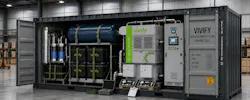
The company says its mobile one-megawatt power source, built around their HOG (Hydrogen Oxygen Generator), is designed to be pre-filled with about 500 gallons of water at the factory and operate without external water sources. The containerized generation package is called the Flying Pig, and has a modular design that allows for increased power generation capability. The company states that the system is an easily deployable, long-term hydrogen power generation platform, running a controlled, closed-loop environment.
The announcement is notable because it reflects the widening search for alternatives to standard utility service and diesel backup. Florida’s data center discussion, as described in the release, included concerns about energy, water, and community resources. That is precisely where AI infrastructure debates are heading across the country: communities are asking whether data centers will strain the grid, consume scarce water, raise rates, or require new fossil fuel generation development.
VIVIFY is positioning its system as a lower-impact bridge technology; a way to support high-demand infrastructure while reducing strain on existing utilities. The company also says the closed-loop hydrogen system is nearing deployment.
As with any new technology there are still questions that need to be answered before it can be deployed for broad data center use: fuel-cycle efficiency, cost per MWh, maintenance requirements, emissions profile, permitting, safety standards, scalability beyond 1 MW modules, and how the system performs under continuous critical-load conditions. But the appearance of new technologies shows that power innovation for data centers is no longer confined to utility-scale renewables, natural gas turbines, batteries, or nuclear. The energy demand has made alternatives more palatable to the industry and worth investigating.
Flex and EP²: The Electrical Supply Chain Becomes Strategic Infrastructure
Flex’s acquisition of Electrical Power Products, or EP², highlioghts the supply chain for electrical control, protection, and modular power systems and its importance to data center development. Flex says the acquisition expands its Critical Power portfolio with engineered-to-order electrical power control and protection capabilities, strengthens its utility and power generation market presence, and supports growth driven by grid modernization, electrification, data center demand, and U.S. reshoring.
Des Moines based EP² brings more than 35 years of experience designing and manufacturing control and relay panels, along with modular integrated control buildings. Flex says EP² will support utility, power generation, and data center customers, and the business will be integrated into Flex’s Embedded and Critical Power segment.
This supply chain deal directly addresses a major limiting factor for power. The issue has become not only whether power can be generated, but also whether switchgear, transformers, relays, control buildings, busways, protection systems, and power management equipment can be designed, manufactured, delivered, and commissioned on the timelines developers require.
Flex’s announcement also explicitly connects the acquisition to data center deployment in the AI era, saying the company is helping customers address power, heat, and scale challenges through power and cooling technology and scalable IT infrastructure. Revathi Advaithi, Chief Executive Officer of Flex described the move:
"This acquisition strengthens our Critical Power platform and supports our strategy to meet growing demand for resilient electrical infrastructure. EP²'s engineering expertise, customer focused culture, and utility grade solutions further enhance our power portfolio."
That language places Flex in the middle of a fast-changing market. AI facilities are moving toward higher rack densities, more complex backup architectures, more liquid cooling, and, behind it all, more sophisticated power distribution. Standardized equipment can help, but many deployments still require engineered-to-order solutions, particularly when power systems must be integrated into modular buildings, utility interconnections, or behind-the-meter generation sites.
Cerberus and S+S Industries: Busbars and Metalwork Become AI Bottleneck Assets
Cerberus Capital Management’s planned strategic investment in S+S Industries is another sign that the capital markets are moving deeper into the electrical backbone of data centers. S+S, based in Houston, serves OEM customers that supply power distribution equipment to hyperscale, colocation, and enterprise data center operators. The company manufactures and distributes copper and aluminum busbars and provides plating, coating, fabrication, kitting, finishing, and scrap recycling services for high-power electrical applications.
In the AI factory era, companies responsible for these components become part of the critical path. Busbars and related components are central to moving large amounts of current through power distribution systems. As AI rack densities rise and facilities require more robust electrical pathways, the physical metalwork of power distribution becomes increasingly important.
Cerberus is investing in that trend. The release says S+S has exposure to leading hyperscalers and key data center hubs, and that the company plans to expand through manufacturing capacity, operational capabilities, and long-term strategic initiatives. Cerberus also describes S+S’s solutions as central to the electrical backbone of modern data centers with Michael Buchbinder, Managing Director at Cerberus, stating:
“S+S’s solutions are central to the electrical backbone of modern data centers, and its critical solutions and execution track record set it apart in the industry. Demand for data center infrastructure continues to surge, and the Company is well positioned to scale alongside it to support this critical buildout.”
This deal follows the industry trend shown in the Flex/EP² acquisition. One transaction targets engineered control and protection systems; the other targets high-power conductive components and value-added services around them. The clarity here is that data center growth is creating investable demand not just for chips and campuses, but for the industrial companies that make the electrical buildout possible.
AZIO AI and EVTV: EV maker to AI infrastructure
After multiple announcements of deals between the two companies, and the end of May, they decided a corporate merger was in order. The AZIO AI–EVTV merger turns Envirotech Vehicles Inc., from an electric-vehicle company into a prospective power-backed AI infrastructure and data center platform. The core impact is not just an increase in AI servers; it is the combination of compute hardware, controlled land, behind-the-meter power, fiber, modular deployment, and cooling validation building on the AI data center growth story.
AZIO describes the deal as part of EVTV’s strategic transformation into an AI infrastructure and compute platform focused on domestic AI deployment, data center operations, and long-term compute capacity expansion.
For data center ambitions, the most important element is power access. AZIO and EVTV say about 11 MW of power capacity has been identified at EVTV’s existing site, with hardware orders placed for an initial 6 MW deployment. They are also discussing long-term rights tied to as much as 500 MW of additional same-site capacity. That matters because AI data center development is increasingly constrained by power availability rather than just real estate or server supply. And with the modular infrastructure the company develops, having that power availability is the key to future site growth.
EVTV later said it had expanded its controlled development footprint to more than 548 acres, secured dedicated fiber for current and future operations, and was advancing natural gas interconnection work. The company described the platform as engineered to support up to 500 MW of planned behind-the-meter power capacity. With the combined company the planning shows a very current approach; secure the site and power stack first, then layer in compute, fiber, cooling, hosting, and customer offtake.
The merger also broadens the business model. After closing, the company expects revenue from GPU and server rack sales, co-developed AI data center infrastructure, company-operated bitcoin mining, and hosting or compute leasing as sites become operational. Note that the merger still requires SEC and shareholder approval.
AI Data Centers Are Driving a Power Architecture Reset
While these announcements cover different layers of the market, together they describe a new AI data center power stack, or at least an industry willingness to examine new solutions and business models to support what has become the standard development path for an energy-hungry AI data center.
At the top are large-scale energy platforms such as the Hitachi/X LABS energy park model, where power generation, storage, grid stabilization, and data center demand are planned together from the beginning. These are long-cycle, capital-intensive projects aimed at the gigawatt era.
At the facility level are operators such as DataBank, using rooftop solar to hedge electricity costs, reduce emissions exposure, and turn existing data center real estate into a source of on-site generation. These projects will not power AI campuses alone, but they improve the operating profile of facilities in constrained markets.
At the technology edge are companies like VIVIFY, proposing alternative power systems such as closed-loop hydrogen platforms that may offer modularity, reduced water draw, and grid independence if they can be proven at scale.
In the supply chain are Flex/EP² and S+S Industries, where the strategic value lies in the hardware required to control, protect, distribute, and physically carry power through increasingly dense infrastructure. Without that equipment, generation and compute cannot be connected at scale.
And at the modular deployment layer are AZIO AI and EVTV, where the strategy is to pair dedicated behind-the-meter generation with high-density AI compute in increments measured in megawatts rather than gigawatts.
The consistent message this range of power related announcement send is the same one we are seeing throughout the AI-demand driven development cycles. More controllable power, closer to the load, delivered through supply chains that can scale quickly enough to meet AI demand.
About the Author
 David Chernicoff