Power First: AI Data Centers Become Energy Systems
Key Highlights
- Data centers are increasingly responsible for their own energy systems, integrating natural gas, fuel cells, batteries, and controls to support growing AI workloads.
- Onsite generation is shifting from backup to primary power, with modular systems enabling incremental capacity and flexible campus energization.
- Reliability strategies are evolving to manage AI-specific transient loads, requiring layered architectures that balance fast-responding UPS with generation and redundancy.
- Hybrid power models allow data centers to accelerate deployment, reduce dependence on utility timelines, and potentially support broader grid stability through demand response.
- Water use considerations are integrated into power system design, favoring closed-loop cooling and water-efficient generation technologies to reduce environmental impact.
For decades, data centers consumed electricity much like other large commercial customers: power arrived from the utility, while batteries and diesel generators stood behind it to protect the load. AI is starting to break that model.
As data center campuses grow toward hundreds of megawatts and, in some cases, gigawatt scale, developers are increasingly taking responsibility for an energy system that once sat largely outside the data center boundary. Natural gas supply, onsite generation, fuel cells, batteries, controls and the behavior of the compute load itself are increasingly becoming parts of the same infrastructure system.
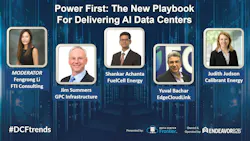
That was the central thread running through “Power First: The New Playbook for Delivering AI Data Centers,” an Aug. 4 session at the Data Center Frontier Trends Summit 2026 in Reston, Virginia.
Moderated by Fengrong Li, Senior Managing Director at FTI Consulting, the panel brought together Jim Summers, CEO of GPC Infrastructure; Shankar Achanta, EVP and Chief Product and Technology Officer at FuelCell Energy; Judith Judson, Executive Vice President at Calibrant Energy; and Yuval Bachar, Founder and CEO of EdgeCloudLink.
The discussion began with the immediate constraint — the grid cannot deliver capacity on the timetable AI developers increasingly require — but quickly moved beyond the familiar concept of “bridge power.”
The larger question was what happens when the data center itself becomes an energy system.
From Backup Power to Prime Power
Behind-the-meter generation is not new. What has changed is its role and scale.
“Traditionally, behind-the-meter generation has been for backup and the sizes were smaller,” Achanta said. “But what they’re seeing is the demand for the power is growing rapidly due to the data center load.”
Interconnection queues, transmission limitations and equipment supply constraints are pushing onsite generation into what Achanta called the “front seat,” supplying primary power rather than waiting behind the utility.
FuelCell Energy, for example, builds around modular 2.5 MW units and adds capacity incrementally. Achanta said customer discussions that once centered on roughly 10 MW are now reaching into the hundreds of megawatts.
That modularity changes more than plant size. Developers can energize portions of a campus while additional generation is still being installed, giving them another tool for managing schedule risk.
Li said she had recently toured a behind-the-meter project under construction in Texas at gigawatt scale, illustrating how far the concept has moved from its earlier role as a niche alternative.
But Achanta pushed against one increasingly common label for these projects: bridge power. “We don’t see it that way,” he said.
Once customers have operationalized onsite generation, he argued, those assets are unlikely simply to disappear when grid service arrives. They become part of the permanent power portfolio.
Bachar made the argument more starkly. The growth rate of the grid, he said, is no longer synchronized with either data center construction or the pace at which companies such as NVIDIA are changing the underlying compute technology.
In California, he said, developers can face utility-power timelines measured in years. “In seven years, this is not a relevant discussion,” Bachar said. “It’s just meaningless for us.”
His distinction was between two emerging versions of behind-the-meter infrastructure. At very large campuses, operators may effectively build a power station alongside the data center. At smaller facilities, generation can instead be distributed across isolated blocks, reducing the consequence of a failure in any single portion of the system.
That second model could become increasingly important as AI infrastructure expands beyond giant training campuses.
Bachar argued that the industry ultimately needs to solve not only the 1 GW campus in a rural power market, but the 25 MW to 35 MW inference site closer to cities and users. Those locations introduce their own constraints — air permits, noise, natural gas access and scarce utility capacity — while leaving developers less room to solve them.
The harder behind-the-meter problem may eventually be not just how to power a gigawatt campus in Texas, but how to deliver several dozen megawatts of AI capacity close to the markets where inference demand emerges.
Reliability Changes With the Load
Moving generation behind the meter also changes the reliability equation. Achanta noted that utility service is generally engineered to a lower availability level than the four or five nines expected from critical data center infrastructure.
Traditionally, operators have closed that gap with UPS systems and diesel backup. But simply reproducing every layer of the traditional architecture behind the meter could become prohibitively expensive.
“If you design your prime generation to meet all five nines, it’ll be extremely expensive,” Achanta said.
His preferred approach is what FuelCell Energy calls a layered architecture: handle the fastest load transients close to the compute through UPS systems or batteries, then work backward through generation and redundancy rather than overbuilding every component independently.
“Creating a grid behind the meter with all the Lego blocks that you have,” Achanta said.
Summers divided the reliability problem into two separate categories. The first is familiar: a forced outage in the generation fleet. The second is increasingly specific to AI: transient load management.
In a conventional environment, power consumption moves within reasonably predictable boundaries. AI training workloads can behave very differently.
“In an AI training scenario, that power may go from hundreds of megawatts to zero within milliseconds,” Summers said.
That creates a challenge not merely for utility infrastructure, but for turbines, reciprocating engines, batteries and the controls tying them together. It also changes how developers think about equipment size.
“If I put a 300-megawatt GE Frame 7 turbine, when that thing goes offline, half my data center just went out,” Summers said. “If I’m putting small reciprocating engines, and I lose one, you’re not going to notice.”
Upstream fuel reliability becomes another part of the same calculation. A natural-gas plant may be technically redundant yet still vulnerable if the project has not secured sufficiently firm gas transportation.
The result is a much broader definition of reliability encompassing prime mover selection, fuel contracts, transient management, controls, maintenance and physical redundancy.
Bachar argued that the industry now has an opportunity to reconsider the backup model entirely.
EdgeCloudLink favors what he described as an active-active architecture, in which generation and storage resources are continuously operating rather than leaving major assets idle until an outage occurs.
That approach also addresses one of the emerging implications of gigawatt-scale campuses: gigawatt-scale backup.
“If you have one gigawatt site and it drops it for eight hours, and let’s say you have a diesel gen backup, you activate the backup system,” Bachar said. “You know how long it’s gonna take to refuel eight hours of diesel?”
The question is increasingly whether the industry should maintain the traditional hierarchy of primary power followed by dormant backup, or design a system in which multiple resources continuously share the job.
Summers similarly left the diesel question open. “If you have a gigawatt campus, are you going to have a gigawatt of diesel generation?” he asked. “Is that logistically feasible?”
For now, he said, the industry is still wrestling with the answer.
Between the Grid and the Island
Yet the panel did not arrive at a simple conclusion that data centers should abandon the grid. In practice, the more likely architecture appears to sit somewhere between complete utility dependence and full islanding.
Li pushed the hybrid concept a step further, asking whether large data center operators could eventually function as a kind of “grid healing agent” — using behind-the-meter generation, storage and flexible load not only to protect their own operations, but to support the wider power system when capacity is available. In that model, onsite infrastructure becomes more than insurance against a constrained grid; it becomes a dispatchable resource that can help manage peaks, provide demand response and potentially create additional economic value for the data center.
Summers described the notion of complete utility dependence vs. full islanding as opposite ends of a spectrum.
Utility-only development remains constrained by aging transmission and generation infrastructure colliding with demand growth the system was not designed to absorb. Fully islanded infrastructure can solve time-to-power, but it creates an energy asset that may ultimately have value to the grid as well.
Summers argued that data centers are moving from being retail electricity customers toward behaving more like major industrial energy consumers. Historically, data centers could simply buy electricity through the local utility. As facilities have grown larger, he said, they have begun to resemble refineries, pulp and paper facilities and other major industrial users that have long managed substantial portions of their own energy supply.
That transition reaches far upstream. Developers must increasingly understand where fuel comes from, how it is transported and treated, how generation technology is selected, how equipment is financed, and how capital can be committed before a tenant is secured.
Projects GPC is working on, Summers said, range from roughly 50 MW to more than a gigawatt, and “there’s always an element of a grid component.”
“It may not be on day one,” he said. “We may not be entirely clear how it integrates, but it’s part of the solution.”
Summers compared the emerging model with cogeneration at refineries, chemical plants and other large industrial facilities, where onsite generation has long operated alongside the bulk power system.
The harder problem may be regulation. Rules being written today are largely attempts to manage reliability problems created by unprecedented load growth.
Summers argued that those rules will eventually need to evolve so onsite power can both meet the operational needs of the data center and become a useful resource to the broader grid.
“It’s going to be painful, I think, before we get all that sorted,” he said. “But I think that’s where we’re headed, is a fully integrated system.”
Judson said the economics of hybrid systems are already moving beyond conventional demand-response revenue. Calibrant worked on a Pacific Northwest data center project where onsite battery capacity allowed the facility to connect to the grid four years earlier than would otherwise have been possible.
That acceleration can be worth considerably more than payments earned by occasionally reducing demand. “Speed means revenue more quickly for that compute capacity,” Judson said.
Consider a 500 MW campus that can initially secure only 300 MW from the utility. If batteries or onsite generation allow the site to reduce consumption to 300 MW during constrained periods, it may be able to operate closer to its full 500 MW capacity through much of the year. Demand flexibility, in that case, becomes a capacity-development tool.
Achanta offered another version of the hybrid case. Even if a 100 MW project receives only 25 MW from the utility and builds the remaining 75 MW behind the meter, that modest grid connection can materially simplify the architecture. Batteries can be smaller. The grid connection itself can absorb some of the variability. Load shifting and energy-management software can coordinate the pieces.
“You use the grid as a battery,” Achanta said. That increasingly requires cooperation far beyond the generation vendor. FuelCell Energy recently announced work with Siemens intended to integrate the electrical architecture from prime generation toward the rack.
“We need to solve this as a whole, not just individual silos,” Achanta said.
AI Can Stress the Grid in Reverse
Hybrid systems introduce another complication. Data centers are commonly discussed as a threat to grid reliability because of how much power they consume. Bachar emphasized the opposite problem: what happens when an enormous load suddenly stops consuming?
Bachar pointed to a recent Virginia grid disturbance, saying data centers rapidly shifted away from utility power and removed hundreds of megawatts of load.
“What will happen if you’re on ERCOT, which is an island, and suddenly there is a fluctuation on the power and like 5 gigawatts gets off the grid in like milliseconds?” Bachar asked.
The point was less the exact hypothetical than the behavior it describes. A data center designed to protect its service-level agreements may switch away from troubled utility power almost instantly. At sufficient scale, that protective action itself becomes something grid operators must plan around.
More transmission and generation alone will not solve that problem, Bachar argued. Grid operations and the coordination between large computational loads and generation will also have to change.
That makes hybrid architecture more complicated than simply connecting an onsite plant to a utility feed. “You have to be very smart on how you do the hybrid,” Bachar said.
Judson similarly framed large computational loads as something that increasingly has to be managed as part of the power system rather than simply attached to it.
The emerging question is not just how the grid provides reliable service to the data center, but how the data center behaves when the grid itself is under stress.
Power, Cooling and Water Become One Design Problem
The same systems approach extends into cooling and water. Bachar argued that many new AI facilities are moving toward closed-loop liquid cooling systems with much lower operational water requirements than older evaporative designs.
Achanta said some fuel-cell technologies can even produce water through their electrochemical process, and suggested that onsite generation should be compared with the water consumed upstream by utility generation rather than considered in isolation.
Judson added that batteries themselves consume essentially no operational water, making storage-plus-generation architectures another option for reducing water use across the power system.
Summers urged a more nuanced calculation. Before founding GPC, he helped build H2O Midstream, which managed water infrastructure in the Permian Basin. His experience made him wary of treating water use as a simple technology scorecard.
Combined-cycle power plants use water to make steam, he noted, but they also extract more electricity from their fuel. A system selected primarily to avoid water may therefore introduce other efficiency tradeoffs.
“If we’re making choices from an optics perspective because it looks like it’s a sustainable solution, but we’re actually doing something so much less efficiently that we’re causing more energy to be used elsewhere, is that really the right balance?” Summers said.
The answer, he argued, requires examining water, energy efficiency, reuse and environmental impact across the full system.
The Last Constraint May Be Dependency
The panel closed with a problem familiar to developers attempting to turn ambitious power strategies into financed projects.
Major infrastructure must often be committed before a hyperscaler is willing to sign. Yet the interconnection work, gas laterals and generation equipment needed to establish a credible path to power can require hundreds of millions of dollars.
That creates a circular problem: developers need customer credit to finance the power, while customers want to see a credible power path before committing. Summers reduced the solution to one word: transparency.
“Laying your cards on the table, working alongside to solve these problems,” he said. “These are complex problems. They’re evolving. They require trust. They require partnership.”
If a hyperscaler wants to manage that complexity itself, Summers said, it needs to build an experienced team capable of understanding the full energy value chain. Otherwise, the better path may be to find partners willing to develop technical and commercial structures collaboratively.
Achanta similarly argued that developers and providers have to expose the full system requirements early: grid availability, generation, load characteristics and the actual use case. “This is a system solution,” he said.
Judson added the capital structure. Energy-as-a-service and tolling arrangements can help prevent a developer from carrying all of the stranded-asset risk before a tenant is secured.
Bachar put the lesson another way: reduce external dependencies wherever possible. “The lower number you have over there, the higher chances to succeed,” he said of the contractors, suppliers and organizations involved in a data center build.
That may ultimately be the defining feature of the power-first model. AI infrastructure has pushed power upstream in the development process, but simply securing generation is not enough. Fuel, electrical architecture, storage, cooling, compute behavior, regulation, capital and grid interaction increasingly have to be considered together.
What is emerging behind the meter is not a substitute utility so much as a new kind of data center architecture. The projects most likely to reach operation may be the ones that treat power not as another utility connection to procure, but as part of the data center architecture itself.
At Data Center Frontier, we talk the industry talk and walk the industry walk. In that spirit, DCF Staff members may occasionally use AI tools to assist with content.
Keep pace with the fast-moving world of data centers and cloud computing by connecting with Data Center Frontier on LinkedIn, following us on X/Twitter and Facebook, as well as on BlueSky, and signing up for our weekly newsletters using the form below.
About the Author
 Matt Vincent
Matt Vincent
Matt Vincent is Editor in Chief of Data Center Frontier, where he leads editorial strategy and coverage focused on the infrastructure powering cloud computing, artificial intelligence, and the digital economy. A veteran B2B technology journalist with more than two decades of experience, Vincent specializes in the intersection of data centers, power, cooling, and emerging AI-era infrastructure. Since assuming the EIC role in 2023, he has helped guide Data Center Frontier’s coverage of the industry’s transition into the gigawatt-scale AI era, with a focus on hyperscale development, behind-the-meter power strategies, liquid cooling architectures, and the evolving energy demands of high-density compute, while working closely with the Digital Infrastructure Group at Endeavor Business Media to expand the brand’s analytical and multimedia footprint. Vincent also hosts The Data Center Frontier Show podcast, where he interviews industry leaders across hyperscale, colocation, utilities, and the data center supply chain to examine the technologies and business models reshaping digital infrastructure. Since its inception he serves as Head of Content for the Data Center Frontier Trends Summit. Before becoming Editor in Chief, he served in multiple senior editorial roles across Endeavor Business Media’s digital infrastructure portfolio, with coverage spanning data centers and hyperscale infrastructure, structured cabling and networking, telecom and datacom, IP physical security, and wireless and Pro AV markets. He began his career in 2005 within PennWell’s Advanced Technology Division and later held senior editorial positions supporting brands such as Cabling Installation & Maintenance, Lightwave Online, Broadband Technology Report, and Smart Buildings Technology. Vincent is a frequent moderator, interviewer, and keynote speaker at industry events including the HPC Forum, where he delivers forward-looking analysis on how AI and high-performance computing are reshaping digital infrastructure. He graduated with honors from Indiana University Bloomington with a B.A. in English Literature and Creative Writing and lives in southern New Hampshire with his family, remaining an active musician in his spare time.
Voices of the Industry
 Image courtesy of Midea Building Technologies