Harnessing Gravity: RRPT Hydro Reimagines Data Center Power




At the 2025 Data Center Frontier Trends Summit, amid panels on AI, nuclear, and behind-the-meter power, few technologies stirred more curiosity than a modular hydropower system without dams or flowing rivers. That concept—piston-driven hydropower—was presented by Expanse Energy Corporation President and CEO Ed Nichols and Chief Electrical Engineer Gregory Tarver during the Trends Summit's closing "6 Moonshots for the 2026 Data Center Frontier" panel.
Nichols and Tarver joined the Data Center Frontier Show recently to discuss how their Reliable Renewable Power Technology (RRPT Hydro) platform could rewrite the economics of clean, resilient power for the AI era.
A New Kind of Hydropower
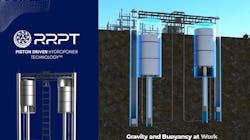
Patented in the U.S. and entering commercial readiness, RRPT Hydro’s system replaces flowing water with a gravity-and-buoyancy engine housed in vertical cylinders. Multiple pistons alternately sink and rise inside these cylinders—heavy on the downward stroke, buoyant on the upward—creating continuous motion that drives electrical generation.
“It’s not perpetual motion,” Nichols emphasizes. “You need a starter source—diesel, grid, solar, anything—but once in motion, the system sustains itself, converting gravity’s constant pull and buoyancy’s natural lift into renewable energy.”
The concept traces its roots to a moment of natural awe. Its inventor, a gas-processing engineer, was moved to action by the 2004 Boxing Day tsunami, seeking a way to “containerize” and safely harvest the vast energy seen in that disaster. Two decades later, that spark has evolved into a patented, scalable system designed for industrial deployment.
Physics-Based Power: Gravity Down, Buoyancy Up
Each RRPT module operates as a closed-loop hydropower system:
- On the downstroke, pistons filled with water become dense and fall under gravity, generating kinetic energy.
- On the upstroke, air ballast tanks lighten the pistons, allowing buoyant forces to restore potential energy.
By combining gravitational and buoyant forces—both constant, free, and renewable—RRPT converts natural equilibrium into sustained mechanical power.
The resulting energy can be converted to electricity through standard turbines, without combustion, rare earths, or reliance on sunlight or wind conditions.
Modular Design for AI Infrastructure
RRPT Hydro’s system was engineered from the start for scalability and modularity—two traits prized by data center developers. Each installation can range from 15 kW to 1 GW, with the latter designed for underground or aboveground installation depending on land availability.
- 1–50 MW plants can be operational within 3–6 months.
- 1 GW facilities are projected to deploy in about 18 months.
Units can be buried underground beneath data centers for resiliency and land optimization—ideal for regions like Loudoun County—or sited above ground in desert or industrial zones.
Nichols says the modular “plug-and-play” architecture is tailored to power-intensive digital infrastructure: “A hyperscale data center could literally sit on top of its own power source—off-grid, resilient, and green.”
Economics That Defy Convention
At the heart of RRPT Hydro’s promise lies its extraordinary Levelized Cost of Energy (LCOE): $3.50 per megawatt-hour—orders of magnitude below traditional and renewable generation sources, including solar, wind, nuclear, or even theoretical fusion.
That cost is derived from the technology’s reliance on fundamental natural forces: “Gravity doesn’t fluctuate, and buoyancy doesn’t degrade,” Tarver notes. “Once installed, the energy cost curve is flat for centuries.”
If achieved, such economics could transform the data center power equation, enabling behind-the-meter generation where operators not only power their own loads but sell excess energy back to the grid, supporting local communities and offsetting regional strain.
Commercialization and Technical Hurdles
RRPT Hydro is progressing through the final stages of Technical Readiness Levels (TRLs 4–8), with ambitions to reach TRL 9 and construct a 1 MW pilot plant within 12–15 months—pending financing.
A central manufacturing challenge lies in turbine production: existing hydropower suppliers aren’t configured for the modular, high-volume blade output this model demands. Nichols frames this as an opportunity: “There’s an open lane for manufacturing partners to build the next generation of hydropower components.”
The team also notes the educational challenge ahead: as with early flight pioneers, explaining a paradigm shift in energy often means confronting disbelief. “It’s our Wright Brothers moment,” says Nichols. “We’ve proven the physics; now we’re proving the scale.”
From Concept to Collaboration
The company envisions partnering with data center operators facing grid constraints or regulatory headwinds. The idea: deploy RRPT modules behind the meter to achieve resilient, self-powered facilities with zero emissions and calculable performance.
“Every community conversation about power draw and infrastructure stress can change tone,” says Tarver. “Instead of consuming grid power, data centers could contribute it.”
Nichols adds that RRPT Hydro is open to multinational partnerships—especially those with deep engineering or fabrication capacity—to accelerate both small (sub-15 kW) and large (>1 GW) deployments.
Synergies with cooling systems are already being explored, integrating energy generation and thermal management.
The Road Ahead
The next phase for RRPT Hydro includes:
- Securing financial partnerships to construct the 1 MW pilot plant.
- Advancing to TRL 7–8 for commercial validation.
- Expanding turbine blade manufacturing capacity.
With those milestones achieved, the company believes it can offer the world’s first modular, gravity-and-buoyancy-driven hydropower system—a new clean-energy category at a time when the data center industry’s appetite for innovation has never been greater.
The Power of Gravity
As data center energy demand surges toward the AI supercycle, RRPT Hydro offers a provocative rethinking of renewable baseload generation.
If Nichols and Tarver are right, the next great leap in clean power may not come from fusion, hydrogen, or SMRs, but from a simple truth as old as the planet itself: gravity always wins.
At Data Center Frontier, we talk the industry talk and walk the industry walk. In that spirit, DCF Staff members may occasionally use AI tools to assist with content. Elements of this article were created with help from OpenAI's GPT5.
Keep pace with the fast-moving world of data centers and cloud computing by connecting with Data Center Frontier on LinkedIn, following us on X/Twitter and Facebook, as well as on BlueSky, and signing up for our weekly newsletters using the form below.
About the Author

Matt Vincent
Matt Vincent is Editor in Chief of Data Center Frontier, where he leads editorial strategy and coverage focused on the infrastructure powering cloud computing, artificial intelligence, and the digital economy. A veteran B2B technology journalist with more than two decades of experience, Vincent specializes in the intersection of data centers, power, cooling, and emerging AI-era infrastructure. Since assuming the EIC role in 2023, he has helped guide Data Center Frontier’s coverage of the industry’s transition into the gigawatt-scale AI era, with a focus on hyperscale development, behind-the-meter power strategies, liquid cooling architectures, and the evolving energy demands of high-density compute, while working closely with the Digital Infrastructure Group at Endeavor Business Media to expand the brand’s analytical and multimedia footprint. Vincent also hosts The Data Center Frontier Show podcast, where he interviews industry leaders across hyperscale, colocation, utilities, and the data center supply chain to examine the technologies and business models reshaping digital infrastructure. Since its inception he serves as Head of Content for the Data Center Frontier Trends Summit. Before becoming Editor in Chief, he served in multiple senior editorial roles across Endeavor Business Media’s digital infrastructure portfolio, with coverage spanning data centers and hyperscale infrastructure, structured cabling and networking, telecom and datacom, IP physical security, and wireless and Pro AV markets. He began his career in 2005 within PennWell’s Advanced Technology Division and later held senior editorial positions supporting brands such as Cabling Installation & Maintenance, Lightwave Online, Broadband Technology Report, and Smart Buildings Technology. Vincent is a frequent moderator, interviewer, and keynote speaker at industry events including the HPC Forum, where he delivers forward-looking analysis on how AI and high-performance computing are reshaping digital infrastructure. He graduated with honors from Indiana University Bloomington with a B.A. in English Literature and Creative Writing and lives in southern New Hampshire with his family, remaining an active musician in his spare time.
Voices of the Industry