How Robotics Is Re-Engineering Data Center Construction and Operations
Key Highlights
- Construction robotics, such as fleet-capable drilling systems, significantly reduce build timelines and improve precision, addressing critical bottlenecks in data center slab work.
- Operational robotics are increasingly integrated with monitoring systems, performing tasks like patrols, environmental sensing, and remote assistance, with a focus on low disruption and high ROI.
- Physical AI, including simulation, perception pipelines, and foundation models, enables robots to adapt to complex, variable environments, facilitating tasks like inspection, manipulation, and verification.
- A phased roadmap for robotics adoption in data centers includes construction acceleration, sensing and patrol, manipulation tasks, and future facility designs optimized for robotic work.
- Emerging innovations, such as robotic microfactories for e-waste recycling, highlight the expanding role of robotics across the entire data center lifecycle, emphasizing robotics as essential infrastructure.
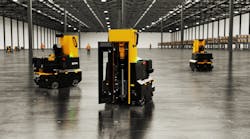
Currently data center development is being shaped by two converging pressures. Hyperscalers need capacity delivered faster than conventional construction labor and sequencing can reliably support; while operations teams are being asked to run higher-density, more complex facilities under tighter uptime, safety, and staffing constraints.
Robotics is one of the few levers capable of addressing both (compressing build schedules while reducing human exposure to repetitive, hazardous, or error-prone work), especially when paired with physical AI (robot perception and learning) and facility-level digital twins.
Three recent announcements illustrate where the market is heading:
-
Construction robotics moves onto the critical path. DEWALT and August Robotics target one of the most schedule-sensitive bottlenecks in data center construction: high-volume, precision drilling in concrete slabs.
-
Operations robotics becomes a platform story. Market forecasts increasingly frame robotics as part of broader smart-infrastructure stacks (integrated with IoT, monitoring, and control systems) and delivered via robotics-as-a-service (RaaS) to improve flexibility and ROI.
-
Physical AI makes robots adaptable, not just automated. A collaboration between Multiply Labs and NVIDIA highlights a reusable robotics stack involving simulation and digital twins, perception pipelines, and foundation models that is well suited to the variable, safety-critical environments found in data centers.
Construction: Robotics Moves Onto the Critical Path
At hyperscale scale, the slab functions like a factory floor. Data center builds require thousands of precisely placed holes for server rack stops and for the structural legs and supports that carry overhead MEP systems. When drilling slips or when holes miss even narrow tolerances, downstream trades begin to stack up: racks, busway, cable tray, cooling distribution, containment, and ultimately final commissioning.
Fleet-capable drilling targets the bottleneck
DEWALT (Stanley Black & Decker) and August Robotics have announced what they describe as the world’s first downward-drilling, fleet-capable robot aimed directly at this constraint. In a pilot with a leading hyperscaler, the system reportedly:
-
Drilled more than 90,000 holes with 99.97% accuracy in both location and depth.
-
Operated up to 10× faster than traditional methods.
-
Reduced construction timelines by roughly 80 weeks across 10 data center projects.
What’s notable is how DEWALT frames the effort; not as a standalone automation novelty, but as part of a broader data center construction ecosystem that includes tools, dust and vibration mitigation, and anchoring systems. This is not a humanoid robot performing a staged demonstration. It is a purpose-built system focused on a high-volume, repeatable task where small errors compound and delays ripple across the schedule.
The real differentiator is scale. Fleet orchestration is what makes this model viable: the winning construction robots in data centers will not be one robot per job, but coordinated robot crews operating like a specialized trade across the slab footprint.
Bill Beck, President of Tools & Outdoor at Stanley Black & Decker, framed the opportunity this way:
Across the globe, hyperscalers, which account for nearly 80% of overall data center demand are investing in infrastructure to power AI computing, with an estimated industry-wide capital expenditure of $7 trillion in data centers by 2030. Our customers consistently emphasize that speed of construction is critical. The robotic drilling solution meets this need head-on through schedule acceleration, cost savings, near-perfect accuracy and enhanced jobsite safety. DEWALT's relentless pursuit of innovation to drive productivity is redefining how the world builds.
What Comes Next: The Robotic Slab Line and Automated QA
Once drilling is automated at fleet scale, adjacent tasks naturally move into the automation orbit. What emerges is not a single robot, but a coordinated “robotic slab line,” where layout, execution, and verification begin to converge.
Key follow-on applications include:
-
Autonomous layout and verification: Scanning and marking the slab, then comparing as-built conditions against BIM models in near real time.
-
Anchoring and fastening automation: Once holes are placed, repeatable installation with torque verification and QA capture becomes the next logical step.
-
Inspection robotics: Mobile platforms that validate penetrations, labeling, and coordinate integrity continuously—before downstream trades arrive on site.
The real prize is not simply drilling faster. It is eliminating rework. By producing a machine-readable audit trail (location, depth, torque, timestamp) robotic systems can turn slab work into verifiable data that feeds directly into commissioning documentation, reducing errors long before they cascade into schedule risk.
Operations: Robotics Moves Toward “Smart Hands” and Perception
A recent market note from ResearchAndMarkets captures the operational drivers pushing robotics into live data center environments. Rising facility complexity, combined with AI-assisted monitoring and automation, is accelerating interest in robotics for maintenance, security, and day-to-day operational efficiency.
The report points to practical use cases already under evaluation or early deployment, including hardware installation assistance, server and environmental monitoring, and aspects of cable management: tasks that are repetitive, time-consuming, and increasingly difficult to staff consistently in high-density facilities.
The report states:
The increasing complexity of data center operations, coupled with the rise of artificial intelligence (AI) and automation, has led to the adoption of robotics to streamline maintenance, security, and operational efficiency. Data center robotics are being utilized to automate routine tasks such as hardware installation, server monitoring, and cable management, reducing the need for human intervention and minimizing operational risks.
What Data Center Robotics Looks Like in Practice Today
In live data center environments, the near-term robotics winners tend to share three traits: low disruption risk, clear return on investment, and compatibility with existing operational workflows.
Near-term, high-confidence use cases
-
Autonomous inspection routes: Repeatable patrols for thermal and visual checks, leak detection, and early anomaly identification.
-
Environmental micro-mapping: Rack-row–level airflow, temperature, and humidity sensing, correlated with workload placement and cooling controls.
-
Security patrol augmentation: Predictable routes, sensor fusion, and rapid alarm verification to reduce false positives and response time.
-
Remote-hands assistance: Teleoperated robots handling simple interactions (buttons, levers, doors) while perception and manipulation capabilities continue to mature.
High-value applications that remain difficult
Some operational tasks offer enormous upside but remain challenging with today’s robotics capabilities:
-
Cabling and patching: Fundamentally a dexterity and perception problem, with high payoff but significant risk, since even small errors can cause outages.
-
Automated server component swaps: More feasible in purpose-built, robot-friendly rack designs; far harder in mixed or legacy footprints.
-
Robotic cleaning and contamination control: Particularly complex in high-density, liquid-cooled environments, where leak risk and slip hazards increase.
Robotics adoption in operations is as much about preparing the facility as it is about deploying the robot. Clearances, fiducials, lighting, labeling, and consistent rack geometry all matter. As standardized designs increasingly define the future of data centers, folding robot requirements into those standards becomes a logical next step rather than a speculative bet.
Fred Parietti, co-founder and CEO of Multiply Labs, described the value of robotics this way:
Advanced biomanufacturing is one of the highest value applications for robots. That puts us in a fortunate position to be able to invest in the most cutting-edge robotic technologies that exist. By combining our robotic approach to biomanufacturing with NVIDIA’s state-of-the-art simulation, perception, and foundation model technologies, we accelerate development and unlock the next level of scalability for hardware and software systems, driving our robots towards broader patient impact.
Physical AI: A Reusable Robotics Stack for Data Center Operations
This is where the recent collaboration between Multiply Labs and NVIDIA becomes relevant, even though the application is biomanufacturing rather than data centers.
Multiply Labs has outlined a robotics approach built on three core elements:
-
Digital twins using NVIDIA Isaac Sim to model hardware and validate changes in simulation before deployment.
-
Foundation-model-based skill learning via NVIDIA Isaac GR00T, enabling robots to generalize tasks rather than rely on brittle, hard-coded behaviors.
-
Perception pipelines including FoundationPose and FoundationStereo, that convert expert demonstrations into structured training data.
Taken together, this represents a reusable blueprint for data center robotics.
Applying the Lesson to Data Center Environments
The same physical-AI techniques now being applied in lab and manufacturing environments map cleanly onto the realities of data center operations, particularly where safety, uptime, and variability intersect.
Digital-twin-first deployment
Before a robot ever enters a live data hall, it needs to be trained in simulation. That means modeling aisle geometry, obstacles, rack layouts, reflective surfaces, and lighting variation; along with “what if” scenarios such as blocked aisles, emergency egress conditions, ladders left in place, or spill events. Simulation-first workflows make it possible to validate behavior and edge cases before introducing any new system into a production environment.
Skill learning beats hard-coded rules
Data centers appear structured, but in practice they are full of variability: temporary cabling, staged parts, mixed-vendor racks, and countless human exceptions. Foundation-model approaches to manipulation are designed to generalize across that messiness far better than traditional rule-based automation, which tends to break when conditions drift even slightly from the expected state.
Imitation learning captures tribal knowledge
Many operational tasks rely on tacit expertise developed over years in the field, such as how to manage stiff patch cords, visually confirm latch engagement, or stage a component swap without risking an accidental disconnect. Turning expert demonstrations into training data allows that tribal knowledge to be encoded, shared, and eventually scaled through robotic systems.
Stepping back, this reflects a broader shift in physical AI: robots moving beyond deterministic, repetitive motion toward systems that can perceive context, adapt to change, and operate safely in dynamic, human-designed environments like the data center.
An Emerging Robotics Roadmap for AI Data Centers
Taken together, recent developments point to a phased adoption curve for robotics in data centers; one that starts with construction acceleration, moves through sensing and patrol in live facilities, and ultimately reshapes how data centers themselves are designed.
Phase 1: Construction acceleration (now)
Fleet-based drilling, exemplified by DEWALT and August Robotics, establishes the model: high-volume, repeatable, and measurable work applied directly to the construction critical path, with immediate and defensible schedule impact.
Phase 2: Operations sensing and patrol (12–24 months)
Inspection and patrol robotics move into live facilities, integrated with DCIM, BMS, and security platforms. These systems emphasize perception over manipulation and are increasingly delivered via robotics-as-a-service (RaaS) to limit operational risk and improve flexibility.
Phase 3: Manipulation in the white space (24–48 months)
Basic “smart hands” tasks progress from teleoperation toward partial autonomy as digital twins, simulation, and foundation-model skill learning mature, following the physical-AI playbook illustrated by Multiply Labs and NVIDIA.
Phase 4: Facilities designed for robots (multi-year)
Over time, data centers themselves evolve to accommodate robotics: standardized rack geometries, fiducials, robot-safe aisles, and clearly defined, robot-accessible MEP maintenance points; mirroring the path warehouses followed once automation consistently proved its return on investment.
Additional Industry Developments Worth Watching
Beyond the construction-to-operations arc described above, adjacent robotics innovation is emerging across the data center lifecycle. For example, Molg, a U.S. robotics startup that raised a $5.5 million seed round in 2024 with participation from investors including ABB Robotics and the Amazon Climate Pledge Fund, is developing robotic “microfactories” to disassemble and recycle end-of-life data center equipment and other electronics, helping operators address e-waste and material recovery at scale.
Industry research also indicates that the broader data center robotics market is expanding rapidly, with multiple forecasts pointing to double-digit compound annual growth as automation and AI adoption accelerate across installation, monitoring, handling, and lifecycle workflows.
Conclusion: Robotics as Infrastructure, Not Novelty
What’s emerging is not a sudden robotic takeover of data centers, but a steady reclassification of robotics as infrastructure. In construction, robots are earning their place by removing bottlenecks on the critical path. In operations, they are finding early footing where perception, patrol, and repeatability reduce risk without disrupting uptime.
And as physical AI matures, the boundary between scripted automation and adaptive “smart work” continues to blur. Adoption will be uneven, gated by standards, design discipline, and trust; but the direction is clear. Robotics is becoming less about replacing people and more about reshaping how physical work gets done at AI-era scale.
At Data Center Frontier, we talk the industry talk and walk the industry walk. In that spirit, DCF Staff members may occasionally use AI tools to assist with content. Elements of this article were created with help from OpenAI's GPT5.
Keep pace with the fast-moving world of data centers and cloud computing by connecting with Data Center Frontier on LinkedIn, following us on X/Twitter and Facebook, as well as on BlueSky, and signing up for our weekly newsletters using the form below.
About the Author
 David Chernicoff
David Chernicoff
Related
Voices of the Industry
 Source: Matthew G Eddy/Shutterstock.com
 Source: Getty Images, courtesy of Schneider Electric