Utah’s Wonder Valley and the Industrialization of AI Infrastructure
Key Highlights
- The Wonder Valley project is designed as a self-sufficient AI campus with up to 9 GW of power, leveraging Utah's natural gas infrastructure for rapid deployment and energy independence.
- It integrates energy generation, manufacturing, housing, and infrastructure, moving beyond traditional data centers to become a comprehensive industrial platform supported by military and state agencies.
- Water management is a key concern, with plans for closed-loop cooling systems to reduce water use, though thermal and resource demands remain significant at this scale.
- Local community concerns focus on transparency, land use, environmental impacts, and economic benefits, with tax incentives playing a crucial role in project viability.
- Despite the scale, no major hyperscale tenants have been announced, emphasizing the project's role as a strategic infrastructure blueprint for future AI developments.
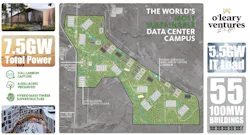
The proposed Utah data center development tied to “Shark Tank” investor Kevin O’Leary is not just another hyperscale campus announcement. It is an early test case for the next phase of AI infrastructure: massive compute campuses paired with dedicated utility-scale power generation, routed through new state-level development authorities, and positioned not simply as cloud real estate, but as strategic national infrastructure.
The development is being organized under the Stratos Project Area, with O’Leary Digital Utah Development Company serving as developer and “Wonder Valley” as the market-facing brand. Located in Box Elder County, the site reportedly includes roughly 40,000 acres of private land along with approximately 1,200 acres tied to military and state-owned parcels connected to the Utah Test and Training Range and other military-adjacent areas. The Military Installation Development Authority (MIDA) approved a development agreement on April 24, 2026, while final Box Elder County approvals were still pending as of April 27.
At full buildout, reported power projections range from 7.5 GW in earlier descriptions to as much as 9 GW in more recent reporting; a scale that moves the development well beyond the traditional boundaries of a data center campus. Phase 1 alone is expected to include roughly 3 GW of generation capacity, with the broader site ultimately tied to the 680-mile Ruby Pipeline natural gas system crossing northern Utah. MIDA Executive Director Paul Morris has described the development as a self-powered campus that would avoid drawing from the existing utility grid and could potentially return surplus electricity back to it.
Utah Gov. Spencer Cox said:
Utah continues to lead the nation in innovation and opportunity. The Stratos Project Area represents the kind of forward-thinking investment that strengthens our economy, supports national security, and creates meaningful opportunities for Utah families.
Why Utah Fits the AI Infrastructure Model
In the pre-AI cloud era, a 50 MW or 100 MW data center was already considered a major development. In the AI factory era, projects are increasingly evaluated as fully integrated infrastructure systems requiring coordinated access to power generation, fuel supply, water rights, fiber connectivity, substations, equipment procurement, and political approvals.
Utah has already emerged as a significant data center market, although most existing development has historically clustered along the Wasatch Front. According to reporting from the Deseret News, the state currently has 48 operational data centers consuming approximately 920 MW of power, with another 2,600 MW under construction. If completed, that pipeline would more than triple Utah’s existing data center capacity. The state’s ten largest facilities reportedly account for roughly 80% of current load, underscoring how hyperscale development continues shifting toward fewer, much larger campuses.
For the AI infrastructure market, Box Elder County checks several increasingly important boxes: large rural land assemblies, proximity to major energy infrastructure, room for dedicated power generation, and political alignment with Utah’s broader energy expansion agenda. KSL News reported that the Stratos Project is being positioned not merely as a data center development, but as a broader industrial platform encompassing energy generation, data center operations, manufacturing, housing, commercial facilities, and related infrastructure. Draft language cited by KSL describes the project as supporting “state-of-the-art energy generation, hyperscale data centers, advanced manufacturing and other compatible uses.”
That distinction matters because these developments are no longer just collections of server halls. They are becoming vertically integrated industrial campuses requiring power plants, cooling systems, substations, transmission or private distribution infrastructure, fiber networks, security perimeters, water strategies, road expansions, workforce development, and supply-chain staging capacity. As DCF has previously reported across multiple AI-era developments, the industry is now operating at industrial scale.
MIDA’s involvement also reshapes the governance model surrounding the development. The Military Installation Development Authority was originally created to support economic development tied to military missions and installations. Community radio outlet KPCW reported that MIDA leaders described Stratos as the organization’s most ambitious project to date, with potential applications supporting not only commercial AI infrastructure, but also the Pentagon, Department of Defense, U.S. Air Force, and Utah National Guard.
That national-security framing is becoming increasingly common in AI infrastructure discussions. O’Leary told the MIDA board the project is part of a broader U.S. effort to compete with China in AI development, while Utah Senate President Stuart Adams reportedly described AI as an “arms race.” Adams said:
The country that’s going to control AI is going to control the world, both economically with goods and services and militarily with weapons systems. Seeing what’s going on in the world, I am very much afraid that we’re losing our edge sometimes when it comes to technology, and that’s never been the case in America before.
The Power Strategy: Natural Gas as AI’s Fastest Bridge Fuel
Recent reporting describes a full buildout approaching 9 GW, with Phase 1 alone projected at roughly 3 GW. That power would reportedly be generated on site through access to the Ruby Pipeline, a 680-mile interstate natural gas transmission system serving the western United States. At that scale, Wonder Valley begins to resemble an independent power development paired with AI infrastructure rather than a conventional data center campus.
According to the U.S. Energy Information Administration, Utah’s average electricity demand is roughly 4 GW, meaning the proposed full buildout could eventually rival or exceed the state’s current average load demand.
The strategy reflects a broader shift now reshaping hyperscale development: bringing power generation directly to the data center. In some markets that means natural gas turbines. In others it involves fuel cells, geothermal systems, nuclear partnerships, utility-scale battery storage, renewable PPAs, or hybrid models combining on-site generation with grid interconnection.
For Utah, natural gas appears to be the most practical near-term option, particularly given the existing Ruby Pipeline infrastructure. Gas generation can typically be deployed faster than new nuclear development, faster than major transmission expansion projects, and at much larger scale than most currently available clean firm-power alternatives.
That does not eliminate the risks. Large-scale gas generation carries exposure to fuel-price volatility, emissions scrutiny, air permitting challenges, methane leakage concerns, turbine procurement bottlenecks, and long-term sustainability pressure if hyperscale customers impose increasingly aggressive carbon requirements across their infrastructure supply chains. But across much of the AI infrastructure sector today, speed-to-power has become the overriding priority.
Developers have emphasized that the campus would generate its own electricity rather than compete directly with Utah households and businesses for existing utility capacity. That argument carries political weight in a state already grappling with accelerating load growth, particularly as Gov. Spencer Cox continues promoting “Operation Gigawatt,” Utah’s initiative to expand energy production and transmission infrastructure.
Even under a BYOP model, however, a 3 GW first phase and potential 9 GW full buildout would still reshape the surrounding region through impacts on gas supply, emissions, water demand, land use, transportation infrastructure, tax policy, and emergency planning. Even if the electrons originate outside the traditional utility grid, developments at this scale remain deeply connected to the environmental, political, and economic systems surrounding them.
Water, Cooling, and the Great Salt Lake
After power, water may become the project’s most politically sensitive issue. Utah faces long-term water stress, and data centers have increasingly become public symbols of industrial-scale resource consumption. The Deseret News cited analysis showing that nearly all existing and planned Utah data centers are located in areas classified by the World Resources Institute as facing high baseline water stress. MIDA officials have argued that the Stratos/Wonder Valley development could ultimately consume less water than existing ranching activity tied to the site and might even produce a net benefit for the Great Salt Lake.
KPCW reported that project backers intend to use a closed-loop cooling architecture and believe the associated water rights would result in lower overall water loss than current agricultural uses.
Those claims remain difficult to independently evaluate at this stage. The distinction between water withdrawal, consumption, discharge, recharge, and evaporation is significant, particularly for large-scale AI infrastructure. Closed-loop cooling systems can substantially reduce consumptive water loss compared with traditional evaporative cooling designs, but gigawatt-scale AI campuses still generate extraordinary thermal loads requiring continuous heat rejection.
Cooling architecture itself is rapidly becoming one of the defining design decisions of the AI infrastructure era. GPUs, accelerators, and high-density rack systems are pushing facilities toward liquid cooling, rear-door heat exchangers, coolant distribution units, and increasingly integrated rack-level thermal management systems. Over the expected development timeline for Wonder Valley, those technologies will continue evolving rapidly. But the long-term cooling, water, and heat-management requirements for multi-gigawatt AI campuses remain far from fully settled.
Local Concerns: Transparency, Land, and Tax Incentives
Public scrutiny around the development is already intensifying. Community-supported outlet KPCW reported local residents raising concerns about transparency, land impacts, water pollution, and noise. One rancher said she did not fully understand how family land could be affected, while another resident argued the community had received a “sales pitch” but still lacked clarity on how the development would directly benefit local residents.
Those concerns are increasingly common around large-scale AI and hyperscale infrastructure projects. As campuses grow larger and more infrastructure-intensive, local debates tend to converge around several recurring questions:
- How many long-term jobs will actually be created?
- What construction impacts will surrounding communities absorb?
- Who pays for roads, emergency services, transmission upgrades, or gas infrastructure?
- What happens if development timelines slip or portions of the project never materialize?
- Are large tax incentives justified relative to the public return?
- What is the long-term risk of stranded infrastructure assets?
The tax structure surrounding Stratos/Wonder Valley is likely to become a central issue in those debates. Reporting indicates that MIDA reduced the project’s energy-use tax from 6% to 0.5% and agreed to rebate 80% of property tax revenue generated by the development back to O’Leary Digital. Even with those incentives, officials reportedly projected roughly $30 million annually for Box Elder County during the initial phase and more than $100 million annually at full buildout. State sales tax receipts tied to the data centers alone were projected at approximately $250 million per year.
The broader policy question is whether the long-term public value of projects at this scale ultimately outweighs the infrastructure obligations, environmental impacts, incentive structures, and community disruption required to support them.
No Public Hyperscaler Yet
While not unusual at this stage of development, no anchor hyperscale customer has yet been publicly identified. Developers frequently secure land, entitlements, and power infrastructure before formally announcing tenants. But at this scale, the absence of a named customer is still significant.
A 3 GW first phase would require extraordinary long-term demand commitments. Any eventual hyperscale or AI infrastructure customer will need confidence that the site can deliver power on schedule, secure permitting approvals, obtain critical electrical and cooling equipment, support sustainable water strategies, meet carbon and sustainability requirements, and connect to sufficient regional and long-haul fiber infrastructure.
The Emerging Blueprint for AI Infrastructure
Whether Wonder Valley ultimately reaches its full proposed scale or not, the development already illustrates where the AI infrastructure market is heading. The next generation of hyperscale campuses is increasingly being conceived not as standalone data centers, but as integrated industrial systems combining power generation, cooling, land, networking, logistics, and public policy into a single coordinated platform.
The broader significance of projects like Stratos may ultimately be less about one Utah campus specifically, and more about the emerging blueprint they represent for AI infrastructure development across the United States.
At Data Center Frontier, we talk the industry talk and walk the industry walk. In that spirit, DCF Staff members may occasionally use AI tools to assist with content. Elements of this article were created with help from OpenAI's GPT5.
Keep pace with the fast-moving world of data centers and cloud computing by connecting with Data Center Frontier on LinkedIn, following us on X/Twitter and Facebook, as well as on BlueSky, and signing up for our weekly newsletters using the form below.
About the Author
 David Chernicoff
David Chernicoff
Voices of the Industry
 Image courtesy of Bell & Gossett
 Source: Adobe Stock, courtesy of ebm-papst