Floating Data Centers Move Toward Infrastructure Scale
Key Highlights
- Floating data centers are moving beyond purely conceptual designs, with projects ranging from 30 MW modular platforms to proposed 200 MW hyperscale systems.
- Innovations include off-site manufacturing, seawater cooling, and integration with renewable energy sources like wave and solar power, addressing traditional cooling and power constraints.
- Major industry players like Samsung, Mousterian, Seatrium, Mocean, and Atomarine are advancing different architectures, including modular units, autonomous renewable platforms, and nuclear-powered vessels.
- Technical challenges such as corrosion, maintenance, environmental impact, and regulatory compliance remain significant but are being actively addressed through engineering and design innovations.
- The projects point toward a potentially significant new data center development model built around shipyard fabrication, marine siting, alternative power architectures and ocean-based heat rejection.
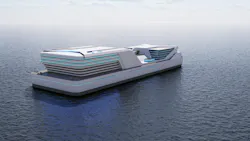
A series of 2026 announcements has moved floating data centers beyond the purely conceptual stage, although most projects remain in engineering, Approval-in-Principle or demonstration phases.
The projects range from a 30 MW modular data center mounted on a barge to 50 MW facilities planned for U.S. deployment, a 200 MW hyperscale floating design, self-powered wave-energy AI platforms, and a startup proposing 75 MW to 100 MW compute barges that could eventually receive electricity from floating nuclear power plants. When we last looked at the move to the ocean as a power and data center platform back in May, it looked like undersea platforms, led by China, were the closest to fruition, but four months later, industry attention has broadened toward floating platforms that can combine marine siting, shipyard fabrication, alternative power architectures and ocean-based heat rejection.
The mix of technologies, being proposed and developed, is quite diverse. Samsung Heavy Industries and Mousterian Corporation want to manufacture data centers in shipyards and moor them alongside existing generation assets. Seatrium has designed a barge carrying modular 5 MW "Data-in-a-Box" units. Scotland's Mocean Energy wants to combine wave power, offshore solar, batteries and GPU servers in a self-powered offshore facility. Panthalassa is developing an autonomous platform that turns wave motion directly into electricity for AI computation. And startup Atomarine envisions large offshore compute campuses initially supplied by gas-fired power vessels and ultimately by marine nuclear reactors.
Collectively, these approaches are designed to address different combinations of the biggest constraints facing data center development: grid interconnection delays, scarce large-scale sites, freshwater availability, community opposition and the increasingly difficult problem of cooling extremely high-density AI hardware.
Samsung and Mousterian Move From Concept to Engineering
One of the more advanced announced U.S. projects comes from Samsung Heavy Industries and Mousterian Corporation. Announced in August, the companies signed an engineering contract covering their first U.S. moored floating data center deployment, moving a partnership announced earlier this year into basic design, detailed engineering and production design.
Each purpose-built unit is designed to provide 50 MW of critical IT capacity, with deployments contemplated in Texas and other U.S. markets. The engineering work is intended to establish the technical baseline for a subsequent engineering, procurement and construction contract. ABS is expected to serve as the classification society. Fifty megawatts is important because this is not a demonstration-scale data center.
A 50 MW IT load could support a significant AI deployment. More importantly, the design is explicitly intended to support facility-scale, high-density liquid-cooled AI computing.
The concept also represents a fundamentally different approach to data center construction. Min Suh, Chief Executive Officer of Mousterian Corporation said of the partnership:
Signing this engineering contract transitions our partnership with Samsung Heavy Industries from intent to execution and gives us a clear path to scaling factory-built critical IT capacity for AI-class facilities. We are jointly engineering the first mission-critical data center of its class to be fabricated off-site to shipyard standards. Because the facility is built in a shipyard, fabrication advances in parallel with sitework rather than after it — a schedule and scale that conventional delivery methods cannot match. And by siting these facilities alongside existing stranded baseload generation and maritime infrastructure, we reach power that land-based development cannot.
Rather than constructing the building sequentially on a conventional site, Samsung can fabricate the floating structure and integrate much of the electrical, mechanical and cooling infrastructure in a shipyard. Site work at the eventual mooring location can proceed simultaneously. This has the potential to compress one of the longest parts of the data center development schedule.
Modern shipyards already operate as enormous industrialized manufacturing environments capable of constructing highly complex LNG carriers, offshore production platforms and other structures containing power generation, electrical distribution, piping, controls and mechanical systems. Adding a floating data center effectively applies those capabilities to digital infrastructure.
Samsung and Mousterian describe the facility as being fabricated off-site to shipyard standards. Instead of pouring foundations and constructing a data center building around the infrastructure, the facility becomes a manufactured asset that can be transported to its operating location.
Samsung has also been building a broader development ecosystem around floating data centers. In June, the shipbuilder signed agreements with Greece-based Capital and Lloyd’s Register covering project development, investment sourcing and regulatory requirements, while LR Advisory is working with Samsung on North American market analysis, infrastructure assessments and commercial feasibility.
Samsung also entered a joint development project with Supermicro to validate AI server infrastructure for offshore conditions, where vibration, vessel inclination, salt-laden air and rapid humidity changes can affect equipment reliability and lifespan. Samsung says it will develop positioning-control and salt- and humidity-protection technologies while Supermicro conducts operational verification of AI server infrastructure in river and marine environments.
Unlocking Power That Data Centers Can't Reach
Mousterian's model also addresses perhaps the biggest constraint facing today's data center industry: power. The facilities are intended to be positioned near existing generation and maritime infrastructure, allowing them to reach electrical capacity that may be difficult to serve through a conventional land-based development.
The companies specifically describe the opportunity as accessing stranded baseload generation. Developers normally search for land that can obtain sufficient utility service. Under the floating model, the data center can potentially be positioned directly beside the generation asset.
This can reduce dependence on transmission infrastructure and lengthy interconnection processes, although the actual electrical architecture will depend on the location and generation source.
The Ocean Becomes the Heat Sink
The other major proposed advantage is cooling. According to Samsung and Mousterian, the design uses bulk non-evaporative cooling, consumes no potable water and is designed to produce no process-water discharge into the surrounding waterway. It is also designed around high-density liquid-cooled AI infrastructure.
The distinction between using seawater as a heat sink and pumping seawater through servers is important. A practical floating facility can retain a closed internal cooling loop. Coolant absorbs heat from processors and other equipment and carries that thermal load to heat exchangers. A separate seawater-side system can then transfer that heat to the surrounding water.
That means developers can exploit the thermal capacity of the ocean without exposing sensitive IT equipment to corrosive saltwater. Removing evaporative cooling also eliminates one of the most controversial aspects of large data center development: freshwater consumption.
The companies also say the architecture is designed to reduce noise. Because the design eliminates much of the large air-cooled chiller and fan infrastructure associated with conventional heat rejection, Samsung and Mousterian expect the floating facility to have a substantially lower noise profile.
That is not a trivial consideration as community resistance to data center noise becomes an increasingly prominent development issue.
Samsung Is Already Looking at 200 MW
Samsung's ambitions extend considerably beyond the initial 50 MW platform. In August, the American Bureau of Shipping announced two milestones with Samsung Heavy Industries. ABS had already granted Approval in Principle to Samsung’s 50 MW design in May; the August agreement moves that design into formal review against applicable classification rules and International Maritime Organization (IMO) requirements while extending the concept to 200 MW.
The 200 MW number changes the scale of the discussion. At that capacity, floating infrastructure is no longer an alternative primarily for edge computing or specialized workloads. It moves the discussion into hyperscale territory.
Classification is particularly important because floating data centers must satisfy engineering requirements that conventional facilities never encounter. Designers have to consider stability, hull integrity, corrosion, flooding, marine fire protection, wave loading, wind, structural fatigue, mooring loads and potentially vessel impact in addition to familiar data center concerns including electrical redundancy, fire suppression and cooling availability.
ABS's involvement therefore represents a necessary bridge between maritime engineering and mission-critical data center design. An Approval in Principle does not mean a commercial 200 MW facility has been built or even that one is imminent. It means the classification society has reviewed the basic design concept and found no fundamental barrier preventing it from progressing toward detailed engineering.
Seatrium Takes the Modular Route
Singapore-based Seatrium is pursuing a somewhat different architecture. On July 27, Bureau Veritas Marine & Offshore granted Approval in Principle to Seatrium Technology & Innovation's 30 MW floating data center concept.
The design places six independent 5 MW Data-in-a-Box modules aboard a jetty-moored, non-propelled barge. Each module integrates IT hardware, cooling, electrical distribution and supporting infrastructure. This is fundamental modular data center construction transferred onto a marine platform.
Rather than designing the entire barge as one giant 30 MW data hall, Seatrium divides capacity into repeatable 5 MW building blocks, which in principle could provide several advantages:
· Modules can be manufactured and commissioned separately.
· Capacity can be added in increments.
· IT generations can be refreshed without rebuilding the marine platform.
· Problems affecting one module need not necessarily remove the entire 30 MW facility from service.
The architecture could prove particularly useful for AI infrastructure, where the useful life of GPU systems is substantially shorter than the useful life of the structures containing them.
Seatrium says the concept combines modular construction with natural seawater cooling and flexible offshore siting. Bureau Veritas' review extended beyond the general concept. Its assessment covered the general arrangement of the facility, cooling process flow, preliminary stability calculations, marine systems and key safety considerations against BV rules, international standards and relevant regulatory requirements.
Seatrium is already looking beyond the initial platform. The company says it is developing a 100 MW floating data center concept based on the 30 MW reference architecture, preserving modular construction, seawater cooling and flexible siting while moving toward hyperscale capacity.
A Data Center That Generates Its Own Electricity
The Samsung and Seatrium concepts remain relatively recognizable as data centers. Mocean Energy's Blue Core does not. The Scottish offshore renewable-energy developer is attempting to integrate the power plant and data center into a single autonomous marine system.
Mocean Energy's Blue Core platform combines wave energy, offshore solar generation, battery storage, power electronics and AI server racks. There is no utility connection and no fossil-fuel backup in the proposed architecture, solving the grid-interconnection problem in the most direct way possible: eliminate the grid connection.
The technology builds on Mocean's existing Blue Star offshore power platform. Several critical subsystems, including power conversion, mooring and controls, derive from technology the company has already tested at sea.
A central component is the wave-energy system. Mocean has developed patented hull geometry intended to amplify the mechanical movement produced by waves. The company says the geometry converts two to four times more wave energy into mechanical motion. That movement drives a direct-drive VHM (Vernier Hybrid Machine) generator, the platform's wave-energy power-take-off system. The direct-drive architecture is intended to improve reliability and reduce maintenance by simplifying the conversion of mechanical movement into electricity.
Solar panels supplement the wave system, while batteries and internal power electronics balance production and compute demand. The resources are intended to complement one another: solar output disappears at night, wave energy can persist after dark, and batteries can smooth shorter variations between generation and compute demand.
Closed-Loop Cooling Without Drinking Water
Blue Core also incorporates closed-loop liquid cooling. Fluid removes heat from the chips and transfers it through heat exchangers to the ocean. Mocean emphasizes that the system consumes zero potable water. Like the Samsung project, the surrounding ocean becomes the ultimate heat sink without requiring seawater to circulate through the IT equipment itself.
Mocean is also designing Blue Core around replaceability. Units can be connected into farms, and farms can be aggregated into larger deployments. An individual unit can be removed for maintenance or a GPU refresh without taking the remaining farm offline. That looks like a server architecture at infrastructure scale: individual physical data center modules become replaceable components within a larger distributed computing system.
Communications are expected to use Starlink satellite connectivity, while catenary moorings use conventional offshore components. Mocean is also developing multi-device mooring and self-transit capabilities for later versions of the system.
The company currently lists a small-scale onboard AI compute demonstration for 2027, a reminder that Blue Core remains a development program rather than deployed commercial data center capacity.
The category has also begun attracting strategic capital from established technology companies. In August, South Korean internet and cloud company Naver disclosed an investment in Panthalassa, which is developing autonomous wave-powered AI compute platforms. The investment amount was not disclosed; Panthalassa is targeting demonstration deployments ahead of a planned 2027 commercialization push.
Atomarine Adds Nuclear Power to the Equation
Y Combinator-backed startup Atomarine is developing one of the most ambitious floating data center architectures yet proposed. Its design separates the compute platform from the power plant.
Each standardized compute barge is designed for approximately 75 MW to 100 MW. Multiple platforms can be moored together to create a campus, with Atomarine illustrating an architecture scaling toward approximately 450 MW. The compute barges would be constructed in centralized shipyards, towed to their deployment location and added incrementally as demand grows.
Atomarine argues that standardized shipyard production could sharply shorten deployment schedules and ultimately support roughly 1.5 GW of annual output per shipyard. Those remain company targets rather than demonstrated operating results.
Atomarine proposes seawater-based cooling and advertises a PUE below 1.1. Instead of integrating generation permanently into the compute platform, Atomarine proposes a separate power vessel moored beside the data center.
Initially, those vessels would use natural gas turbines. Eventually, Atomarine proposes replacing the gas power vessel with one containing compact marine nuclear reactors.
The data center infrastructure might have a 20- to 40-year service life while server generations and potentially power technologies change repeatedly. Separating compute from generation allows either side of the system to evolve without replacing the other.
A gas-fired power ship could theoretically be disconnected and replaced by a nuclear-powered vessel while the compute barges remain in place, building a model similar to plans for interim natural gas-powered solutions for traditional data center campuses.
Floating Nuclear Meets the AI Factory
Atomarine's nuclear proposal also points toward a potentially important intersection between two emerging data center trends. Hyperscalers and developers are already investigating small modular reactors, advanced reactors and microreactors as potential sources of dedicated data center power.
The challenge is that terrestrial nuclear plants bring their own site-development, licensing and community issues. Marine nuclear power raises a different, and hardly trivial, set of regulatory, safety and security questions. But conceptually it could turn the power plant into another factory-manufactured modular component.
Atomarine's first generation avoids waiting for that technology. Existing gas-turbine equipment would provide power while marine reactor technology matures. Atomarine’s Y Combinator materials target a first gas-powered pilot for 2028; the nuclear configuration sits further out.
The regulatory path is also beginning to take shape. In 2026, the Nuclear Regulatory Commission said existing Parts 50, 52 and 53 could be used to license maritime nuclear reactors and established new coordination frameworks with the U.S. Coast Guard and federal offshore regulators for civilian maritime nuclear projects. Those steps do not make commercial floating reactors imminent, but they move the concept from a regulatory blank slate toward an identifiable licensing framework.
The Floating Data Center Is Multiple Ideas
The recent announcements also demonstrate why ‘floating data center’ may already be too broad a description. At least three distinct architectures are emerging.
· Near-shore floating hyperscale facilities are represented by Samsung/Mousterian and Seatrium. These resemble conventional data centers placed on marine platforms. Their principal advantages are industrialized shipyard construction, reduced land requirements, proximity to generation and seawater heat rejection.
· Autonomous renewable compute nodes are represented by Mocean and our previously covered Panthalassa. These integrate renewable generation with IT and potentially rely on satellite communications rather than terrestrial utility and fiber infrastructure.
· Offshore AI campuses with dedicated power vessels are represented by Atomarine, where large compute barges operate alongside separate generation vessels.
The Engineering Challenges Shouldn't Be Underestimated
There are good reasons most data centers are still built on land. Saltwater is extraordinarily corrosive. Humidity must be tightly controlled. Marine structures experience continuous movement, wind loading and mechanical stress. Moorings must survive extreme weather. Heat exchangers exposed to seawater face fouling and corrosion.
Maintenance is another issue. Replacing a failed GPU in a terrestrial data center is relatively straightforward. Doing so miles offshore could involve specialized vessels, crews and weather windows.
The economics of subsea fiber, or the bandwidth and latency limitations of satellite connectivity, also vary dramatically depending on the workload and location.
Then there are environmental questions. The environmental impact of these projects would still need to be evaluated. Using receiving waters as a heat sink can reduce freshwater consumption, but developers would still have to evaluate site-specific thermal loading, intake systems and potential effects on aquatic ecosystems. Offshore facilities also face maritime permitting, navigation, coastal-use and potentially fisheries issues that don't exist for inland campuses. And, of course, nuclear power would add an entirely different regulatory regime.
A floating AI factory still needs to deliver data center-class availability while operating in one of the harshest industrial environments on Earth.
A New Front in the Search for the Next Gigawatt
No one should interpret the recent announcements as evidence that hundreds of megawatts of floating AI capacity are about to appear off U.S. coastlines. But these are notable milestones.
· Samsung/Mousterian is in engineering.
· Seatrium has an Approval in Principle.
· Mocean is targeting a small-scale Blue Core compute demonstration for 2027.
· Atomarine's large-scale and nuclear-powered architecture remains a proposed development model.
In a matter of weeks, the industry has seen a 30 MW modular design receive classification approval, a 50 MW U.S. project enter engineering, a 200 MW design receive Approval in Principle, a wave-powered AI data center move toward demonstration, an investment by a major cloud company in an autonomous offshore compute developer, and a startup propose 75 MW to 100 MW barges eventually powered by marine nuclear reactors.
The emerging floating data center industry has an answer: stop assuming the data center has to be a building. Make it a manufactured piece of infrastructure. Build it in a shipyard. Take it to the power. Cool it with the world's largest heat sink. The wager is that shipyard manufacturing, marine siting and ocean-based heat rejection can convert some of the hardest constraints of land-based development into marine-engineering problems.
Whether that trade works at hyperscale will depend on permitting, connectivity, reliability, environmental performance and economics that none of these projects has yet demonstrated in commercial operation.
At Data Center Frontier, we talk the industry talk and walk the industry walk. In that spirit, DCF Staff members may occasionally use AI tools to assist with content.
Keep pace with the fast-moving world of data centers and cloud computing by connecting with Data Center Frontier on LinkedIn, following us on X/Twitter and Facebook, as well as on BlueSky, and signing up for our weekly newsletters using the form below.
About the Author
 David Chernicoff
David Chernicoff
Related
Voices of the Industry
 Source: Adobe Stock, courtesy of ebm-papst
 Source: Champion Fiberglass