Beyond Colossus: 5C Advances $575M Memphis AI Factory Expansion
Key Highlights
-
5C Data Centers is converting a former Fred's distribution complex in Memphis into a high-density AI computing facility, with a $575 million fourth-phase construction permit application.
-
5C plans to expand available power at MEM01 from approximately 20 MW to 84 MW, using fuel cell technology to supply additional capacity rather than relying on a corresponding increase in utility power.
-
The project's announced AI architecture includes NVIDIA GB200 and newer GB300 NVL72 systems, liquid cooling, high-bandwidth networking and integrated storage to support large-scale AI training and inference.
-
Memphis is considering a data center moratorium and new zoning standards while conducting a 90-day policy review addressing electricity demand, water resources, air quality and community impacts.
-
5C has secured more than $1.4 billion in financing for its North American AI infrastructure platform, supporting development in Memphis and other markets as questions remain about execution, infrastructure capacity and local economic benefits.
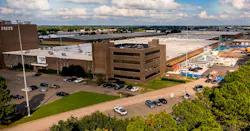
Memphis has emerged as a major center of AI infrastructure development, driven largely by the extraordinary scale of xAI's Colossus supercomputing operations. But the city's growing AI computing market extends beyond Elon Musk's flagship project. At the former headquarters and distribution complex of discount retailer Fred's, 5C Data Centers is developing another substantial AI computing facility, combining industrial adaptive reuse with a phased expansion strategy and plans for behind-the-meter power generation.
On October 6, 2026, a $575 million commercial alteration permit application was filed for the fourth phase of 5C's MEM01 data center at 4300 Getwell Road. The application covers approximately 504,000 square feet of the property's 1.1 million-square-foot building, representing the largest construction phase yet proposed at the site.
MEM01 is already operating. According to September reporting from The Daily Memphian, 5C had established operations in approximately 200,000 square feet of the former Fred's property, leaving substantial additional space available for conversion. The latest permit application marks a significant escalation in the scope of the development.
The expansion also introduces a major new element to 5C's power strategy. On October 11, 5C Group Chief Revenue Officer Brad Nimri told The Daily Memphian that the company plans to increase available power at MEM01 from approximately 20 MW to 84 MW over the next six months, using fuel cell technology to supply the additional capacity rather than relying on a corresponding increase in electricity from Memphis Light, Gas and Water (MLGW).
Like Colossus, which began with the conversion of a former Electrolux manufacturing facility, 5C's development reflects the growing role of industrial adaptive reuse in AI infrastructure. The projects differ considerably in scale and their approaches to on-site power generation, but both illustrate the challenge of transforming existing industrial properties into high-density computing environments with substantial electrical requirements. As Memphis considers tighter oversight of data center development, 5C's expansion underscores a broader industry challenge: bringing new AI computing capacity online while navigating power constraints, regulatory scrutiny and mounting concerns over the environmental and community impacts of large-scale infrastructure.
From Retail Distribution to AI Infrastructure
The MEM01 development occupies a property with a long history in Memphis commerce. Fred's operated hundreds of discount retail and pharmacy locations across the southeastern United States before declaring bankruptcy in 2019. Its former headquarters and distribution complex on Getwell Road, near Memphis International Airport, served as a major logistics hub for the regional retail chain.
In June 2026, 5C acquired the 1.1 million-square-foot complex and its approximately 58-acre property from Olymbec USA for $25 million, according to Shelby County property records, securing ownership of a site where data center construction and infrastructure modifications were already underway.
The project's development history reflects a rapid escalation in scale. Plans submitted in late 2024 and reported in 2025 contemplated converting the property into a data center supporting an initial 15-MW IT load. An April 2025 construction permit, valued at $25 million, described a more limited initial deployment of 2.5 MW, together with infrastructure designed to support future expansion.
Additional permits issued in early 2026 included $100 million for interior construction and $8 million for accessory structures. The October phase-four application, valued at $575 million, represents a substantial increase in the scope of planned construction, although permit valuations do not necessarily represent completed capital expenditures or the project's total investment.
The expansion also illustrates the distinction between announced capacity and operational computing infrastructure. According to 5C's published data center portfolio, the Memphis facility's 20-MW capacity for 2026 is fully committed, with additional capacity listed for subsequent years. That commercial designation does not establish how much electrical capacity has been energized or how much IT load is currently supporting customer workloads. The company has not publicly disclosed a complete inventory of installed and operating AI accelerators at the site, leaving the precise scale of its commissioned computing infrastructure unclear.
Converting a former distribution facility into an AI computing environment presents engineering challenges beyond the availability of industrial floor space. The existing building provides a substantial physical foundation for expansion, but supporting high-density GPU deployments requires extensive electrical distribution, cooling infrastructure, high-bandwidth network connectivity and systems engineered for continuous operation.
These requirements become increasingly demanding as rack power densities rise and computing architectures incorporate more tightly integrated liquid cooling, networking and storage systems. For 5C, the successive construction phases represent not simply the redevelopment of a former warehouse complex, but the creation of specialized infrastructure capable of supporting increasingly powerful generations of AI computing hardware.
Building a Frontier AI Factory
5C has identified its Memphis development as a Frontier AI Factory being built in collaboration with Together AI, reflecting the industry's shift toward integrated computing environments designed specifically for large-scale AI training and inference. The companies initially outlined an architecture incorporating NVIDIA GB200 NVL72 systems, Dell Technologies' liquid-cooled Integrated Rack Scalable Systems, VAST Data's AI storage platform and an accelerated software stack built around the Together Kernel Collection.
The technology plans have continued to evolve. More recently, 5C announced that it was deploying NVIDIA GB300 NVL72 systems at the Memphis facility in partnership with Together AI, working alongside Pegatron, Vertiv and VAST Data. The newer systems reflect the progression toward increasingly powerful rack-scale AI architectures, with corresponding demands on liquid cooling, high-bandwidth networking, storage performance and power distribution. The announcement does not specify the number of GB300 systems commissioned or their operational capacity.
For 5C, the project represents a business model extending beyond conventional data center development and colocation. In addition to providing powered facilities, the company offers GPU cluster deployment, commissioning and management services, supported by specialized field engineering and both InfiniBand and Ethernet networking. Its role encompasses the integration of computing hardware with the physical infrastructure needed to support demanding AI workloads, coordinating systems that might otherwise be delivered and operated by separate providers.
That coordination is central to the execution of modern AI factories. The challenge is not simply installing successive generations of accelerated computing hardware, but bringing compute, networking, storage, cooling and software into operation as a reliable, high-performance platform. At MEM01, the ability to scale that integrated infrastructure will depend in significant part on 5C's capacity to deliver the electrical power required to support it.
The Power Strategy Takes a Different Direction
The next stage of MEM01's development centers on a significant expansion of its electrical capacity, with 5C pursuing a combination of utility service and behind-the-meter generation.
According to 5C's published capacity schedule, the Memphis facility has 20 MW listed for 2026, followed by 64 MW in 2027 and another 35 MW in 2029 and beyond. The company identifies the site's power sources as both grid-connected and behind-the-meter infrastructure, although its published schedule does not clarify whether the annual figures represent incremental additions or total available capacity.
That distinction becomes important in light of 5C's latest expansion plans. In October, Group Chief Revenue Officer Brad Nimri said the company intends to increase available power at MEM01 from approximately 20 MW to 84 MW over six months, using fuel cell technology rather than drawing the additional capacity from Memphis Light, Gas and Water (MLGW). The 64-MW difference between those figures corresponds to the capacity listed for 2027 on 5C's website, but the company has not publicly reconciled the two descriptions or established how much of the proposed expansion would be operational within the announced timeframe.
Fuel cells are attracting growing interest among data center developers as a source of continuous on-site generation that can supplement or reduce dependence on utility-supplied electricity. Unlike conventional gas turbines, fuel cells generate electricity through electrochemical reactions rather than combustion, although their emissions and overall environmental performance depend heavily on the technology, fuel source and associated infrastructure. Systems can operate on hydrogen or hydrogen-rich fuels derived from natural gas and other feedstocks.
For MEM01, 5C has not publicly detailed the proposed equipment supplier, generation capacity, fuel supply arrangements or implementation schedule, leaving important questions about the project's economics and environmental implications unresolved.
The company's latest strategy also introduces questions about its previously disclosed utility requirements. During a September 1 briefing to the Memphis City Council, MLGW President and CEO Doug McGowen reported that 5C had already received approval for approximately 9 MW of additional electrical service at Getwell Road during 2026.
He also identified a further 5C expansion of approximately 50 MW among the utility's prospective large-load projects, with infrastructure requirements still under evaluation. Nimri's subsequent announcement suggests a greater emphasis on on-site generation, but it remains unclear whether the fuel-cell plan replaces, supplements or otherwise changes that earlier request for additional grid service.
The distinction carries financial implications as well. In August, the Tennessee Valley Authority approved a new Large Data Service rate structure, effective October 1, 2026, establishing higher electricity rates for data centers and a separate capacity commitment charge for qualifying new and expanded loads.
For the initial fiscal 2027 capacity allocation, the charge is $1.521 million per megawatt, generally applying to new contracted loads above the first 5 MW. However, the tariff also provides exemptions for certain previously approved or contracted loads, including qualifying in-flight expansion requests of 100 MW or less during initial implementation. Whether any portion of 5C's previously requested utility capacity would qualify for those provisions has not been established.
For developers, these requirements add another consideration to the economics of acquiring utility capacity versus generating electricity on-site. Behind-the-meter systems may reduce the amount of new grid capacity a project must secure, but they introduce their own capital costs, fuel requirements, operating obligations and permitting considerations. The financial implications for 5C cannot be established without knowing the configuration of its planned generation and the status of its utility service agreements.
MEM01's expansion therefore represents more than an increase in available megawatts. It illustrates the increasingly complex decisions facing AI infrastructure developers as they balance grid access, on-site generation, project economics and deployment schedules. For 5C, the central execution challenge will be converting its announced power strategy into reliable electrical capacity capable of supporting the high-density computing systems planned for the Memphis facility.
Financing the Expansion
The scale of 5C's Memphis expansion reflects the substantial institutional capital flowing into AI infrastructure development. In August 2026, 5C Group announced the closing of $605 million in new debt financing led by Brookfield Asset Management, building on $835 million in equity and debt capital raised in 2025. The earlier financing included equity investment led by Brookfield and debt financing led by Deutsche Bank. Together with capital raised before 2025, the transactions brought 5C's cumulative financing to more than $1.4 billion.
The company specifically identified the acquisition and construction of its Memphis campus among the activities supported by the new capital, alongside development and expansion projects in Ohio and Phoenix. The financing applies to 5C's broader North American portfolio, however, and the company has not disclosed how much is allocated to MEM01 or whether the full scope of the latest $575 million construction application is covered by existing financing. The distinction is important as AI infrastructure developers pursue increasingly capital-intensive projects involving both specialized facilities and the computing systems they are designed to support.
5C's ability to attract that investment follows a significant corporate transformation. In April 2025, Hypertec Cloud acquired 5C Data Centers, coinciding with Hypertec Cloud's separation from Hypertec Group and the formation of the independent 5C Group. The combination brought together AI cloud infrastructure expertise, hardware procurement and cluster operations with a portfolio of data center development assets. That integrated business model provides the foundation for 5C's effort to deliver complete AI computing environments rather than conventional powered-space capacity alone.
The financial scale and economic-development expectations surrounding the Memphis project have also varied over time. Initial reporting in May 2025 described anticipated investment exceeding $500 million and more than 250 direct and indirect jobs. In November 2025, however, 5C sought a 15-year payment-in-lieu-of-taxes (PILOT) agreement through the Economic Development Growth Engine for Memphis and Shelby County (EDGE) based on a more narrowly defined project budget of approximately $152 million.
That application included $25 million for property acquisition and $111 million in construction costs, along with plans to create 15 permanent jobs at average annual wages of approximately $103,400. The figures reflect different project scopes and employment measures rather than directly comparable estimates of the same development program.
The proposed tax incentive was never approved. EDGE canceled the November 2025 board meeting at which the application was scheduled for consideration, held no December meeting, and did not return the project to subsequent board agendas, according to October reporting from the Memphis Business Journal. Nevertheless, 5C proceeded with the property acquisition and development without the proposed tax freeze.
The latest $575 million phase-four filing underscores the scale of construction now being contemplated at MEM01, although permit valuations, project investment estimates and company-wide financing represent different financial measures. The project's evolving employment projections also leave open questions about its eventual contribution to the local economy. How the expansion translates into permanent jobs, local tax revenue and other economic benefits will remain an important consideration as Memphis evaluates further data center development.
Memphis's Data Center Market Faces a Regulatory Test
The timing of 5C's expansion places it within an increasingly contentious debate over data center development in Memphis, where city officials are weighing new restrictions amid public concerns about electricity demand, water consumption, air quality and the effects of large-scale computing facilities on surrounding communities.
On October 6, the same day 5C's phase-four permit filing was reported, the Memphis City Council voted 7-5 to postpone consideration of a proposed 12-month moratorium on new data center development. The measure, sponsored by Councilman JB Smiley Jr. and other council members, would temporarily restrict the processing and approval of certain development and infrastructure permits. A final vote was rescheduled for October 20.
The council has also been considering alternatives to a blanket moratorium. On October 8, members advanced two ordinances on first reading that would amend the city's Unified Development Code to establish new zoning, land-use and siting standards for data centers and other resource-intensive facilities.
The proposals remain subject to additional readings and potential revisions before becoming law, reflecting an ongoing debate over whether Memphis should temporarily suspend new development approvals or establish permanent standards governing where and how these facilities operate.
The following day, Mayor Paul Young issued an executive order establishing a 90-day policy review of large-scale data center development. The initiative directs a group of technical and policy experts to develop recommendations addressing land use and neighborhood protections, infrastructure requirements, air quality, water and aquifer protection, electricity costs and noise.
The order also calls for public engagement and directs the city's Engineering Department to incorporate an extended review period of at least five business days into its permitting process during the study. The mayor's initiative is proceeding independently of the council's legislative deliberations and does not suspend its authority to enact regulations.
For operators with projects already underway, the emerging regulatory framework introduces uncertainty about the treatment of future expansion. An existing industrial facility may present different zoning and land-use considerations from a newly proposed campus, but that distinction does not necessarily exempt additional construction, power-generation equipment or infrastructure modifications from permitting and environmental requirements.
Whether any eventual moratorium or new development standards would affect subsequent phases of MEM01 will depend on the final regulatory language, the status of existing approvals and any provisions protecting previously authorized development.
Much of the controversy has centered on xAI's Colossus facilities and their associated natural gas turbine generation, which has prompted legal challenges and sustained scrutiny of air emissions and permitting practices. The broader debate also encompasses water resources, electricity infrastructure, utility costs and the economic returns local communities can expect from major AI investments.
Some city officials and development advocates have cautioned that a moratorium could discourage investment or shift projects to neighboring jurisdictions, while supporters argue that additional scrutiny is necessary before further large-scale development proceeds.
For 5C, the proposed fuel-cell expansion introduces another set of questions into that debate. Although fuel cells operate differently from the gas turbines associated with Colossus, their environmental profile, fuel requirements and permitting obligations cannot be established without additional details about the planned installation.
Ultimately, MEM01's next phase will test whether 5C can translate its considerable financial commitments, planned computing infrastructure and behind-the-meter power strategy into operational AI capacity amid mounting regulatory scrutiny.
In this October 2025 project preview, 5C outlines its collaboration with Together AI and the planned computing architecture for MEM01, including NVIDIA GB200 NVL72 systems, Dell liquid-cooled infrastructure and VAST Data storage. The project has since expanded its announced technology plans to include NVIDIA GB300 NVL72 systems. (Source: 5C)
At Data Center Frontier, we talk the industry talk and walk the industry walk. In that spirit, DCF Staff members may occasionally use AI tools to assist with content.
Keep pace with the fast-moving world of data centers and cloud computing by connecting with Data Center Frontier on LinkedIn, following us on X/Twitter and Facebook, as well as on BlueSky, and signing up for our weekly newsletters using the form below.
About the Author
 David Chernicoff
 Matt Vincent
Matt Vincent is Editor in Chief of Data Center Frontier, where he leads editorial strategy and coverage focused on the infrastructure powering cloud computing, artificial intelligence, and the digital economy. A veteran B2B technology journalist with more than two decades of experience, Vincent specializes in the intersection of data centers, power, cooling, and emerging AI-era infrastructure. Since assuming the EIC role in 2023, he has helped guide Data Center Frontier’s coverage of the industry’s transition into the gigawatt-scale AI era, with a focus on hyperscale development, behind-the-meter power strategies, liquid cooling architectures, and the evolving energy demands of high-density compute, while working closely with the Digital Infrastructure Group at Endeavor Business Media to expand the brand’s analytical and multimedia footprint. Vincent also hosts The Data Center Frontier Show podcast, where he interviews industry leaders across hyperscale, colocation, utilities, and the data center supply chain to examine the technologies and business models reshaping digital infrastructure. Since its inception he serves as Head of Content for the Data Center Frontier Trends Summit. Before becoming Editor in Chief, he served in multiple senior editorial roles across Endeavor Business Media’s digital infrastructure portfolio, with coverage spanning data centers and hyperscale infrastructure, structured cabling and networking, telecom and datacom, IP physical security, and wireless and Pro AV markets. He began his career in 2005 within PennWell’s Advanced Technology Division and later held senior editorial positions supporting brands such as Cabling Installation & Maintenance, Lightwave Online, Broadband Technology Report, and Smart Buildings Technology. Vincent is a frequent moderator, interviewer, and keynote speaker at industry events including the HPC Forum, where he delivers forward-looking analysis on how AI and high-performance computing are reshaping digital infrastructure. He graduated with honors from Indiana University Bloomington with a B.A. in English Literature and Creative Writing and lives in southern New Hampshire with his family, remaining an active musician in his spare time.
Voices of the Industry
 Adobe Stock image courtesy of Hitachi Energy