AI’s New Land Grab: Meta’s Indiana Megaproject and the Rise of Europe’s Neocloud Challengers
Key Highlights
- Meta's new Indiana campus represents one of the largest digital infrastructure projects in the U.S., with a potential capacity approaching one gigawatt, supporting AI training and deployment at a massive scale.
- Indiana's emergence as a hyperscale hub is driven by abundant land, regional power incentives, and proactive utility planning, making it a key player in the global AI infrastructure race.
- Europe's Nebius is repurposing industrial sites like the former Bridgestone plant in France to build large-scale AI data centers, emphasizing regional capacity and industrial redevelopment.
- The industry now prioritizes power availability over fiber or land, with utility coordination and long-term energy procurement becoming central to data center siting decisions.
- Specialized AI infrastructure providers like Nebius are rapidly expanding, signing multi-billion-dollar deals with hyperscalers, and focusing on regional markets to complement global cloud giants.
A survey of this week’s data center and AI frontier shows the map of global computing being redrawn in real time.
Two announcements — one in the American Midwest, the other in northern France — make clear that AI infrastructure expansion has moved beyond experimentation and pilot deployments. Indeed, the industry is now entering a period of utility-scale industrialization, where campuses are measured in hundreds of megawatts, and planning timelines resemble heavy manufacturing more than traditional IT deployment.
Put simply: the land grab for AI infrastructure is not slowing down.
Meta Goes Big in the Silicon Prairie
Meta this week officially broke ground on a new data center campus in Lebanon, Indiana, launching what could become one of the largest digital infrastructure projects in the United States.
Located roughly 30 miles northwest of downtown Indianapolis in Boone County, the development positions central Indiana as one of the newest hubs in what industry observers increasingly call the “Silicon Prairie,” a Midwest corridor now attracting hyperscale investment as traditional coastal markets strain under land and power constraints.
The long-term investment, estimated around $10 billion, is designed to support Meta’s expanding AI operations alongside its core platforms. At full buildout, the campus could approach one gigawatt of power capacity, placing it among the most energy-intensive digital campuses ever constructed.
To put that into perspective, one gigawatt can power hundreds of thousands of homes. Here, that energy will instead be directed toward dense GPU clusters training and serving AI models at global scale.
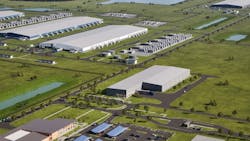
Concept renderings released by the company suggest a multi-building campus that could ultimately include a dozen or more data center structures, deployed in phases as demand grows.
Indiana’s Emergence as a Hyperscale Market
The move highlights a broader shift in hyperscale strategy. Markets such as Northern Virginia, Silicon Valley, and parts of the Pacific Northwest increasingly face power grid congestion and land scarcity, pushing developers toward emerging regions capable of supporting heavy industrial-scale loads.
Indiana offers what hyperscale developers now prioritize:
• Large contiguous land parcels capable of supporting campus-style expansion
• Utilities coordinating years in advance to prepare substations and transmission for heavy loads
• Competitive regional power pricing
• Cooperative regulatory and permitting environments
• Economic development incentives aimed at attracting next-generation infrastructure investment
Meta’s move into Lebanon follows earlier negotiations with local officials dating back to 2024, when the company secured local tax abatements and began quietly assembling land parcels for development.
The Lebanon campus will also be Meta’s second Indiana project, joining the company’s Jeffersonville campus near Louisville, announced in 2024. That 619-acre development inside the River Ridge Commerce Center is already nearing completion, with rack installation reportedly underway.
Viewed together, the two campuses establish Indiana as a growing Meta infrastructure cluster in the Midwest.
Workforce and Community Impact
Meta says construction activity in Boone County will support more than 4,000 jobs at peak construction, with roughly 300 permanent operational roles once the facility comes online.
The company has also committed to grants, workforce development programs, and local infrastructure investments as part of its community engagement strategy, reflecting the growing importance of local partnerships as projects scale toward industrial levels of energy consumption.
Sustainability and Cooling Strategy
Meta emphasized sustainability commitments tied to the new campus, pledging to match 100% of the facility’s electricity use with clean energy while coordinating closely with utilities to ensure residential customers are not negatively impacted by infrastructure expansion.
The campus will deploy closed-loop liquid cooling systems, recirculating water to minimize consumption and allowing operations to run with minimal water use for much of the year. The company also says it will restore 100% of water consumed at the site to local watersheds.
Such measures are increasingly important as communities scrutinize water and energy impacts of hyperscale projects.
Part of a Larger Gigawatt Strategy
The Indiana project is only one component of Meta’s expanding infrastructure footprint. The company is simultaneously developing several gigawatt-scale campuses nationwide, including the massive Hyperion project in Louisiana, which could ultimately exceed 5 GW of capacity, as well as expansions underway in Ohio, Texas, and Wisconsin.
To coordinate these ambitions, Meta recently formed Meta Compute, a division focused on delivering tens of gigawatts of compute capacity this decade, with CEO Mark Zuckerberg suggesting even larger capacity targets over time.
Supporting those ambitions requires unprecedented energy procurement. Earlier this year, Meta announced agreements involving nuclear developers and utilities that could help support up to 6.6 gigawatts of new and existing nuclear capacity by the early 2030s.
Infrastructure Now Planned at Industrial Scale
One takeaway is unavoidable: AI infrastructure expansion now apparently operates on timelines and power scales historically associated with heavy industry.
Projects of this magnitude require coordination with utilities and grid planners well before construction begins, with transmission upgrades and generation planning now integral to early site selection decisions.
Infrastructure timelines increasingly resemble heavy manufacturing investment cycles rather than commercial real estate development.
And Indiana, once peripheral in data center siting discussions, now sits firmly on the hyperscale map.
Power, Not Fiber, Now Defines Site Selection
Meta’s Indiana campus also underscores what developers now openly acknowledge: power availability has become the decisive factor in where data centers can be built.
Utilities across the U.S. report unprecedented interconnection requests driven largely by AI infrastructure expansion. In several major markets, data center demand now represents the single largest contributor to projected load growth over the coming decade.
Developers say that while land and fiber remain important, they are no longer the gating variables. Instead, projects increasingly succeed or stall based on how quickly utilities can deliver new capacity, expand substations, or build transmission upgrades.
As a result, infrastructure strategy now routinely includes:
• Behind-the-meter generation planning
• Long-term renewable and nuclear power procurement
• Early-stage coordination with utilities and grid operators
• Multi-phase power delivery agreements aligned to campus expansion
Community impacts also become more visible as facilities grow larger and energy demand climbs. Operators are responding with greater emphasis on clean energy sourcing, water-efficient cooling systems, and local infrastructure investments aimed at maintaining long-term community support.
Meta’s Indiana build illustrates what may soon become standard practice: campuses planned not just for current demand, but for expansion phases stretching across a decade or more as AI compute needs continue to scale.
Europe’s Neocloud Momentum: Nebius Targets France
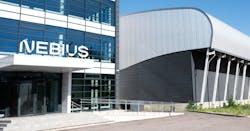
While Meta’s Indiana campus anchors hyperscale expansion in the United States, Europe recorded its own major infrastructure milestone this week as Amsterdam-based AI infrastructure provider Nebius unveiled plans for a 240-megawatt data center campus in Béthune, France, near Lille in the country’s northern industrial corridor.
When completed, the campus will rank among Europe’s largest AI-focused data center facilities and positions northern France as a growing node in the continent’s expanding AI infrastructure map.
The development repurposes a former Bridgestone tire manufacturing site, reflecting a broader trend across Europe in which legacy industrial properties, already equipped with heavy power access, transport links, and industrial zoning, are being converted into large-scale digital infrastructure hubs.
Located within reach of connectivity and enterprise corridors linking Paris, Brussels, London, and Amsterdam, the site allows Nebius to serve major European markets while avoiding the congestion and power constraints increasingly shaping Tier 1 data center hubs.
Industrial Infrastructure Becomes Digital Infrastructure
Developers increasingly view former industrial sites as ideal for AI campuses because they often provide:
• Existing grid interconnection capacity built for heavy industry
• Transport and logistics infrastructure already in place
• Industrial zoning that reduces permitting friction
• Large contiguous parcels suited to phased campus expansion
For regions like Hauts-de-France, redevelopment projects also offer economic transition opportunities, replacing legacy manufacturing capacity with next-generation digital infrastructure investment.
Local officials have positioned the project as part of broader efforts to reposition northern France as a logistics and technology hub within Europe.
The Neocloud Model Gains Ground
Beyond the site itself, Nebius’ expansion illustrates the rapid emergence of neocloud infrastructure providers, companies building GPU-intensive AI capacity without operating full hyperscale cloud ecosystems.
These firms increasingly occupy a strategic middle ground: supplying AI compute capacity to enterprises, startups, and even hyperscalers facing short-term infrastructure constraints.
Nebius’ rise over the past year illustrates how rapidly demand is shifting.
In November 2025, the company disclosed it had signed a $3 billion, five-year infrastructure agreement with Meta, even as executives noted the deal had to be limited by available capacity because the company was effectively sold out of deployable infrastructure.
Two months earlier, Nebius also signed a $19.4 billion infrastructure deal with Microsoft, reportedly tied to providing access to more than 100,000 Nvidia GB300 GPUs; one of the largest GPU infrastructure supply agreements announced to date.
All in all, the agreements underscore how hyperscalers themselves increasingly rely on specialized infrastructure providers to supplement internal capacity as AI demand accelerates.
Capacity Constraints Drive Expansion
Nebius executives have openly acknowledged that capacity availability, not customer demand, has been the primary constraint on revenue growth.
The company’s Q3 2025 financial results showed revenue surging more than 350% year over year, while capital expenditures climbed to nearly $1 billion for the quarter, reflecting rapid investment in new infrastructure and hardware.
CEO Arkady Volozh told shareholders that the company is aggressively working to remove deployment bottlenecks and expects rapid scaling through 2026.
The company now aims to secure approximately 2.5 gigawatts of contracted power capacity by the end of 2026, up sharply from earlier projections of one gigawatt. Of that amount, Nebius expects between 800 MW and 1 GW of power to be connected to operational data centers by that time.
Such numbers place Nebius among the fastest-scaling independent AI infrastructure providers globally.
To support expansion beyond 2026, the company plans to combine corporate debt, asset-backed financing, and equity issuance, underscoring the capital intensity required to compete in the AI infrastructure market.
A Rapidly Expanding Global Footprint
Nebius’ expansion extends well beyond France.
The Amsterdam-based company emerged after Yandex spun off its European infrastructure assets, including its Finnish data center operations, into an independent entity. Today, Nebius operates or develops infrastructure across Finland, Iceland, France, the UK, Israel, and the United States.
Recent deployments include:
• Launch of a 4,000-GPU Nvidia cluster at Ark Data Centres’ Longcross Park campus in Surrey
• Development of a 300 MW campus in New Jersey with DataOne, with initial capacity coming online in 2025
• Planned leasing activity at a new facility in Kansas City
• Operation of infrastructure within Equinix facilities in Paris
• Construction of a national AI supercomputer project in Israel supported by government funding
The Béthune campus now becomes one of the largest planned additions to that footprint.
Phased Deployment Reflects Demand Urgency
Construction at Béthune will proceed in phases, with initial capacity expected online by late summer 2026, and roughly half of total planned capacity operational by year-end.
Industry analysts note phased deployment strategies reflect the urgency of AI demand: operators increasingly bring partial capacity online quickly rather than waiting for full campus completion.
Investment figures for the project have not been publicly disclosed, but industry benchmarks suggest AI-focused facilities at this scale typically require multi-billion-euro capital commitments, given the cost of power delivery, cooling systems, and GPU infrastructure.
Why Béthune Matters for Europe’s AI Strategy
Beyond scale alone, the project supports Europe’s growing emphasis on domestic AI infrastructure capacity, reducing reliance on overseas compute resources for enterprises and public-sector workloads subject to data residency requirements.
Projects like Nebius’ expansion support:
• Growth of regional AI infrastructure capacity
• Enterprise AI adoption within European jurisdictions
• Industrial redevelopment aligned with digital infrastructure investment
• Competitive alternatives to hyperscaler-dominated cloud ecosystems
It's hard not to see how Nebius’ expansion signals that AI infrastructure competition, once defined almost entirely by hyperscale cloud providers, is becoming broader, more regionalized, and increasingly multinational.
Infrastructure Becomes the Battleground
A decade ago, data center expansion was largely a question of connectivity and real estate: finding fiber routes, favorable latency profiles, and land that penciled out economically.
Today, infrastructure decisions sit at the intersection of energy policy, supply chain execution, and geopolitical competition. This week’s announcements in Indiana and northern France make clear just how much the landscape has shifted.
Meta’s Lebanon campus represents hyperscale infrastructure industrialized at unprecedented scale; a greenfield development built to funnel up to a gigawatt of power into AI and core platform workloads serving billions of users worldwide.
Nebius’ expansion in Béthune, by contrast, shows how specialized AI infrastructure providers are repurposing former industrial sites to build GPU-heavy capacity aimed at serving regional markets and enterprises seeking alternatives to hyperscaler ecosystems.
One project is designed to feed global hyperscale platforms; the other supports regional AI compute sovereignty. One rises from open farmland engineered for expansion; the other converts legacy industrial infrastructure into digital capacity.
Both, however, depend on the same scarce input: large-scale, long-term access to power.
Seen together, the projects also ilustrate the industry’s new reality. AI infrastructure expansion is no longer defined solely by hyperscalers building ever larger campuses. Specialized compute providers now play an increasingly important role in shaping where and how capacity emerges across global markets.
And in both cases, success hinges on the same factors: securing land suitable for expansion, aligning with utilities capable of delivering massive power capacity, and planning infrastructure years ahead of deployment demand.
The competitive battleground is no longer just server performance or cloud market share. It is access to energy, industrial-scale sites, and the capital required to turn both into operational infrastructure.
The AI infrastructure race, in other words, is no longer just about building data centers. It is about securing the physical and energy foundations capable of sustaining the next generation of compute. And judging by this week’s pace, the land and power scramble shaping that future is only accelerating.
At Data Center Frontier, we talk the industry talk and walk the industry walk. In that spirit, DCF Staff members may occasionally use AI tools to assist with content. Elements of this article were created with help from Google Gemini and OpenAI's GPT5.
Keep pace with the fast-moving world of data centers and cloud computing by connecting with Data Center Frontier on LinkedIn, following us on X/Twitter and Facebook, as well as on BlueSky, and signing up for our weekly newsletters using the form below.
About the Author
 Matt Vincent
Matt Vincent
Matt Vincent is Editor in Chief of Data Center Frontier, where he leads editorial strategy and coverage focused on the infrastructure powering cloud computing, artificial intelligence, and the digital economy. A veteran B2B technology journalist with more than two decades of experience, Vincent specializes in the intersection of data centers, power, cooling, and emerging AI-era infrastructure. Since assuming the EIC role in 2023, he has helped guide Data Center Frontier’s coverage of the industry’s transition into the gigawatt-scale AI era, with a focus on hyperscale development, behind-the-meter power strategies, liquid cooling architectures, and the evolving energy demands of high-density compute, while working closely with the Digital Infrastructure Group at Endeavor Business Media to expand the brand’s analytical and multimedia footprint. Vincent also hosts The Data Center Frontier Show podcast, where he interviews industry leaders across hyperscale, colocation, utilities, and the data center supply chain to examine the technologies and business models reshaping digital infrastructure. Since its inception he serves as Head of Content for the Data Center Frontier Trends Summit. Before becoming Editor in Chief, he served in multiple senior editorial roles across Endeavor Business Media’s digital infrastructure portfolio, with coverage spanning data centers and hyperscale infrastructure, structured cabling and networking, telecom and datacom, IP physical security, and wireless and Pro AV markets. He began his career in 2005 within PennWell’s Advanced Technology Division and later held senior editorial positions supporting brands such as Cabling Installation & Maintenance, Lightwave Online, Broadband Technology Report, and Smart Buildings Technology. Vincent is a frequent moderator, interviewer, and keynote speaker at industry events including the HPC Forum, where he delivers forward-looking analysis on how AI and high-performance computing are reshaping digital infrastructure. He graduated with honors from Indiana University Bloomington with a B.A. in English Literature and Creative Writing and lives in southern New Hampshire with his family, remaining an active musician in his spare time.