CoreWeave and Bell Canada Reset AI Data Center Scale
Key Highlights
- CoreWeave is shifting from GPU rental to operating AI-native production infrastructure, focusing on continuous, scalable AI workloads.
- The company announced the general availability of NVIDIA HGX B300 systems, optimized for reasoning, inference, and agentic AI tasks at GTC 2026.
- Bell Canada’s Saskatchewan data center project exemplifies the move toward sovereign, hyperscale AI infrastructure, with a focus on land, power, cooling, and regional control.
- Both companies are emphasizing the importance of integrated hardware, software, and operational platforms to support persistent AI deployment at industrial scale.
- The trend reflects a broader geopolitical shift, with nations and corporations building autonomous AI ecosystems to secure control over critical infrastructure and advance technological sovereignty.

CoreWeave’s latest announcements at NVIDIA GTC 2026 point to a broader trend underway in the AI infrastructure market. The company is moving beyond GPU rental toward building and operating AI-native production infrastructure, as the industry pivots from headline-grabbing training runs to the more complex challenge of running agentic AI reliably, continuously, and at industrial scale.
That transition is forcing a reset across the market. Enterprises are now under pressure to operationalize AI investments, where success depends not just on access to compute, but on integrating deployment, observability, and iteration into a continuous loop. The result is a more demanding infrastructure model; one that extends well beyond GPUs into software platforms, networking, and sustained operational performance.
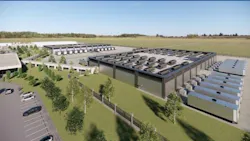
CoreWeave’s role in Bell Canada’s newly announced 300 MW Saskatchewan data center underscores the scale of that shift. The project reflects how the AI infrastructure race is expanding beyond U.S. hyperscalers and pure-play GPU clouds into a broader contest over land, power, cooling, sovereign compute, and full-stack control of AI environments.
At GTC, CoreWeave framed its strategy around the next phase of “production-scale AI.” The centerpiece was the general availability of NVIDIA HGX B300 on its cloud platform, positioned for reasoning, inference, and agentic workloads rather than traditional large-scale training. The system brings 2.1 TB of HBM3e memory (a roughly 50% increase over B200 instances) along with next-generation InfiniBand and liquid-cooled designs aimed at sustaining peak performance without thermal constraints.
CoreWeave also signaled its intent to remain at the front edge of NVIDIA’s platform roadmap, stating it expects to be among the first providers to deploy Vera Rubin NVL72 systems and the Vera CPU rack in production in the second half of 2026. That positioning reflects a clear competitive thesis, i.e. that advantage will come not just from access to accelerators, but from early deployment of each new generation, and the ability to operationalize those systems at scale.
From Training Runs to Continuous AI Operations
The trend as described is fundamentally economic. The AI market is moving beyond large, one-off training runs toward reinforcement learning, post-training optimization, long-context inference, and fleets of agents operating in live environments.
In that model, infrastructure is no longer defined by peak flops alone. It must support a continuous loop connecting research, deployment, observability, evaluation, and iteration.
CoreWeave’s GTC messaging reflects that transition. Alongside the B300 rollout, the company highlighted a deeper integration of Weights & Biases, the developer platform it acquired in 2025. The updates point toward a more operational AI stack, including serverless reinforcement learning, production agent evaluation through W&B Weave, robotics-focused experiment tracking, and mobile-based monitoring of training runs.
The apparent strategy is to collapse the boundary between model development and production. In doing so, CoreWeave is positioning itself not just as a provider of compute, but as a platform for managing the full lifecycle of AI workloads, where stickiness comes from workflow integration as much as infrastructure scale.
From GPU Cloud to AI Factory Operator
In sum, CoreWeave is moving beyond its origins as a fast-scaling GPU cloud built on scarcity. The company is increasingly positioning itself as an AI infrastructure operator, where competitive advantage comes from integration across hardware, networking, cooling, platform software, workload orchestration, and early access to NVIDIA’s latest systems.
That positioning has been reinforced by NVIDIA itself. In January, NVIDIA outlined a deeper alignment with CoreWeave focused on building AI factories, accelerating the procurement of land, power, and shell, and validating CoreWeave’s AI-native software and reference architecture.
The partnership also includes deployment of multiple generations of NVIDIA infrastructure across CoreWeave’s platform, including Rubin systems, Vera CPUs, and BlueField data processing units, alongside a $2 billion equity investment. No simple vendor relationship, this is co-development around physical AI infrastructure.
Bell Canada and the Rise of Sovereign AI Capacity
Viewed through that lens, Bell Canada’s Saskatchewan announcement can be seen as part of the same structural shift. On March 16, Bell and the Government of Saskatchewan unveiled plans for a 300 MW AI Fabric data center in the Rural Municipality of Sherwood, outside Regina. CoreWeave is expected to anchor the site’s NVIDIA-based GPU infrastructure, extending its AI-native platform into a sovereign, hyperscale, power-dense environment.
BCE described the project as its largest-ever investment in the province and said it is expected to become Canada’s largest purpose-built AI data center campus. Bell projects up to $12 billion (CDN) in long-term economic impact, along with at least 800 construction jobs and a minimum of 80 permanent roles once the site is operational. More importantly, Bell is explicitly framing the development as a foundation for domestic compute capacity, positioning AI infrastructure as a national asset tied to economic growth and technological sovereignty.
That project extends Bell’s broader sovereign AI strategy. In 2025, the company outlined its AI Fabric roadmap, including a 7 MW Groq-powered inference facility in Kamloops, a second 7 MW site in Merritt, and a 26 MW TRU-linked data center in Kamloops, alongside additional developments in planning. The Saskatchewan campus represents a step-change in scale. What began as a distributed sovereign-AI footprint is now moving into hyperscale territory.
The inclusion of Cerebras introduces a differentiated approach. Bell has indicated that Cerebras will supply its wafer-scale systems for large-scale training and inference, while CoreWeave provides NVIDIA-based GPU infrastructure. The result is a dual-architecture campus: conventional hyperscale GPU clusters paired with a specialized, high-performance Cerebras environment optimized for specific AI workloads.
Two Models, One Direction
The contrast between CoreWeave and Bell Canada is instructive. CoreWeave operates as an AI-native cloud platform, closely aligned with NVIDIA’s roadmap and focused on serving frontier developers and production AI workloads across sectors such as robotics, industrial systems, and financial services.
Bell, by contrast, is building a sovereign compute network shaped by national priorities, regional development, and domestic capacity requirements.
Yet the underlying playbook is converging. Both models are being built around AI-specific assumptions: higher density, greater power intensity, advanced cooling, and tightly integrated software stacks. In both cases, infrastructure is no longer a commodity layer. It is a source of strategic control.
The implication may be broader than either company. Apparently, the constraint in AI is no longer limited to access to chips. It is the ability to design and operate integrated environments that support continuous, production-scale deployment.
AI Infrastructure Becomes a Geopolitical Asset
A geopolitical dimension is now clearly emerging. CoreWeave’s announcements at NVIDIA GTC 2026 align with a U.S.-led model of AI industrialization, where NVIDIA’s platform roadmap, AI factories, and frontier cloud providers form the foundation of deployment. Bell Canada’s Saskatchewan project reflects a parallel shift: allied nations are moving to establish sovereign or nationally anchored compute capacity rather than relying entirely on U.S.-based hyperscale infrastructure.
At its core, this is a question of control. Who owns and operates the physical infrastructure on which next-generation AI systems run? Bell’s AI Fabric positions Canada within that equation, extending domestic capacity while aligning with a broader push among governments to localize critical AI resources.
NVIDIA’s messaging at GTC reinforced the pace of this transition, pointing to rapid expansion across cloud, robotics, physical AI, and enterprise deployments. CoreWeave used that backdrop to emphasize readiness for production-scale AI, while Bell's announcement that same week demonstrated that sovereign infrastructure is now scaling into the hundreds of megawatts.
Taken together, these signals point to a new buildout cycle. Success will still depend on the traditional fundamentals of hyperscale development (land, power, and cooling) but under more demanding technical conditions: higher rack densities, liquid cooling, advanced interconnects, long-term power visibility, and software platforms capable of managing increasingly autonomous workloads.
CoreWeave’s GTC announcements should be read in that context as a move to control a critical layer of the AI factory stack; combining early access to NVIDIA systems, integrated developer tooling, and production-scale operational environments. Bell’s Saskatchewan project shows that the same logic is now spreading across geographies and institutions, as telecom operators, governments, and sovereign initiatives move to establish their own position within the emerging AI infrastructure landscape.
AI Infrastructure Becomes an Industrial System
The common thread between the GTC announcements and Bell Canada’s Saskatchewan project is not simply that both involve data centers. It is that both reflect the maturation of AI infrastructure into a full industrial system.
CoreWeave is positioning itself as an AI-native execution layer for frontier and enterprise workloads, while Bell is emerging as a sovereign capacity anchor within Canada’s national AI strategy. Even with the inclusion of Cerebras, NVIDIA remains at the center of the ecosystem, pushing partners toward larger, more tightly integrated AI factory deployments.
The shift is structural. What was, until recently, a story about GPU supply has become a broader contest over land, power, cooling, software integration, and sovereignty.
That is why Bell’s 300 MW development and CoreWeave’s GTC announcements belong in the same narrative. Both point to the same conclusion: the next phase of AI will be defined not just by advances in models, but by the physical campuses, regional power strategies, and integrated platforms required to run those models continuously, at scale.
At Data Center Frontier, we talk the industry talk and walk the industry walk. In that spirit, DCF Staff members may occasionally use AI tools to assist with content. Elements of this article were created with help from OpenAI's GPT5.
Keep pace with the fast-moving world of data centers and cloud computing by connecting with Data Center Frontier on LinkedIn, following us on X/Twitter and Facebook, as well as on BlueSky, and signing up for our weekly newsletters using the form below.
About the Author
 David Chernicoff
David Chernicoff
Related
Voices of the Industry
 Source: SNEHIT PHOTO/Shutterstock.com
 Source: Matthew G Eddy/Shutterstock.com