DCFTS 2026: Data Center Development Moves From Projection to Execution
The data center industry spent much of the past several years preparing for extraordinary growth. At the Data Center Frontier Trends Summit 2026, the opening message was that preparation has entered a harder phase: execution.
Opening the third annual DCF Trends Summit in Reston, Virginia, Data Center Frontier Editor in Chief Matt Vincent framed the industry’s current challenge around the event’s theme, “From Projection to Execution.”
“A year ago, much of the industry was still speaking in projections — unprecedented AI demand, enormous development pipelines, new power strategies, and an accelerating race to become AI ready,” Vincent said. “Today, those projections are being tested against execution.”
That test now stretches across virtually every piece of the development process.
Power has to be generated, transmitted and delivered. Campuses have to be financed, entitled and constructed. Infrastructure must be designed against rapidly evolving compute architectures. Skilled workers need to be available not only to build facilities, but to operate increasingly complex power and cooling systems safely. And communities are demanding a clearer accounting of what is being built in their backyards and why.
“The business, technology, and community inflection points have all become larger, more fraught, and more consequential just in a year,” Vincent said.
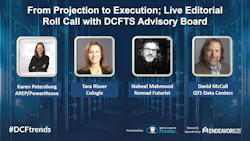
Rather than follow those remarks with a traditional opening keynote, DCF brought members of its Editorial Advisory Board onstage for a rapid-fire assessment of what had changed most since the previous Summit.
Their answers converged around a common point: demand remains extraordinary, but the ability to execute against that demand is increasingly determined by what happens at the seams between technology, construction, utilities, government, workforce and the public.
Data Centers Become Visible Infrastructure
For Tara Risser, Chief Business Officer at Cologix, one of the most consequential changes has occurred outside the data center itself.
“This is the year where it really feels like data centers went from invisible infrastructure to being very, very visible,” Risser said.
For much of the internet era, she noted, most consumers gave little thought to the physical infrastructure delivering digital services. AI has changed that.
The larger facilities, power requirements and accelerated development associated with AI have brought data centers much more directly into public debate. At the same time, the facilities have become a tangible representation of broader anxiety surrounding artificial intelligence, including questions about energy, water, jobs and the pace of technological change.
Communities are increasingly asking what they receive in return, Risser said, and why a large data center campus needs to be located near them rather than somewhere else. That has direct consequences for development.
Entitlement and permitting processes that data center developers once navigated with relatively little public attention can no longer be assumed to proceed quietly. Risser pointed to Data Center Watch research finding that local opposition blocked or delayed at least 75 U.S. data center projects worth roughly $130 billion in the first quarter of 2026 — roughly matching the scale the group tracked during all of 2025.
Instead, she said, developers need to become more transparent and build trust with engagment that begins before opposition hardens. Communication cannot simply be “an afterthought or a step in permitting,” Risser said.
The stakes may ultimately rival another constraint the industry already understands well. “I really believe this is going to be the next power crisis, so to speak,” she said.
At Scale, the Seams Begin to Matter
QTS Data Centers Brand Evangelist David McCall approached execution from inside the delivery machine itself.
McCall noted that some of the construction and operations professionals who populated industry events several years ago are now conspicuously absent. “They’re executing,” he said.
The observation led to a more consequential distinction. Speed, McCall argued, is becoming normalized across large data center organizations. The industry has learned to design, construct and commission facilities quickly.
Scale is proving more difficult. At today's development volumes, processes that worked effectively for smaller programs can begin to strain supply chains, organizations and project coordination.
Data center companies have become highly capable at the individual disciplines required to deliver infrastructure, McCall said. The more difficult problems increasingly appear between those disciplines.
“Those seams in between, the arrows in between, the handoff because of scale between these things is where it’s breaking,” McCall said.
That same problem extends outside project teams. Developers often communicate in megawatts, equipment specifications, economic impact and other metrics readily understood inside the industry.
Communities may be looking for a much more basic answer: What does the infrastructure actually do for them? Explaining that benefit — and proving it — has become part of execution as well.
Collaboration Moves Upstream
Nabeel Mahmood, Managing Director of Nomad Futurist, extended that argument into workforce development and public engagement.
The data center industry has become much better known, Mahmood said, but remains too inclined to discuss its challenges internally.
“The challenge is the fact that we are talking amongst ourselves,” he said. “We need to welcome the outsiders to come in and let them do the talking instead and listen.”
That means giving communities a meaningful place in the conversation rather than approaching engagement primarily as a means of gaining project approval.
It also means building the next generation of workers required to support the broader digital infrastructure ecosystem.
Mahmood described education, exposure and experience as necessary to create the industry's institutional “muscle memory” for future generations.
Karen Petersburg, Senior Vice President of Design & Engineering at AREP/PowerHouse Data Centers, brought the discussion back to the rapidly changing physical requirements inside the facility.
Chip platforms can evolve on cycles considerably shorter than the development timeline for a major data center, she said. Developers may begin planning facilities two years before the compute that will eventually occupy them arrives.
That creates a basic design problem: how to build infrastructure for the future without knowing precisely what will be placed inside it.
The answer increasingly requires much earlier coordination among developers, customers, semiconductor companies and utilities.
“You can’t do it in a silo anymore,” Petersburg said.
Developers may need NVIDIA or AMD participating earlier in infrastructure discussions. Utilities can no longer simply be treated as entities expected to deliver power after a request is submitted. Customers may need to become involved earlier as utilities demand stronger financial commitments before recognizing enormous load requests as real.
“We’re in the era of, I would say, collaboration,” Petersburg said.
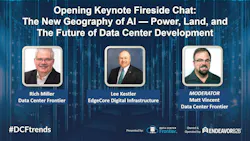
That observation provided a natural bridge into the Summit’s opening fireside discussion, where EdgeCore Digital Infrastructure CEO Lee Kestler and Data Center Frontier founder Rich Miller examined what those execution requirements mean for the emerging geography of AI infrastructure.
The Data Center Map Gets More Selective
For EdgeCore, finding viable development locations has become an exercise in aggressive filtering. Kestler said the company evaluated 172 sites during the previous 12 months to narrow the field to seven locations it wanted to actively manage.
Its requirements include roughly 100 acres or more, the ability to support a 300-MVA-or-larger substation, credible utility development timelines and sufficient network proximity to support what Kestler called “interdependent compute” locations.
The distinction matters. Not every AI workload needs the same geography, and not every site marketed as available for AI infrastructure can support the combination of land, network, power and timing required to make a project real.
Miller placed that process in the context of a data center map already being redrawn by power availability.
Northern Virginia's power constraints in 2022 provided an early warning, redirecting capacity into markets including Atlanta and driving developers farther afield in search of large blocks of electricity. AI has intensified the process.
As campus requirements move toward hundreds of megawatts and, in some cases, gigawatt scale, Miller said, fewer locations can satisfy all of the requirements simultaneously. Community acceptance is narrowing the map further.
At the same time, Miller pointed to a potential countertrend: the growth of AI inference could create another layer of data center geography. Some inference architectures may favor smaller, distributed facilities rather than concentrating every workload inside enormous campuses.
The result could be a more stratified infrastructure market. “Everything everywhere all at once,” Miller said.
Build Where Data Centers Are Wanted
For large campus development, Kestler offered another increasingly important filter.
EdgeCore wants to build where it is wanted.
In practical terms, that means targeting municipalities and jurisdictions that have already made deliberate decisions about where data center or other light industrial development belongs.
Kestler pointed to technology development zones and planned industrial areas in markets including Culpeper and Louisa County, Virginia, and Mesa, Arizona.
The goal is not to eliminate community engagement. It is to begin development in places where government, infrastructure planning and land-use expectations already recognize what is intended for the site.
Even then, community relationships require continued investment.
Kestler recalled earlier developments in Northern Virginia where residential neighborhoods arrived after data center facilities had already been built. That did not remove the operator's responsibility to work with homeowner groups and address local concerns.
“We want to make sure that when we do go into a place, we’re a member of the community, not just a tax revenue base,” Kestler said.
Miller agreed that long-term alignment increasingly needs to begin much earlier, with municipalities clearly defining where development makes sense and developers researching the communities they intend to enter.
The same principle applies to utilities.
What Does It Mean to Have Power?
One of the most consequential exchanges of the opening session came when Vincent asked a deceptively simple question:
When a developer says a site “has power,” what must actually be true?
For Kestler, the answer goes well beyond a large number attached to a parcel of land.
A credible powered site should have site-plan approval that accounts for the substation, equipment on order, a completed load-impact study establishing a realistic service range and a load ramp agreed upon against the utility system's ability to deliver.
Without those elements, large power claims deserve scrutiny.
The industry is entering a period, Kestler said, when “accuracy and deliberacy and transparency” around power and land will matter more.
That also changes the developer-utility relationship.
Kestler, who spent time at NextEra Energy after leaving Vantage Data Centers, said developers need to understand how utilities operate rather than entering meetings focused exclusively on what the data center needs.
A productive relationship begins with realistic discussions about timing, system capabilities, capital obligations and who pays for infrastructure at different stages.
His advice was deliberately simple: “Talk to them like they’re people.”
Getting More From the Grid We Already Have
Miller expanded the power discussion beyond traditional utility service.
Until recently, many data center operators viewed uninterrupted utility power as essentially non-negotiable. Grid constraints are forcing a closer look at flexibility.
The electric grid is built to accommodate peak demand, including the relatively small number of extreme periods when heat waves and other conditions push usage toward system limits. During much of the rest of the year, additional capacity may exist but remain difficult for large new loads to access under traditional arrangements.
That is creating new interest in batteries, curtailment agreements, workload management software and other strategies that can make data centers more responsive to grid conditions.
A facility able to ride through a critical period on battery storage, generators or flexible workloads may be easier for a utility to accommodate earlier than a load demanding maximum grid capacity around the clock.
Miller also pointed to emerging software and grid-analysis approaches designed to identify pockets of available power that conventional interconnection processes may overlook.
Behind-the-meter generation will remain part of the discussion as well.
But before assuming massive amounts of new generation and transmission can arrive quickly, Miller argued, the industry has a strong incentive to extract more usable capacity from infrastructure that already exists.
“Getting the most out of the grid we have,” he said, is likely to become increasingly important over the next several years.
Workforce Becomes Part of Site Selection
Power and land are not the only resources becoming harder to secure. Asked what keeps him up at night, Kestler pointed to labor.
The challenge is not simply finding people willing to work in data centers. New electrical architectures, higher voltages and changing equipment are creating training and safety requirements that evolve with the technology.
For EdgeCore, workforce availability now factors directly into development planning.
The company has invested in community college programs, technical education and apprenticeships in markets where it operates. Kestler pointed to graduates from technical programs in Culpeper moving into jobs across the broader digital infrastructure ecosystem, including electrical, plumbing, safety and other skilled trades.
The objective is to develop a durable labor pool capable of supporting campuses that may continue expanding for decades.
Miller said newer data center markets can learn from Northern Virginia by investing early in those education pipelines, particularly community colleges, high schools and the trades.
Power availability alone does not create a sustainable data center market if the workers needed to build and operate the infrastructure cannot be found locally.
Miller also cautioned against allowing public discussion of artificial intelligence to obscure the broader role of the infrastructure.
“AI does not equal data centers,” he said.
Data centers support AI, but they also support streaming, communications, cloud services and the wider internet economy on which consumers already depend.
That distinction may become increasingly important as the industry competes for workers and community support at the same time.
Building for Hardware That Hasn't Arrived Yet
The session's closing discussion returned to a problem that has followed the AI infrastructure boom from its beginning: how do developers construct facilities today when GPU platforms and rack architectures are changing so rapidly?
Kestler challenged the assumption that each technology generation necessarily makes existing infrastructure obsolete.
Developers still need a durable basis of design. They still need to order generators, switchgear and substation equipment years in advance. And they still need to make investment decisions before knowing exactly which hardware will occupy a building.
The answer, Kestler argued, is not attempting to predict every future GPU. It is building enough adaptability into the underlying infrastructure to accommodate change.
“What will become obsolete is the inability for you to convert what you already have because you didn’t think through it first,” he said.
That may also be one of the clearest definitions of the execution challenge confronting the data center industry in 2026.
Demand remains immense. The technology will continue moving. New markets will continue emerging.
But the differentiator now is increasingly what can actually be financed, powered, entitled, staffed, built, adapted and accepted by the communities around it.
The projections brought the industry to this point. Execution will determine what gets built next.
At Data Center Frontier, we talk the industry talk and walk the industry walk. In that spirit, DCF Staff members may occasionally use AI tools to assist with content.
Keep pace with the fast-moving world of data centers and cloud computing by connecting with Data Center Frontier on LinkedIn, following us on X/Twitter and Facebook, as well as on BlueSky, and signing up for our weekly newsletters using the form below.
About the Author
 Matt Vincent
Matt Vincent
Matt Vincent is Editor in Chief of Data Center Frontier, where he leads editorial strategy and coverage focused on the infrastructure powering cloud computing, artificial intelligence, and the digital economy. A veteran B2B technology journalist with more than two decades of experience, Vincent specializes in the intersection of data centers, power, cooling, and emerging AI-era infrastructure. Since assuming the EIC role in 2023, he has helped guide Data Center Frontier’s coverage of the industry’s transition into the gigawatt-scale AI era, with a focus on hyperscale development, behind-the-meter power strategies, liquid cooling architectures, and the evolving energy demands of high-density compute, while working closely with the Digital Infrastructure Group at Endeavor Business Media to expand the brand’s analytical and multimedia footprint. Vincent also hosts The Data Center Frontier Show podcast, where he interviews industry leaders across hyperscale, colocation, utilities, and the data center supply chain to examine the technologies and business models reshaping digital infrastructure. Since its inception he serves as Head of Content for the Data Center Frontier Trends Summit. Before becoming Editor in Chief, he served in multiple senior editorial roles across Endeavor Business Media’s digital infrastructure portfolio, with coverage spanning data centers and hyperscale infrastructure, structured cabling and networking, telecom and datacom, IP physical security, and wireless and Pro AV markets. He began his career in 2005 within PennWell’s Advanced Technology Division and later held senior editorial positions supporting brands such as Cabling Installation & Maintenance, Lightwave Online, Broadband Technology Report, and Smart Buildings Technology. Vincent is a frequent moderator, interviewer, and keynote speaker at industry events including the HPC Forum, where he delivers forward-looking analysis on how AI and high-performance computing are reshaping digital infrastructure. He graduated with honors from Indiana University Bloomington with a B.A. in English Literature and Creative Writing and lives in southern New Hampshire with his family, remaining an active musician in his spare time.
Voices of the Industry
 Image courtesy of Midea Building Technologies