DCF Trends Summit 2025: Beyond the Grid - Natural Gas, Speed, and the New Data Center Reality
By 2025, the data center industry’s power problem has become a site-selection problem, a finance problem, a permitting problem and, increasingly, a communications problem.
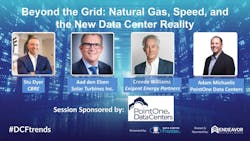
That was the throughline of “Beyond the Grid: Natural Gas, Speed, and the New Data Center Reality,” a DCF Trends Summit panel moderated by Stu Dyer, First Vice President at CBRE, with Aad den Elzen, VP of Power Generation at Solar Turbines (a Caterpillar company); Creede Williams, CEO & President of Exigent Energy Partners; and Adam Michaelis, Vice President of Hyperscale Engineering at PointOne Data Centers.
In an industry that once treated proximity to gas infrastructure as a red flag, Dyer opened with a blunt marker of the market shift: what used to be a “no-go” is now, for many projects, the shortest path to “yes.” Vacancy is tight, preleasing is high, and the center of gravity is moving both in scale and geography as developers chase power beyond the traditional core.
From 48MW Campuses to Gigawatt Expectations
Dyer framed the panel’s premise with a Northern Virginia memory: a “big” 48MW campus in Sterling that was expected to last five to seven years—until a hyperscale takedown effectively erased the runway. That was the early warning sign of what’s now a different era entirely.
Today, Dyer said, the industry isn’t debating 72MW or even 150MW blocks. Increasingly, the conversation starts at 500MW critical and, for some customers, pushes past a gigawatt. Grid delivery timelines have not kept pace with that shift, and the mismatch is forcing alternative strategies into the mainstream.
“If you’re interested in speed and scale… gas.”
If there was a sharp edge to the panel, it came from Williams’ assertion that for near-term speed-to-power at meaningful scale, natural gas is the only broadly viable option.
Williams spoke as an independent power producer (IPP) operator who “delivers electrons,” and he repeatedly brought the discussion back to the requirements that underwriting doesn’t let you avoid: firm fuel, predictable economics, and repeatable reliability. Intermittent resources may play a role, he argued, but they don’t solve the central problem for AI-era delivery schedules: you still need firm supply to make firm power.
Den Elzen largely agreed, while widening the aperture. Gas, he said, is not a hypothetical or a future bet. It’s already deployed at data centers today, across a range of sizes, and it’s increasingly being treated not just as a bridge, but as infrastructure that may persist alongside grid interconnection.
Michaelis captured the mood on the owner/operator side: gas may enter the conversation as a “bridge,” but once organizations normalize the concept of onsite generation, it tends to stick: because it works, and because it shows up faster than the utility queue.
The “Holy Trinity”: Water, Gas, and Transmission
Williams boiled development reality down to what he called a “Holy Trinity”: water, gas, and transmission. Miss any one of the three, and the project’s foundation is compromised.
He also drew a line between “gas is available” and “gas is financeable.” In his telling, many sites present interruptible gas: and interruptible fuel is incompatible with the reliability expectations of “critical” infrastructure. If a developer can’t secure firm, non-interruptible supply, Williams argued, it becomes difficult to model long-term economics or make credible commitments to customers.
Behind-the-Meter, but not “Anything Goes”
A recurring theme was that behind-the-meter generation isn’t a loophole; it’s more a different shape of complexity.
Williams emphasized that permitting and approvals still exist in force: site plans, zoning, air permits, design constraints, and the realities of building a power asset adjacent to (or inside) a data center master plan. In some jurisdictions, he noted, these installations are treated as auxiliary equipment supporting the data center rather than a “power plant” in the traditional sense, but that classification comes with limits and expectations.
One practical implication surfaced in the discussion: behind-the-fence power is typically not intended to be exported beyond the property line. It’s sized and designed as part of the data center’s use case, not as a merchant asset serving the broader grid—at least under many current structures.
“Recips” vs. Turbines: the Vocabulary Behind the Decision
Dyer also did what good moderators do: he admitted what many in the room were likely feeling. The industry is suddenly speaking a new language: reciprocating engines vs. turbines, quick-start characteristics, footprint, fuel flexibility, future fuels—and it can feel like learning power-generation “recipes” in real time.
Den Elzen laid out the trade space in plain terms:
-
Lead time can be the deciding factor, period. Whoever ships first wins some deals.
-
Footprint can favor turbines, depending on configuration.
-
Start speed often favors reciprocating engines; turbines may require system-level buffering if ramp time matters.
-
Fuel flexibility (including dual-fuel switching) can be an advantage for turbines, though technology is evolving on both sides.
-
Efficiency can favor reciprocating engines on fuel consumption, while turbines can offer different operational profiles and—critically—paths to combined-cycle efficiency gains if schedules and designs allow.
-
Future-proofing matters to some financers; den Elzen cited hydrogen-capable pathways as a real selection criterion in at least one project context, where financing depended on a plausible route to lower-carbon operation over time.
His bottom line: there is no universal answer, only project-specific optimization, and a need for data center and power-generation teams to learn each other’s constraints.
Reliability Isn’t Just Engineering—it’s Risk Allocation
The panel kept returning to a sobering reality: reliability is not only a technical specification. It’s also the foundation of contract structures, liquidated damages, and who eats the cost when something slips.
Williams described the gap between a traditional merchant model—optimized against markets—and behind-the-fence arrangements that are often more constrained, with “onerous” reliability requirements. He also warned that the sector will need enough sophistication to tell the difference between partners who can truly underwrite and deliver those obligations and those who can’t.
Den Elzen offered a related point from the equipment side: modularity isn’t only about delivery speed; it’s also about failure domains. Losing a single large unit can be a major pain event; smaller modules can support resilience and phased buildouts.
AI Load Swings: the System, not the Machine
A particularly current technical thread emerged around AI-driven load variability, involving sharp swings on very fast timescales.
Den Elzen pointed to a real-world example and described the core challenge: rotating generation equipment—turbines or reciprocating engines—cannot, by itself, absorb extreme fast load transients.
The answer, he said, is system design: capacitors, batteries, fast inverters, controls, and close coordination with the tenant’s load profile. Michaelis reinforced the practical limitation: the profile can change with each new chip generation, and “the right solution” today may be outdated surprisingly fast.
Workforce: Data Centers are Hiring “Power People”
If natural gas is becoming a new pillar of data center delivery, it’s also becoming a new staffing model.
Michaelis said PointOne hired a specialist with deep behind-the-meter EPC experience to navigate unfamiliar territory, because running a data center does not automatically translate into building and operating a power asset. Williams cautioned that long-term profitable operation is an “art,” with expensive lessons around pipeline redundancy, hedging exposure, and the realities of firm supply, and that knowledge that doesn’t always come packaged with utility experience alone.
The subtext seemed to be: the industry is building an internal power competency, just as it previously built internal utility-interconnection teams when “power as a constraint” became a standing condition.
Public Perception, Permitting, and the Obligation to Explain
Dyer pushed the panel to address the broader narrative battle: data centers, power demand, and public skepticism.
Den Elzen argued that gas power can be “very clean” relative to other fossil options—while also acknowledging the short-term “panic mode” of speed-first deployments. He suggested that when schedules allow, there is meaningful upside in combined-cycle approaches and in using waste heat more intelligently to drive efficiency (and improve the industry’s credibility in the process).
Audience questions brought the pressure points into sharper relief:
-
Will data centers drive up electricity rates?
-
Does behind-the-meter power isolate other ratepayers from new grid upgrade costs?
-
How realistic is nuclear in the near term, and what does the permitting fight look like?
-
Will gas-driven campuses push away from metros toward where pipelines already exist—and what does that mean for network density?
On rates, the panel’s answer was consistent: if data centers self-supply and self-fund, they can reduce the need for utilities to socialize massive infrastructure upgrades across broader customer bases.
On siting, Williams was skeptical that new pipelines would be welcomed into dense areas; others pointed to the reality that pipeline proximity will increasingly become a core diligence criterion; alongside fiber, land, and interconnection pathways.
Gas as Bridge—and as Baseline
The closing sentiment wasn’t a victory lap. It was an acknowledgment of the moment.
Natural gas is not arriving as a perfect solution, and the panelists didn’t pretend it was. They described it as the option that matches the industry’s current constraints: scale, speed, firm power, financeability, and the uncomfortable truth that grids and permitting regimes are not built for the timeline expectations of AI-era compute.
Dyer ended where he began: the industry has moved into a new reality. Natural gas is no longer the thing you avoid. It’s increasingly the tool you evaluate—carefully, soberly, and in full view of the tradeoffs—because the alternative, for many projects, is simply not getting built on time at all.
At Data Center Frontier, we talk the industry talk and walk the industry walk. In that spirit, DCF Staff members may occasionally use AI tools to assist with content. Elements of this article were created with help from OpenAI's GPT5.
Keep pace with the fast-moving world of data centers and cloud computing by connecting with Data Center Frontier on LinkedIn, following us on X/Twitter and Facebook, as well as on BlueSky, and signing up for our weekly newsletters using the form below.
About the Author
 Matt Vincent
Matt Vincent
Matt Vincent is Editor in Chief of Data Center Frontier, where he leads editorial strategy and coverage focused on the infrastructure powering cloud computing, artificial intelligence, and the digital economy. A veteran B2B technology journalist with more than two decades of experience, Vincent specializes in the intersection of data centers, power, cooling, and emerging AI-era infrastructure. Since assuming the EIC role in 2023, he has helped guide Data Center Frontier’s coverage of the industry’s transition into the gigawatt-scale AI era, with a focus on hyperscale development, behind-the-meter power strategies, liquid cooling architectures, and the evolving energy demands of high-density compute, while working closely with the Digital Infrastructure Group at Endeavor Business Media to expand the brand’s analytical and multimedia footprint. Vincent also hosts The Data Center Frontier Show podcast, where he interviews industry leaders across hyperscale, colocation, utilities, and the data center supply chain to examine the technologies and business models reshaping digital infrastructure. Since its inception he serves as Head of Content for the Data Center Frontier Trends Summit. Before becoming Editor in Chief, he served in multiple senior editorial roles across Endeavor Business Media’s digital infrastructure portfolio, with coverage spanning data centers and hyperscale infrastructure, structured cabling and networking, telecom and datacom, IP physical security, and wireless and Pro AV markets. He began his career in 2005 within PennWell’s Advanced Technology Division and later held senior editorial positions supporting brands such as Cabling Installation & Maintenance, Lightwave Online, Broadband Technology Report, and Smart Buildings Technology. Vincent is a frequent moderator, interviewer, and keynote speaker at industry events including the HPC Forum, where he delivers forward-looking analysis on how AI and high-performance computing are reshaping digital infrastructure. He graduated with honors from Indiana University Bloomington with a B.A. in English Literature and Creative Writing and lives in southern New Hampshire with his family, remaining an active musician in his spare time.
Related
Voices of the Industry
 Source: SNEHIT PHOTO/Shutterstock.com
 Source: Matthew G Eddy/Shutterstock.com