Data Centre West 2026: Alberta Moves From Data Center Ambition to Execution
Key Highlights
- Alberta has moved beyond potential discussions, focusing now on rapid project delivery amid AI-driven demand growth.
- Certainty in power supply, permitting, and community acceptance is critical for Alberta to scale its data center industry.
- AI inference workloads are reshaping infrastructure needs, emphasizing flexibility in cooling, power, and connectivity.
- Hybrid power solutions—grid, onsite generation, and storage—are likely to define Alberta’s data center architecture.
- Regulatory clarity and infrastructure readiness are essential; Alberta’s success depends on swift, coordinated execution.
The most revealing thing about Data Centre West 2026 may have been how little time anyone spent making the basic case for Alberta. That case has largely been made.
For several years, Western Canada’s data center conversation revolved around potential: abundant energy resources, available land, a cool climate, growing cloud demand, favorable economics and the possibility that Alberta could develop into a meaningful alternative to North America’s increasingly constrained data center hubs. In Calgary this September, the conversation had moved on. “Why Alberta?” has increasingly been replaced by a much more consequential question: How quickly can you actually deliver?
Across the opening keynote and a succession of panels covering hyperscale development, colocation, AI inference and power, Data Centre West returned repeatedly to the same dividing line. Announced megawatts are plentiful. AI demand is real. Capital is available. What is scarce is certainty.
Certainty that a first block of power will arrive when promised. Certainty that the transmission, generation and fuel behind it are real. Certainty that cooling infrastructure can support rapidly changing rack densities. Certainty that a project can make it through permitting and community review. And certainty that a data center built for the current AI cycle will remain useful when the next generation of compute arrives.
That is a different stage of market development. Alberta is moving from proving that it belongs in the data center conversation to confronting the much harder work of becoming a data center market at scale.
From Potential to Proof
Western Canada Data Centre Alliance founder and president Vlad Oujegov opened the conference by pointing to a room of roughly 500 attendees and an Alberta market that, only a few years ago, would have been difficult to imagine at that scale.
Oujegov said he had recently counted more than 30 open full-time data center positions on Alberta job boards, even as the province remained near the beginning of its development curve.
More significant was his contention that the scale of projects now entering Alberta is capable of transforming the local industry almost overnight. Oujegov said the Meta project announced this summer could increase Alberta’s existing data center industry tenfold over several years.
The message was not simply that large projects are coming. It was that Alberta is beginning to acquire the characteristics of an infrastructure cluster: cloud deployments, colocation capacity, power development, construction expertise, suppliers and specialized labor beginning to reinforce one another.
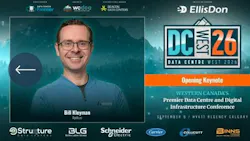
That point was picked up by Bill Kleyman, CEO of Apolo, in his opening keynote. Kleyman placed Alberta inside a much larger global contradiction. AI demand is producing extraordinary development pipelines, but only a fraction of what is proposed is actually making its way into construction.
Citing data presented in his AFCOM State of the Data Center 2026 research, Kleyman pointed to a global development pipeline of approximately 264 GW, with only about 6.9% under construction.
The implication was straightforward: the industry has to become much better at separating actual demand from option value. A 1-GW data center campus on a presentation slide does not carry the same value as the first 50 or 100 MW that can actually be energized.
“Not all megawatts are created equal” became one of the morning’s recurring ideas. And increasingly, power is not simply one input in the data center development process. It is the scheduler.

Hyperscalers Are Buying a Date
That shift was especially clear during the morning’s Hyperscale Outlook panel.
Angela Adam of eStruxure said customers no longer ask why Alberta. They understand the market proposition. What they increasingly want to know is whether an operator can deliver capacity on a specific date.
Customers, Adam said, are no longer simply buying megawatts. They are buying a credible date around which they can construct their own business plans. That distinction changes how data centers have to be developed.
Waiting for a completely signed customer contract before beginning work may protect against speculative development, but it can also make competitive delivery dates impossible. Building everything to a highly customized specification before the customer is committed creates the opposite problem.
The emerging strategy sits somewhere between the two. How so? Advance the things that take the longest and can serve the widest range of customers: land, power, permitting, operating pathways and community acceptance. Preserve enough flexibility to configure the final facility around the customer once the contract is signed.
Dermot Callaghan of Beacon Data Centers, who previously spent a decade developing infrastructure at Google, reduced hyperscale deliverability to three elements: energy, development pathway and scalability. Hyperscalers, he said, can see through headline gigawatt numbers quickly.
They want to know where the electrons are coming from, whether equipment and permits are real, how quickly the first data hall can be placed in service, and whether the supply chain and labor force can continue delivering after that first tranche.
The first request-for-service date increasingly matters more than the ultimate campus number. That puts enormous value on a credible first block. It also complicates one of Alberta’s central power strategies: bring-your-own-generation.
Callaghan argued that onsite generation can materially shorten a development schedule when utility upgrades might otherwise require years. But it does not remove risk. It transfers that risk. Instead of waiting on the utility, the developer may now be responsible for gas contracting, air permits, generation equipment, operating performance and longer-lead infrastructure.
AWS Vice President Shannon Kellogg added another dimension. Bring-your-own-generation should remain available, he said, but the industry also has an interest in investing in the grids where it operates. That matters because the data center power debate is increasingly inseparable from energy affordability.
For hyperscalers planning assets with long operating lives, regulatory certainty may therefore matter as much as regulatory leniency. Kellogg said AWS values Alberta’s willingness to define expectations clearly: the province wants data centers, but it is also establishing standards operators know they will be expected to meet.
For capital-intensive infrastructure, knowing the rules early is itself a competitive advantage.
Community Acceptance Becomes Part of the Design
One of the strongest themes of the morning was that those rules increasingly extend beyond the electrical system. To wit: Community acceptance is becoming infrastructure.
Rachel Attebery of Diode Ventures described a two-year rezoning process for a data center project in Wheatland County that required three application submissions, repeated technical studies, third-party validation and voluntary community-engagement sessions.
Her account was notable because it did not dismiss project opposition as an information problem. Some of the information circulating about data centers may be inaccurate, Attebery said, but “the fear is very real.”
That distinction matters. Developers facing worried residents cannot assume that another fact sheet will solve the problem. At Wheatland County, the process became a negotiation over what the project itself would become.
Diode had initially considered onsite generation. Community feedback made clear that approach would not be acceptable. The development changed course.
The company also committed that ongoing industrial cooling would not draw from surface water, aquifers or groundwater, instead relying on air-cooled or closed-loop systems. Those were not simply talking points offered at an open house. Attebery said the commitments became conditions tied to the approved rezoning.
That gave elected officials something tangible to defend. Rather than telling constituents merely that the economic benefits outweighed their concerns, officials could point to project changes and mitigation measures obtained through the review process.
Kleyman made a related point during his keynote. For decades, the data center industry deliberately cultivated invisibility: nondescript buildings, limited public discussion and extensive nondisclosure agreements.
That model worked reasonably well when individual facilities represented modest power loads tucked into industrial parks. It works less well when projects arrive asking communities to accommodate hundreds of megawatts of demand, new transmission, generation, cooling systems and years of construction.
The industry can no longer rely on being misunderstood because it preferred not to be noticed.

Inference Changes the Map
If hyperscale development is forcing Alberta to rethink how infrastructure gets delivered, AI inference may change where that infrastructure needs to live.
Data Center Frontier’s “Colocation & Inference Trends” panel examined the other side of the AI infrastructure buildout: what happens after models leave giant training campuses and begin interacting continuously with applications, enterprise data, networks and users.
Earl McKoon of datacenterHawk said the market is already beginning to show two different inference deployment patterns.
Some customers are taking large, metro-specific deployments in the range of roughly 20 MW to 60 MW. Others are pursuing distributed architectures with perhaps 1 MW to 10 MW deployed across 20 or 30 metropolitan areas.
James Beer, CEO of Qu Data Centers, said his company is already seeing relentless Canadian demand around 1 MW to 2.5 MW.
Those deployments can look strikingly different from the giant liquid-cooled AI campuses dominating industry headlines. Beer described medium-density requirements in the range of roughly 20 to 30 kW per cabinet, often still air-cooled but highly dependent on network connectivity, carrier diversity and operational reliability.
Latency is central. Sean Maskell, president and general manager of Cologix Canada, said customers do not necessarily describe these installations as “inference.” They call them production.
That may be the more useful distinction. Training requires enormous concentrations of compute to build models. Production requires those models to interact with the rest of the digital economy. Training can chase large blocks of available power. Inference increasingly has to chase connectivity and users.
Maskell compared the large training campus to a university: students gather in one place to learn. Once they go to work, they disperse. AI production workloads face a similar geographic pressure.
An inference platform generating an actual business outcome may need to reach enterprise databases, payment systems, logistics platforms, inventories, public clouds and end users in near real time. That pulls portions of AI infrastructure back toward established metropolitan interconnection markets.
It also creates a potentially important role for colocation. Maskell agreed with the idea that colo could become the “connective tissue” of enterprise AI: the place where private data, public cloud, GPU infrastructure, networks and AI platforms meet.
What Does “AI-Ready” Actually Mean?
That distributed future also complicates one of the industry’s most overused phrases: AI-ready.
There is no single AI-ready specification. A customer may need 50 kW per rack today but expect to move toward liquid cooling 18 or 24 months later. Another may simply require high-quality network access to externally hosted GPU infrastructure.
For Maskell, the common denominator is flexibility: power headroom, cooling choices and the operational capability to manage changing infrastructure. Beers identified cooling as one of the harder design problems.
Once utility power has been secured, the electrical configuration inside a data center is relatively understandable. Thermal design is becoming much less uniform. Operators may have to accommodate traditional air cooling, rear-door heat exchangers, direct liquid cooling and in-row systems within the same broader portfolio. The difficult question becomes how far to build before the customer’s precise architecture is known.
That echoed Kleyman’s keynote, where he described average rack density reaching approximately 27 kW across the facilities represented in AFCOM research while the industry begins discussing architectures measured in hundreds of kilowatts and, increasingly, the possibility of 1-MW racks.
The significance is not that every data hall is suddenly heading to a megawatt per rack. It is that AI is pushing thermal infrastructure much earlier into the development decision.
The modern data center has to be designed around uncertainty.
The Economics of Inference Could Drive Another Shift
Beer also raised a less-discussed constraint: the cost of AI consumption itself. Enterprises went through one financial reckoning with public cloud as variable consumption expanded and CIOs began scrutinizing unexpectedly large bills. AI could produce a similar moment around tokens.
As enterprises deploy AI more broadly across their workforces, Beer expects executives to begin asking whether the productivity gains justify the consumption costs and whether some inference workloads should move onto privately controlled GPU infrastructure closer to existing CPU workloads and enterprise applications.
That could create another natural demand driver for metro colocation. Canada adds another variable: sovereignty.
Beer described the issue as “sovereignty, not solitude.” Canadian organizations may want Canadian teams, Canadian infrastructure and Canadian networks - without pretending the country can isolate itself from the global chip, cloud and AI ecosystem.
Maskell offered a similar formulation: choice without isolation.
That means sovereignty is unlikely to produce a wholly separate Canadian technology stack. It may instead influence where workloads are stored, who operates the infrastructure and how customers connect local environments to global platforms.
McKoon cautioned that the leasing evidence remains mixed. Some operators are seeing sovereign requirements translate into business. Others are still waiting. And even in the inference market, power availability continues to exert the strongest pull.
Asked to choose between customer geography and available power, both Maskell and Beer ultimately landed on power. Inference may chase users. But without electricity, it cannot chase anything.

Firm Power Is an Architecture
That brought the morning back to its recurring problem: What counts as available power?
During the “Solving for Power” panel, moderator Lillian Kasa of Metlen Energy & Metals argued that data centers cannot operate on announcements. They need reliable electricity delivered on a schedule and backed by a commercial structure that can be financed.
Margarita Patria of Charles River Associates made the distinction even sharper. Firm power is not merely generation. It is generation, transmission and fuel availability working together.
Todd Detling of FortisAlberta added an important Alberta-specific qualification. Despite perceptions that the province had substantial transmission capacity available for new development, FortisAlberta is encountering constraints, particularly around the Edmonton and Calgary fringes.
At the distribution level, the demand is already material. Detling said FortisAlberta has connected nearly 80 MW of data center load over the past several years, has approximately another 80 MW in the build queue, and has received roughly 300 MW in additional requests.
Those smaller increments matter in a market dominated rhetorically by gigawatt announcements. They are another indication that developers are searching for power pathways they can execute now.
AI Is Not Just a Bigger Load
Tesla’s Sean Jones added another technical wrinkle: AI training loads can change extremely quickly.
Data center power planning traditionally focuses heavily on annual consumption, peak demand and hourly load. GPU clusters can create significant changes at the second or even sub-second level.
Jones described AI training demand falling from full load to around 30% in less than a second. That kind of movement can be difficult for onsite turbines and reciprocating generators to follow and potentially disruptive to the grid.
Battery energy storage is therefore taking on a different role. The familiar data center battery story is backup power. The emerging AI story is power quality.
Storage can act as an electrical buffer between rapidly changing GPU loads and generation assets that respond more slowly. It may also help data centers meet voltage, load-stability and ramp-rate requirements, participate in demand-response programs, or increase utilization of an existing power feed.
That makes batteries less an isolated piece of backup infrastructure than part of the interface between AI compute and the power system.
Matthew Swinamer of Collicutt Energy Services made a corresponding point about onsite generation. It can accelerate a project dramatically because developers gain more control over timing.
But again, it does not eliminate risk. Permitting, emissions, fuel infrastructure, noise and equipment availability all become the developer’s problem. As Callaghan had argued earlier in the morning, risk moves. It does not disappear.
The Data Center as a Grid Participant
The longer-term result may be a fundamental change in the relationship between data centers and utilities.
Historically, a large facility asked for firm service and the utility supplied it. The scale and behavior of emerging AI loads increasingly make that model difficult.
Patria pointed to evolving large-load policies in U.S. power markets where flexibility could become part of the price of earlier interconnection.
Instead of waiting five or more years for unconditional firm service, a data center might accept curtailment conditions or demonstrate that batteries, onsite generation or other systems can reduce its demand during periods of system stress.
Detling said FortisAlberta is already testing demand-response concepts. Jones divided the emerging requirements into two groups.
Some are likely to become basic conditions of connection: stable loads, voltage ride-through capability and behavior that does not destabilize the grid. Others could become incentives.
Bring additional generation. Add storage. Accept demand response. Offer flexibility. In return, receive power sooner. That transforms the data center from a passive industrial consumer into an active component of the energy system.
Alberta’s Likely Answer: Hybrid
By the end of the power panel, there was substantial agreement about the direction Alberta is likely to take. To wit: Hybrid.
Grid power where available. Onsite or nearby generation where needed. Batteries to smooth load and support system requirements. Renewable generation where economic. Flexible interconnection where appropriate.
And, eventually, greater integration among all of them.
The reason is simple arithmetic. Alberta’s existing interconnected system was built over generations. Data center developers are now contemplating several gigawatts of new load on timelines measured in years.
The grid cannot simply absorb every announced project immediately. Nor is it realistic to assume that every large data center will permanently become an electrical island. The practical answer is likely to sit between the two.
Kasa closed the discussion with a formulation that captured much of the morning: The projects most likely to move forward will not necessarily be those making the largest announcements. They will be those with the most credible, firm and financeable path to power.
That may ultimately describe Alberta’s opportunity better than any gigawatt forecast. Cheap energy alone will not create a major data center market. Neither will land, tax policy, natural gas, hyperscaler interest, cooling technology or political support considered separately.
The winners will be the projects capable of assembling all of it into something that can actually be delivered. That was the larger message running through Data Centre West 2026. Alberta no longer needs to prove that AI infrastructure is interested in locating there. Now it has to prove that it can execute.

The Demand Window Will Not Stay Open
Execution, however, is occurring against a demand curve that is still accelerating. Gordon Dolven, who leads data center research for the Americas at CBRE, put numbers around that acceleration in a morning market update.
Observed token usage across major large language models from OpenAI, Anthropic and Google has increased roughly tenfold year over year, Dolven said, adding another demand engine to the cloud and digitalization trends that drove the previous generation of data center growth.
The infrastructure market has responded accordingly.
CBRE’s data shows rental rates have rebounded approximately 70% from their 2020 lows. In major U.S. markets, the amount of colocation capacity under construction has risen roughly fifteenfold since 2020, while the percentage of that capacity already pre-leased has climbed from around 50% in 2020 to approximately 80% during the first half of 2026.
And the next demand wave may extend well beyond today’s familiar generative AI applications. Dolven pointed toward industrial automation and robotics, where proprietary models operating closer to physical systems could create another layer of infrastructure requirements that is only beginning to appear in current forecasts.
That growth creates an obvious opportunity for Alberta. It also creates a clock. A supply chain and innovation panel that followed Dolven’s presentation repeatedly returned to the same constraint heard throughout the morning: demand is not the problem. Delivering infrastructure fast enough to serve it is.
Shitiz Agarwal, vice president of power systems at Schneider Electric, said the industry understands how to generate electricity and build data centers individually. The challenge is integrating generation, grids, equipment, developers and construction at a pace the infrastructure business has not traditionally been built to support.
“AI is working at digital speed,” Agarwal said. “Infrastructure is built at infrastructure speed.” The companies that succeed, he argued, will increasingly be those capable of mastering the entire delivery ecosystem rather than optimizing one component inside it.
Open Compute Project Chief Innovation Officer Cliff Grossner described how that complexity now runs all the way from silicon to the grid.
Advanced semiconductor capacity remains constrained, while a widening variety of AI accelerators introduces different power and thermal characteristics. Those differences cascade outward: cooling must adapt at the rack, electrical distribution must adapt inside the facility, and power systems ultimately have to accommodate load profiles that vary by compute architecture.
The infrastructure itself is already beginning to change. Grossner pointed to 800-volt DC distribution architectures being developed for extremely high-density racks, along with future work around high-temperature superconducting cables. Co-packaged optics, which moves optical networking closer to the semiconductor itself, is another technology he expects to receive significant attention during the next two years.
But not every innovation requires entirely new technology. David Bell, vice president of development for behind-the-meter power developer VoltaGrid, described adapting reciprocating-engine systems to cope with AI loads capable of changing by as much as 70% almost instantaneously.
His team also redesigned plant architectures around more readily available electrical equipment, allowing 50-MW generation projects to move more quickly rather than competing directly with utilities for the same constrained transformers and breakers.
That kind of systems thinking may matter as much as the next breakthrough component. So will policy. Bell argued that capital markets care less about whether every rule is favorable than whether the rules are stable.
“Just tell me what the rules are and I’ll play within the confines of the rules,” he said. “But don’t change them on me every 15 minutes and then expect me to grow my enterprise.”
That theme surfaced repeatedly throughout Data Centre West. For developers committing billions of dollars to infrastructure with multi-year delivery schedules, regulatory certainty itself has economic value.
Agarwal said closer coordination among federal and provincial governments, grid operators and energy providers could remove many of the bottlenecks now slowing development.
Bell supplied an extreme example from Texas, where he said a state air permit for a 2-GW power project was processed in 72 hours after extensive advance preparation and clear compliance with the regulator’s requirements.
Grossner, meanwhile, called Alberta a Canadian trailblazer and said the Open Compute Project is developing a Canadian regional chapter intended to help local technology companies build in Canada while reaching global markets.
The opportunity is significant. But Agarwal offered perhaps the most important qualification of the morning.
Canada, he said, is currently capturing only a portion of the data center demand available to it because the infrastructure and processes needed to accommodate more are not yet ready. Will that demand remain available forever?
No, said Agarwal. There may be several years in which Canada can capture more of it, he said, but only if infrastructure and policy move quickly enough.
That gives Alberta’s execution challenge a deadline. The province has moved beyond needing to prove that global AI infrastructure is interested. It now has to convert that interest into operating infrastructure while the opportunity is still there.
At Data Center Frontier, we talk the industry talk and walk the industry walk. In that spirit, DCF Staff members may occasionally use AI tools to assist with content.
Keep pace with the fast-moving world of data centers and cloud computing by connecting with Data Center Frontier on LinkedIn, following us on X/Twitter and Facebook, as well as on BlueSky, and signing up for our weekly newsletters using the form below.
About the Author
 Matt Vincent
Matt Vincent
Matt Vincent is Editor in Chief of Data Center Frontier, where he leads editorial strategy and coverage focused on the infrastructure powering cloud computing, artificial intelligence, and the digital economy. A veteran B2B technology journalist with more than two decades of experience, Vincent specializes in the intersection of data centers, power, cooling, and emerging AI-era infrastructure. Since assuming the EIC role in 2023, he has helped guide Data Center Frontier’s coverage of the industry’s transition into the gigawatt-scale AI era, with a focus on hyperscale development, behind-the-meter power strategies, liquid cooling architectures, and the evolving energy demands of high-density compute, while working closely with the Digital Infrastructure Group at Endeavor Business Media to expand the brand’s analytical and multimedia footprint. Vincent also hosts The Data Center Frontier Show podcast, where he interviews industry leaders across hyperscale, colocation, utilities, and the data center supply chain to examine the technologies and business models reshaping digital infrastructure. Since its inception he serves as Head of Content for the Data Center Frontier Trends Summit. Before becoming Editor in Chief, he served in multiple senior editorial roles across Endeavor Business Media’s digital infrastructure portfolio, with coverage spanning data centers and hyperscale infrastructure, structured cabling and networking, telecom and datacom, IP physical security, and wireless and Pro AV markets. He began his career in 2005 within PennWell’s Advanced Technology Division and later held senior editorial positions supporting brands such as Cabling Installation & Maintenance, Lightwave Online, Broadband Technology Report, and Smart Buildings Technology. Vincent is a frequent moderator, interviewer, and keynote speaker at industry events including the HPC Forum, where he delivers forward-looking analysis on how AI and high-performance computing are reshaping digital infrastructure. He graduated with honors from Indiana University Bloomington with a B.A. in English Literature and Creative Writing and lives in southern New Hampshire with his family, remaining an active musician in his spare time.
Related
Voices of the Industry
 Source: Adobe Stock, courtesy of ebm-papst
 Source: Champion Fiberglass