When AI Compute Meets Real-World Infrastructure: What Operators Need to Know
The era of AI-optimized data centers has shifted from theoretical conversations to operational realities. As operators plan and manage facilities supporting NVIDIA’s latest high-density accelerators, like the B300, infrastructure teams are confronting a simple truth: compute isn’t the bottleneck — power distribution and thermal management are.
NVIDIA’s accelerator platforms (including B300 systems) deliver vastly increased performance per device, but they also demand more from infrastructure than legacy IT loads.
The B300 Reality Check: Power & Cooling at Scale
From an operator’s standpoint, the raw specs of a modern AI accelerator like the NVIDIA B300 underscore why infrastructure matters:
- These systems can draw ~142kW per rack or upwards of 2,432kW per cluster at 415VAC. Average rack density in legacy data centers likely ranges between 4 to 12kW.
- These systems consume power in a way unlike traditional IT loads requiring a deep understanding of waveforms and workload profiles to avoid undesirable interaction with existing infrastructure (like UPS, generators, and others).
- These systems will require 8EA, 60A cords per “AI rack” in a 4 to make 3 configuration, which takes up considerable space above or below the rack.
- These systems are heavy and can weigh 3,000 lbs./rack or 56,000 lbs. for a 1152 GPU Cluster occupying 247 sq ft of floor space. This equates to an average floor loading of 226.7 lbs./sq. ft., which can pose a challenge for some facilities.
- These systems introduce the OCP, ORV3 topology that provisions 48VDC to an integral bus bar at the rack level. This architecture will require an operational upskilling to minimize risk and maintain reliability and availability.
- These systems require direct-to-chip liquid cooling, which brings liquid to the rack and conversely the compute tray, but these systems also need roughly 18.46kW of air support at the rack level. This architecture will require an operational upskilling of support staff to maintain both the facility and the technical cooling loops.
For data centers built decades before GPU-scale throughput, these realities translate into challenges that ripple through design, operations, and cost models which force upgrades to support this densification:
- Electrical infrastructure: Upgrading switchgear, PDUs, busways, generation, and UPS systems to reliably deliver tens to hundreds of kilowatts per rack while maintaining reliability, redundancy, availability, and sustainability targets.
- Cooling infrastructure: Deploying liquid loops, chillers, and robust coolant distribution units (CDUs) that can carry heat efficiently without localized hotspots.
This is where validated reference designs and holistic management platforms no longer feel like vendor marketing — they become operational necessities.
Schneider Electric’s Reference Design 111: A Blueprint for the Next Generation
To help bridge the gap between AI hardware and real-world facilities, Schneider Electric’s AI-optimized reference designs codify power and cooling strategies for environments with rack densities up to ~142 kW per rack built around NVIDIA GB300 NVL72 systems.
Although marketed in partnership with NVIDIA, the guidance in these frameworks is extremely valuable for any operator integrating accelerated parallel compute:
What the Reference Designs Address
- Power infrastructure specification
- Detailed frameworks for facility power and distribution architectures that support high-density racks.
- Integration with high-capacity, remotely monitored PDUs and RPPs with redundant power feeds.
- Liquid cooling integration
- Guidance on deploying direct-to-chip liquid loops and coordinating with facility chillers or adiabatic systems.
- Plans tuned to dense GPU clusters ensure heat is removed effectively without stranding capacity or creating thermal bottlenecks.
- Operational standards
- Establishing real-time rack power profiles and introducing best practices for power quality monitoring and thermal profiling.
- Frameworks that enable simulation via digital twin tools so planners can see how power and heat behave under real load before committing infrastructure spend.
For operators, the reference designs aren’t a one-size-fits-all prescription. Rather, they’re diagnostic frameworks that reduce risk by aligning facility specs with the unique load characteristics of AI hardware like B300 clusters.
EcoStruxure Pod and Rack Solutions: Modular, Monitored, and AI-Ready
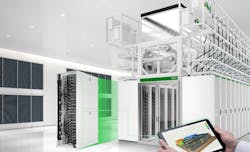
As operators grapple with these demands, modular infrastructure like Schneider Electric’s EcoStruxure AI Pod is emerging as a compelling way to deploy and manage high-density compute without reinventing the wheel.
What EcoStruxure Brings to the Table
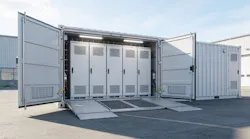
- Modular Pod Architecture: Pre-engineered pods unify power delivery, busway distribution, cooling systems, and rack infrastructure into factory-assembled units designed for scale — often reducing onsite build times and construction risk.
- Integrated Cooling & Power: By integrating liquid cooling and advanced busway power systems from the outset, pods are ready to host racks with 100 kW+ capacities, making them ideal for clusters built around B300 or similar systems.
Monitoring and Management with EcoStruxure
A critical component of the EcoStruxure ecosystem is real-time monitoring and analytics through tools like EcoStruxure IT:
- End-to-end visibility: Operators can track power consumption, thermal performance, coolant loop health, and other key metrics across both facility and IT layers from a unified dashboard.
- Predictive insights: Data collected can feed into analytics and predictive maintenance tools — surfacing anomalies before they become failures and helping teams tune cooling curves around AI workload profiles.
- Operational continuity: Alerts and thresholds integrate with automation systems so HVAC, power, or CDU adjustments can be triggered without manual intervention — a key advantage when sustaining densely packed GPU environments.
This operational feedback loop — from sensors to analytics to action — turns what used to be static infrastructure into a responsive, intelligent environment, resilient to the dynamic loads and thermal swings that B300 deployments introduce.
Wrapping Up: From Compute Density to Operational Confidence
For operators, the story of NVIDIA’s B300 and similar high-performance accelerators isn’t just about compute performance — it’s about the infrastructure that makes that performance sustainable and cost-effective. Without power delivery upgrades, advanced cooling techniques, and sophisticated monitoring, these systems could overwhelm even well-funded data halls.
Schneider Electric’s reference design frameworks (e.g., Reference Design 111) and EcoStruxure Pod & Rack Solutions with integrated monitoring provide practitioners with a pragmatic, validated playbook — one that aligns facility capabilities with hardware requirements, reduces deployment risk, and delivers operational confidence in a world where AI workloads are only getting more demanding.
About the Author

Vance Peterson
Vance Peterson is a Solutions Architect with Schneider Electric. An industry veteran, Vance brings over 30 years of experience working with end users, OEMs, and service providers supporting mission-critical facilities and data centers. His expertise spans both electrical and mechanical engineering, and he excels in balancing risk and operational management, making him an indispensable asset in the design and delivery of products and services for data centers. Vance collaborates with a team of highly skilled professionals to deliver cutting-edge and innovative solutions for data centers.
Schneider Electric is your energy technology partner. We electrify, automate, and digitalize every industry, business and home, driving efficiency and sustainability for all; leading the convergence of electrification, automation, and digital intelligence into what we define as energy technology. We invent the technology that makes the energy transition possible, enabling buildings, data centers, factories, plants, infrastructure, and grids to operate as open software-defined systems, simplifying complexity and enabling smarter, more sustainable operations across every sector.

Allegia (Gia) Wiryawan
Allegia (Gia) Wiryawan is a Senior Systems Design Engineer with Schneider Electric. She evaluates and analyzes new trends and technologies relevant to data centers, specifically power system architectures and energy storage technologies. Gia specializes in evaluating and analyzing emerging trends and technologies, focusing on power system architectures and energy storage. Her work includes developing reference design packages that integrate thought leadership and showcase our latest innovations, providing actionable strategies for optimizing data center operations. Gia holds a Bachelor’s degree in Electrical Engineering with a minor in Computer Science from Tufts University. With a strong foundation in technical knowledge and analytical capabilities, she drives progress in the design and implementation of advanced data center technologies.
Schneider Electris is your energy technology partner. We electrify, automate, and digitalize every industry, business and home, driving efficiency and sustainability for all; leading the convergence of electrification, automation, and digital intelligence into what we define as energy technology. We invent the technology that makes the energy transition possible, enabling buildings, data centers, factories, plants, infrastructure, and grids to operate as open software-defined systems, simplifying complexity and enabling smarter, more sustainable operations across every sector.
Voices of the Industry