An Industry Moving at AI Speed: Challenges and Opportunities
Last week we launched our article series on how data center leaders are rethinking cooling strategies, embracing modularity, and preparing their facilities to support AI at scale with confidence and resilience. This week, we’ll examine where legacy infrastructure begins to break down and why an industry built for predictability is now being forced to operate at AI speed.
For years, airflow management in data centers followed a stable and repeatable playbook. Raised floors, hot and cold aisle containment, and air-based cooling strategies were sufficient for workloads that behaved predictably and scaled gradually. Thermal management was largely an exercise in optimization, not reinvention.
The challenge extends beyond temperature alone. Air quality, pressure balance, and cleanliness now directly influence system performance and reliability. In environments where individual racks represent significant capital investment, airflow stability is no longer a background concern. It is a limiting factor.
Let’s dive further into where traditional cooling approaches begin to break down, why air can no longer be treated as a passive resource, and how operators are responding as density, power, and operational complexity accelerate.
Staying Cool Under Pressure
If the first phase of AI adoption felt disruptive, the second has felt abrupt. Many operators describe the last 18 to 24 months as a period where infrastructure requirements appeared to change almost overnight. Planning cycles that once spanned years have compressed into quarters. Decisions that were previously made with a long runway now carry immediate consequences.
According to the AFCOM State of the Data Center report, average rack densities have climbed rapidly, reaching roughly 27 kW per rack today, with 79 percent of operators expecting further increases, largely driven by AI and accelerated computing workloads. Just a note, this was the largest year-over-year jump in rack density ever recorded in the report.
What makes this shift particularly challenging is not just the magnitude of change, but the speed.
Facilities designed for gradual density growth are being asked to absorb step changes without the time or flexibility to fully retool.
Cooling Becomes a Constraint
As density accelerates, cooling has emerged as one of the most significant inhibitors to expansion. About 40% of operators report that their current cooling infrastructure is already insufficient to meet workload demands. At the same time, nearly half of respondents indicate they are actively planning liquid cooling deployments within the next 12 to 24 months, signaling broad recognition that traditional approaches alone will not scale.
These pressures are compounded by supply chain constraints. Mechanical and electrical systems face longer lead times, rising costs, and limited availability. Chillers, switchgear, and power distribution components are increasingly difficult to procure on traditional schedules. As a result, many operators are forced to stretch existing infrastructure beyond its original design intent, increasing operational risk precisely when workloads are becoming less tolerant of instability.
The Modern Rack is No Longer a Box
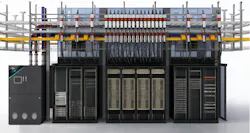
Nowhere is this pressure more visible than at the rack itself. AI-driven designs have transformed the rack from a passive container into an integrated system that combines power delivery, cooling, monitoring, and serviceability.
The AI Blueprint reference architecture illustrates this shift clearly. NVIDIA GB200-based racks have 100+ kW/rack density with direct liquid cooling capabilities. The remaining thermal load is intentionally minimized and handled by a controlled air loop designed to maintain stability rather than carry the full burden.
This approach highlights an important reality. Deployability is no longer defined by nameplate capacity alone. A system rated for megawatts of power is not inherently deployable if it cannot be serviced, scaled, or integrated within real-world operational constraints.
Bigger is not Better
This industry certainly likes to build big. However, as densities climb, many organizations have learned that oversizing does not guarantee success. Larger cooling units, higher megawatt ratings, and excessive redundancy can introduce complexity that slows deployment and increases operational burden.
Instead, leading operators are prioritizing:
- Right-sized cooling systems aligned to actual workload profiles
- Modular architectures that scale incrementally
- Designs that minimize unnecessary components and service points
- Systems that integrate power, cooling, and monitoring coherently
In this new environment, sizing becomes the most important measurement. The ability to deploy quickly, operate efficiently, and adapt over time matters more than headline capacity numbers.
Preparing for What Comes Next
The pressures facing the industry are unlikely to ease. AI adoption continues to accelerate, rack densities continue to rise, and deployment timelines continue to compress. Facilities built around static assumptions are struggling to keep pace.
This article in our series makes one reality clear. Cooling challenges in the AI era are not isolated technical problems. They are systemic issues tied to how infrastructure is planned, sized, and operated.
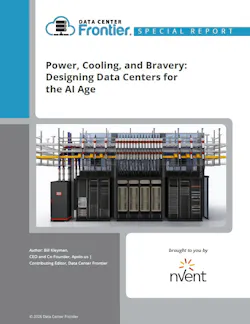
Download the full report, Power, Cooling, and Bravery: Designing Data Centers for the AI Age, featuring nVent, to learn more. In our next article, we’ll explore what happens when data centers move beyond reactive upgrades and begin designing cooling systems intentionally for AI. It introduces new philosophies built around modularity, hybrid architectures, and systems engineered from the start to operate under AI-level pressure.
About the Author
 Bill Kleyman
Bill Kleyman
Related
Voices of the Industry
 Source: SNEHIT PHOTO/Shutterstock.com
 Source: Matthew G Eddy/Shutterstock.com