A New Way to Stay Cool: Designing for AI from the Start
We continue our article series on how data center leaders are rethinking cooling strategies, embracing modularity, and preparing their facilities to support AI at scale with confidence and resilience. This week, we’ll explore what happens when data centers move beyond reactive upgrades and begin designing cooling systems intentionally for AI.
AI and high-performance computing workloads have fundamentally changed what it means to cool a data center. GPU-dense racks now concentrate far more power and heat into smaller footprints, pushing legacy cooling strategies beyond their practical limits. Designs built for predictable, evenly distributed loads struggle to keep pace with workloads that generate intense, localized heat and respond quickly to even minor thermal variation.
Under these conditions, cooling can no longer be treated as a secondary system. Airflow behavior, pressure balance, and cleanliness directly influence performance, reliability, and operating cost. Traditional hot- and cold-aisle approaches alone are no longer sufficient for environments where density, sensitivity, and capital investment continue to rise.
This article explores how data center leaders are rethinking cooling design to create AI-ready environments that are resilient, efficient, and scalable.
It’s Cool to be This Cool
As AI workloads push data centers beyond legacy limits, the industry is undergoing a fundamental design evolution. The traditional model favored static, over-engineered facilities built for peak capacity well ahead of actual demand. In an AI-driven environment defined by uneven density growth and compressed deployment timelines, that approach is proving increasingly inefficient and risky.
Research reflects this shift. Operators report growing variability in both capital and operating costs as density increases, driven largely by cooling choices, serviceability requirements, and the ability to adapt infrastructure quickly. Facilities designed around fixed assumptions are struggling to absorb AI workloads that arrive faster and behave less predictably than prior generations of IT.
From Overbuilt to Intentionally Modular
The emerging alternative is a move toward flexible, modular architectures designed to scale with workloads rather than anticipate them years in advance. Instead of oversizing systems to cover every possible future scenario, leading designs emphasize right-sizing, repeatability, and operational clarity.
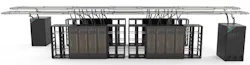
This evolution is clearly demonstrated in the 100 MW AI Blueprint reference architecture. The design shifts away from monolithic data halls toward repeatable AI pods, each supporting approximately 2.2 MW of IT load. Liquid cooling serves as the primary heat-removal method in each pod, significantly reducing the burden on the air loop and enabling more controlled, predictable airflow. Even at extreme density levels, the system remains deployable because cooling, power delivery, and serviceability are engineered together from the outset rather than layered on as afterthoughts.
This approach highlights several realities now shaping data center design:
- AI infrastructure scales unevenly, often pod by pod rather than hall by hall.
- Cooling quality directly influences server longevity, uptime, and total cost of ownership.
- Serviceability becomes a limiting factor long before nameplate capacity does.
What was once described informally as “servers breathing better” is now a measurable financial outcome. Cleaner airflow, stable thermal conditions, and predictable cooling behavior reduce fan power, limit thermal stress, and extend component life. In environments where individual GPUs represent tens of thousands of dollars in capital investment, cooling quality directly impacts return on infrastructure spend.
Designing from First Principles
Within this broader shift, some organizations are moving beyond incremental upgrades and designing cooling systems from first principles. Rather than scaling legacy designs upward, they are rethinking how power and cooling should function in AI-native environments.
nVent provides an example of this design philosophy in practice. Its approach centers on modular power and cooling architectures that align with how AI infrastructure is actually deployed and operated. Key principles include:
- Modular CDU and power architectures that scale incrementally with AI demand.
- Elimination of unnecessary redundancy, reducing service overhead and operational complexity.
- Serviceability designed for real-world conditions, enabling maintenance without specialized equipment or extended downtime.
These principles closely mirror the Blueprint’s emphasis on repeatable, serviceable building blocks. In both cases, deployability is achieved not by oversizing systems, but by integrating cooling, power, and operations into a coherent architecture.
Reframing the Metrics That Matter
This design evolution also forces a rethink of how success is measured:
- Past: watts per square foot defined facility efficiency.
- Present: kilowatts per rack capture localized density.
- Future: workload-aware, system-level metrics reflect how AI behaves in production.
In AI environments, a system rated for megawatts of power offers little value if it cannot be installed, serviced, or scaled within operational constraints. This reality challenges common myths around liquid cooling, particularly concerns about leaks, complexity, and service risk. Modern liquid-cooled systems are engineered with isolation, containment, and maintainability in mind, often reducing risk compared to overstressed air-only designs.
At the same time, the rack itself is fundamentally changing. It is heavier, more integrated, and more thermally dense. Power delivery, cooling, monitoring, and service access are converging into a single system rather than a collection of independent components.
From Design Philosophy to Real Outcomes
The conclusion is clear. Cooling for AI is no longer about adding capacity. It is about designing systems that can adapt, scale, and operate reliably under sustained pressure.
Download the full report, Power, Cooling, and Bravery: Designing Data Centers for the AI Age, featuring nVent, to learn more. In our next article, we’ll move from design philosophy to execution, examining how these principles are applied in real AI deployments where hybrid cooling systems and modular architectures translate directly into measurable gains in efficiency, uptime, and hardware longevity.
About the Author
 Bill Kleyman
Bill Kleyman
Voices of the Industry
 Image courtesy of Midea Building Technologies
 Adobe Stock image courtesy of Hitachi Energy