Harmonic Distortion in Data Centers: A Power Quality Planning Guide


What are harmonics?
Harmonics in an electrical system refer to unwanted distortions in a power signal that corrupts the normally smooth sinusoidal waveform of electricity. They are generated by non-linear loads – equipment that draws current unevenly, rather than in a clean sine wave. Common examples of non-linear loads are variable frequency drives (VFDs), switch-mode power supplies and LED lighting. The total level of distortion present in a system is expressed as a single number called Total Harmonic Distortion (THD).
Impacts of Harmonics
Harmonic currents travel through the entire electrical infrastructure causing problems at every level of the system. The most immediate impact is excess heat. Transformers, conductors and wiring all run hotter than designed when harmonic currents are present, accelerating insulation degradation and shortening equipment lifespan.
Beyond heat, harmonic current distortion (THID) destabilizes the power supply for everything connected to the system. This can cause protective devices to trip unexpectedly, disrupt sensitive IT loads, and push cooling systems into inconsistent or degraded operation. In a data center environment, where cooling and power are interdependent, a fault in one can quickly impact the other. Reduced airflow leads to thermal throttling; thermal throttling leads to performance degradation; left unchecked, the result is unplanned downtime. Additionally, in some cases the harmonic disturbances can extend beyond the data center itself, affecting neighboring facilities connected to the same electrical infrastructure.
Sources of Harmonics in Datacenters
The efficiency gains achieved through the use of non-linear loads have driven their widespread adoption. However, non-linear loads are also a significant source of harmonic generation.
When we think about data center design key we generally think about two ‘spaces’:
- Grey Space – which is anything outside of the data hall which includes systems critical to the operation of the data center such as chillers, cooling towers and large pumps. This equipment plays a major role in maintaining temperature and humidity in data centers, and they commonly rely on VFDs and Electrically Commutated (EC) fans for efficient operation and precise control. While VFDs and EC fans help reduce overall energy consumption, they also introduce electrical harmonics into the power system.
- White Space – which is typically the data hall – which is the heart of the data center. The data hall houses the core IT infrastructure for the data center, including servers, storage systems, networking equipment and power distribution components.
Cooling within these spaces is typically done in one of two ways:
-
-
- Air cooled – using Computer Room Air Conditioners (CRACs) and Computer Room Air Handlers (CRAHs).
- Liquid cooled – using Cooling Distribution Units (CDUs)
-
No matter if the approach is air cooled or liquid cooled, the cooling units rely on fans, pumps, compressors, and electronic controls, many of which use VFDs, EC fans or other non-linear loads. All of this equipment can introduce harmonics and electrical noise into the system.
Ensuring clean, stable power throughout the entire data center is critical to maintain continuous operation and prevent downtime of the facility.
Harmonic Mitigation Solution: Active Harmonic Filters
Active harmonic filters measure system harmonics and make incremental changes to produce anti-harmonics to cancel them. Active harmonic filters should be installed on the same voltage source as the non-linear loads they are correcting. Along with the active harmonic filter, current transformers (CTs) are placed upstream to measure the current that needs correction.
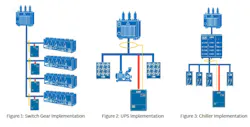
To mitigate harmonics in the white and grey spaces as described above, there are several common installation points of active harmonic filters:
- At the system level – switchgear implementation (Figure 1)
- On UPS outputs for CDU’s (Figure 2)
- At the equipment level – chiller implementation (Figure 3)
How to specify
Active harmonic filters are specified based on correcting current required. Correcting current can be estimated utilizing just two values, load current (IL) multiplied by the harmonic current distortion (THID). This calculation is completed for each non-linear load and summed to determine total correcting current.
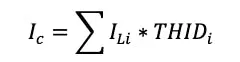
Typical non-linear loads will have a THID value around 30-40%. This range can be utilized to help estimate harmonic filter requirements.
Power Quality Is Not Optional
Without effective power quality management, harmonic distortion can compromise the performance, efficiency, and reliability of a data center. Integrating solutions such as active harmonic filters throughout the facility helps maintain proper equipment cooling, cleaner power, and consistent operational performance.
In today’s always-on digital economy, power quality is not optional, it is foundational!
About the Author
 Rick Hombsch
Rick Hombsch
Rick Hombsch, Director of Engineering, leads MTE’s electrical and mechanical engineering teams and has over a decade of experience with the organization.
Voices of the Industry
 Source: Robert Kneschke/Shutterstock.com
 Source: Starline, a brand of Legrand