Expanding On-Site Power Capacity: Planning Beyond the Genset

From data centers to manufacturing facilities, demand for reliable, scalable power continues to rise faster than ever. In fact, data centers alone are projected to consume more than 1,000 TWh of electricity by 2026, underscoring the pace at which energy demand is accelerating.
As facilities expand, adding generation capacity often introduces a new set of emissions and permitting considerations.
For many facility owners, the challenge is no longer: “How to generate more power?”
It is: “How to grow without hitting emission limits?”
As organizations plan for growth, retrofit existing assets, or prepare for future expansion, aftertreatment is becoming an increasingly important part of long-term power strategy.
Three Key Considerations Before Expanding On-Site Generation Capacity
1. Power capacity is often not the limiting factor – emissions are
Facilities rarely reach expansion limits because diesel gensets cannot provide additional power. More often, cumulative emissions reach regulatory thresholds before power capacity does. As additional gensets are added, NOx emissions can increase quickly, potentially placing projects into more restrictive permitting categories.
2. Diesel gensets continue to play a critical role – with greater emissions considerations
Despite the emergence of new technologies, diesel gensets remain a preferred solution for many critical applications due to their fast response times, proven reliability, strong load acceptance capabilities, and fuel flexibility.
The challenge is no longer performance; it is managing emissions as sites grow.
Aftertreatment systems are designed to treat exhaust gases after combustion, helping facilities meet increasingly stringent emissions requirements.
- SCR (Selective Catalytic Reduction): Converts NOx into nitrogen and water
- DPF (Diesel Particulate Filter): Removes particulate matter
- DOC (Diesel Oxidation Catalyst): Reduces carbon monoxide and hydrocarbons
3. Aftertreatment can support future capacity expansion
Aftertreatment technologies have the ability to reduce NOx emissions by as much as 90–95%, helping facilities:
- Install additional generators
- Support expansion without triggering new compliance barriers
- Preserve flexibility for future growth
Tier 2 diesel gensets equipped with aftertreatment can achieve emissions performance comparable to Tier 4 levels. This can significantly increase the amount of generation capacity that can be installed within a given emissions threshold. See the table given below for details.
For example, under a 50-ton annual NOx limit and 100 operating hours per year, Tier 4 emission levels allow approximately 644 MW of installed capacity, compared to 67 MW for Tier 2 engines without aftertreatment. Therefore, by adding aftertreatment to Tier 2 gensets, an additional 577 MW of capacity can be unlocked within the same emissions constraints.
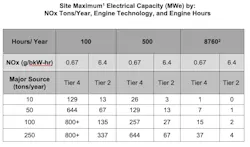
- MW electrical installed based on 95% gen efficiency emissions standards. Permits based on actual values may slightly increase installed MW.
- NOx limitations typically drive permit requirements, but continuous-run engines may need additional toxic or PM controls.
Why Early Aftertreatment Planning Matters?
Many projects assume aftertreatment can be addressed after installation.
While that may be possible in some cases, incorporating it early in the planning process often provides greater flexibility and can help avoid costly redesigns later.
Aftertreatment considerations can influence:
- Space requirements
- Exhaust routing
- Cooling and airflow design
- Acoustics and enclosure design
- Permitting schedules and project timelines
Five Considerations for Evaluating Aftertreatment Solutions
1. Future Emissions Requirements
Design for where regulations may be heading, not simply where they stand today.
2. Operating Profile
Run hours, load characteristics, and application requirements can all influence aftertreatment performance and genset solution selection.
3. Site Layout and Available Space
Aftertreatment systems can affect equipment footprint, exhaust configuration, cooling requirements, and acoustic design.
4. Scalability
Solutions should support future expansion plans without requiring significant redesign or reconfiguration.
5. Long-Term Reliability and Serviceability
Emissions control technologies deliver the greatest value when they support uptime, simplify operation, and remain manageable throughout the life of the equipment.
Planning for Growth Starts with Planning for Emissions
Diesel gensets will continue to play a critical role in supporting reliable power. What is changing is the importance of incorporating emissions considerations into long-term capacity planning.
Aftertreatment can help facilities:
- Navigate evolving regulatory requirements
- Preserve flexibility for future expansion
- Support long-term infrastructure strategies
- Reduce the risk of project delays and redesigns
Looking Ahead
Whether planning a new installation, expanding an existing site, or evaluating future capacity needs, understanding the role of aftertreatment is becoming an increasingly important part of power system design.
By incorporating emissions planning into broader infrastructure strategies, facility owners can better position themselves to meet both performance objectives and regulatory requirements as their operations grow.
For more information about aftertreatment technologies and emissions planning strategies, explore the Cat® aftertreatment solutions page and consult with your Cat® dealer.
About the Author
 Paul Cook
Paul Cook
Paul Cook is a Senior Product Consultant in the Large Power Systems Division within Power & Energy of Caterpillar. With extensive experience in the aftertreatment space, Paul works closely with our dealers and customers in the application of these products to meet their specific project needs.
Voices of the Industry
 Image courtesy of Bell & Gossett
 Source: Adobe Stock, courtesy of ebm-papst