Applying Decades of Critical Infrastructure Insights to Data Center Cooling Challenges


Whether considered on a macro scale or for individual data centers, cooling requirements have been a challenge for data centers from the earliest days of the internet, and they are increasing as servers and racks grow both in scale and density. Typical computing racks today consume from a few kw of power up to 40kW for hyperscaler designs, but future designs have set their sights on racks of needed 600kW and greater. This will increase the power consumption required to run datacenters over ten-fold, with a corresponding increase in cooling demands.
Air cooled systems used in traditional architectures simply can’t handle the heat generated with new installations, requiring a shift to more complex hydronic systems with water, or water/glycol mixes, working with chillers and cooling towers. These liquid, closed-loop technologies have been incorporated to increase cooling capacity, and they have significantly improved the power usage effectiveness (PUE) for data centers.
Obviously, these cooling systems are critical to overall operation. Cooling liquid flow is now carried into individual servers, and even individual chips, so cooling fluid distribution for these huge systems must be monitored and controlled effectively. This calls for strategic instrumentation configured in ways that are often new territory to designers of such spaces, but familiar in industrial contexts.
Monitoring flow verifies heat removal
Hydronic cooling systems depend on pushing chilled liquid through points where the actual heat exchange is designed to take place. Removing the necessary amount of heat requires sufficient volume and temperature differential at all critical points, typically primary cooling loops, throughout an enormous system. If flow is in spec with the relevant temperature difference, cooling action at a specific point should be correct. If something is impeding flow, such as a clogged line, the affected areas will overheat. Consequently, measuring flow at critical points throughout the distribution is necessary to ensure complete heat removal throughout all parts of the system. This calls for effective flow metering.
Such instrumentation challenges are part and parcel of Emerson’s skill set. We have a wide range of flow meter technologies that can be optimized to specific application requirements. For hydronic cooling systems at data center scale, our engineers have concluded that magnetic flow meters provide an excellent combination of capabilities, with decades of use in countless industrial applications. Equipment able to run 24/7/365 for years at a time is nothing new to many of our customers across all manner of process industries, and these benefits transfer easily to data centers.
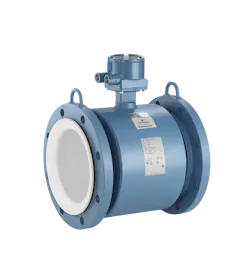
Emerson is bridging the gap between industrial automation and the digital infrastructure of tomorrow by refining our proven technologies to meet the heating, ventilation, and air conditioning (HVAC) requirements of modern data centers. The result is Emerson’s Rosemount 8795 Magnetic Flow Meter Sensor (Figure 1), specifically designed for primary cooling loops at data centers using closed loop systems. The primary differences from the industrial version are streamlined ordering configuration, special transmitter compatibility for multiple outputs, and an updated accuracy specification as required by hydronic cooling systems.
The sensor must be used in combination with one of several transmitters based on application specifics. These vary primarily according to data protocol (4-20 mA, Ethernet/IP, Modbus) format and positioning of the transmitter itself relative to the sensor. All of these transmitters provide the same accuracy spec as required for data center use of 0.2% ± 2 mm/s, although there are other differences related to the graphical interface, powering options, and onboard record keeping.
Why magnetic flow meter technology?
As mentioned, Emerson has a wide variety of flow meter technologies, but for this application, after comparing capabilities and trade-offs, magnetic proved the first choice. Here are some reasons:
- Proven technology in use for decades in countless demanding applications, so reliability and stability are exceptional.
- Dual 4-20mA plus Modbus output capabilities, allowing for redundancy in different control and monitoring systems.
- Multiple transmitter options help optimize characteristics for a specific site, including mounting directly on the sensor or remotely.
- No moving parts
- No pressure loss because the sensor has a full internal diameter, which also greatly reduces clogging potential.
- Ability to achieve 0.5% accuracy with zero straight pipe lengths after elbows, without additional leak points or reduced bore design.
- Self-diagnostic capabilities verify accuracy and reduce the need for calibration, while detecting deposits left by contaminated coolant.
- Process temperature range from -20 to 60 C (-4 to 140 F).
- Pipe sizes from 2 to 18 inch, flange connection.
A reliable solution and solution partner
Data center teams face constant pressure to protect uptime, maintain efficiency, and provide tight control across critical cooling systems because their projects demand consistency, scale, and reliability across every phase of the lifecycle.
Emerson understands these challenges, and the Rosemount 8795 sensor is just one of our many flow solutions that help data center teams install faster, verify performance more easily, and maintain visibility into system health. Emerson helps those teams reduce operating costs, while supporting effective long‑term maintenance. Our global presence and proven experience help reduce risk, simplify execution, and maintain confidence as systems scale.
About the Author
 Wally Baker
Wally Baker
Wally Baker is Director Global Magnetic & Vortex Growth at Emerson, leading strategy and growth initiatives for the company’s magnetic and vortex flow measurement portfolio. He holds a Bachelor’s degree in Electrical Engineering from Iowa State University and an MBA in Strategy and Marketing from the University of Minnesota.
Related
Voices of the Industry
 Source: Adobe Stock, courtesy of ebm-papst
 Source: Champion Fiberglass