Engineering the Transportation of Mission-Critical Data Center Equipment
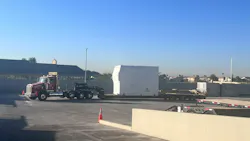

Transporting mission-critical equipment to a hyperscale data center job site is not a standard freight move.
In data center construction, heavy-haul transportation can be divided into two distinct phases: the first-mile haul from the manufacturing facility to a secure warehouse and the final delivery from the pickup point to the final set location. Both phases carry engineering complexity. Both influence what happens when the equipment is ready to be set.
The trailer selected, the way the load is secured, and the route it travels are not logistics details to be addressed after the fact. They are engineering decisions that connect directly to lift planning, installation sequencing, and the project commissioning timeline.
Treating transportation as a separate function from installation is where projects often introduce risk they never intended to assume.
Trailer Selection Starts With the Load
The equipment moving into today's data centers is anything but uniform. Generators, transformers, switchgear, UPS systems, PDUs, chillers, cooling equipment, and prefabricated electrical and mechanical skids all present different transportation requirements.
Weight, overall dimensions, center of gravity, designated support points, and sensitivity to movement during transit all influence how a piece of equipment should be transported.
For that reason, trailer selection begins with a thorough understanding of the load itself. Confirmed weights, dimensions, center-of-gravity information, and structural support requirements should drive transportation decisions.
Choosing a trailer before those factors are understood means building the transportation plan on assumptions. In heavy-haul transportation, early assumptions often create field issues later.
Common Configurations and What They Solve
Heavy-haul transportation relies on a variety of specialized trailer configurations, each designed to solve specific transportation challenges.
Step deck trailers accommodate taller loads by lowering the deck height behind the gooseneck. Their versatility and multiple axle configurations make them a practical option for tall equipment that does not require the lowest possible ride height.
Double drop trailers provide additional height clearance through a lower center deck. They are commonly used when the overall transportation height is a primary constraint and additional clearance is required.
Removable gooseneck (RGN) trailers allow equipment to be loaded from ground level by removing the trailer neck. They are frequently used for large rolling equipment and oversized loads that benefit from direct loading access.
Conestoga trailers provide weather protection while maintaining the loading flexibility of a flatbed. For sensitive electrical equipment, this combination offers protection without sacrificing accessibility.
Extendable double drop trailers combine low ride height with adjustable deck length, making them well-suited for equipment that is both long and tall. Hydraulic removable goosenecks, jeeps, boosters, and additional axle configurations provide flexibility for heavier loads.
Perimeter trailers support loads on a structural frame rather than a traditional deck. Their extremely low ride height and full-perimeter support make them particularly valuable for large skid-mounted equipment with structural limitations or unique load-distribution requirements.
While each trailer serves a different purpose, the objective remains the same: selecting the configuration that best supports the equipment throughout transportation, offloading, and final set.
Engineering the Move
Once the trailer type and configuration have been selected and the load specifications have been reviewed and confirmed with the manufacturer or owner, the engineering team responsible for transporting the equipment should create a load diagram. This diagram will serve as a blueprint, addressing key aspects such as position, securement, and haul path.
While not every heavy-haul movement requires a load diagram, it is best practice to create one.
Transportation Decisions Have Installation Consequences
Heavy-haul transportation decisions do not exist in isolation.
Trailer selection influences deck height, loading orientation, securement methods, and offloading and equipment staging methods once equipment reaches the project site. Those factors directly affect crane selection, rigging configurations, haul paths, and installation sequencing.
On hyperscale projects, where multiple installation activities occur simultaneously, transportation and installation cannot be planned independently.
A transportation strategy that works well on the highway may create challenges once equipment reaches the site. Likewise, a trailer selected without consideration for the final set location can introduce unnecessary handling, additional crane time, or more complex rigging requirements.
Prefabrication Raises the Stakes
As electrical and mechanical contractors continue expanding their prefabrication capabilities, transportation engineering has become even more important.
Large electrical skids, mechanical modules, and prefabricated assemblies are increasingly being built offsite and delivered closer to their final installed condition. This approach can improve quality, reduce on-site labor, and accelerate project schedules.
It also introduces transportation considerations that must be addressed early.
A skid may be perfectly engineered for operation once installed, but still create transportation and lifting challenges if support locations, center-of-gravity conditions, lifting points, or transportation requirements were not considered during design.
Engineering for transportation is most effective when it begins before fabrication is complete.
Early collaboration between equipment designers, fabricators, transportation specialists, and rigging engineers helps ensure that equipment is designed not only for operation, but also for transportation, lifting, and final placement.
When those considerations are addressed during design rather than after fabrication, projects can avoid many of the field modifications, schedule impacts, and installation constraints that emerge later.
Securement Is Engineered, Not Assumed
Selecting the right trailer is only part of the process. The securement strategy determines what condition the equipment arrives in.
Effective securement begins with confirmed weight, center-of-gravity information, and structural support requirements. Tie-down configurations, blocking, bracing, and weight distribution must be engineered for the specific equipment being transported.
For large equipment such as generators, transformers, and prefabricated assemblies, transportation support requirements may differ significantly from the support the equipment ultimately requires once installed. Securement planning must account for both conditions.
The result is a transportation plan engineered specifically for the load rather than a standard approach applied universally across different equipment types.
The Route Is Part of the Plan
Oversized and overweight transportation requires more than selecting a destination and dispatching a truck.
Bridge capacities, posted road restrictions, overhead clearances, permit requirements, escort vehicles, and time-of-day travel restrictions all influence route selection.
A route that appears straightforward on a map often becomes significantly more complex once transportation requirements are evaluated.
That complexity is rarely visible until permits are pulled, routes are surveyed, and the actual constraints of the move are understood.
On data center projects where equipment deliveries are tied directly to crane availability and installation sequencing, transportation delays quickly become installation delays.
Route planning is schedule planning.
Transportation Is the First Phase of Installation
Heavy-haul transportation is often viewed as the handoff between manufacturing and construction.
In reality, it is the first phase of installation.
Trailer selection, securement, route planning, and delivery coordination all influence what happens when equipment reaches the site.
On hyperscale projects, transportation and installation cannot be treated as separate activities. Projects that integrate transportation and installation planning earlier are better positioned to control schedule impacts and reduce field changes.
About the Author
 Bill Tierney_PLR
Bill Tierney_PLR
Bill Tierney is Chief Strategy Officer (CSO) | Project Development | Branch Leadership for The ProLift Rigging Company. Bill is a rigging and heavy transport leader with experience in the industry since 1999, including project development and branch management roles since 2010. He has deep background delivering engineered rigging, crane, and heavy transport solutions for complex work at U.S. refineries, nuclear facilities, and large-scale data center new-builds. Bill is known for developing alternative rigging approaches that overcome severe site constraints and improve safety, feasibility, and execution.
Voices of the Industry
 Source: Adobe Stock, courtesy of ebm-papst
 Source: Champion Fiberglass