The Smallest Line Item That Can Stop an AI Campus
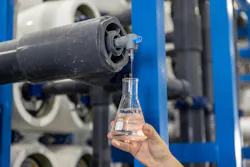

Water is easy to overlook amid the investments AI requires. BNP Paribas Equity Research estimates that of every $100 of AI capital spending, $50 goes to semiconductor chips and $20 to power. Cooling accounts for $7.50. Water gets no line of its own.
A water constraint can stop a multibillion-dollar project as effectively as a transformer that cannot be sourced. Compute is what gets bought. Water is part of what determines where it can actually be built, and which communities agree to host it.
Developers routinely evaluate power, fiber, land, permitting, incentives, and speed to market when selecting a site. Water usually gets a lighter look: confirmation that the region has enough of it.
The distinction that matters is between resource and infrastructure. A region can have adequate water resources, but a particular site may still lack the treatment, transmission, storage, or wastewater capacity to serve a new data center. Extending or upgrading that infrastructure takes time, particularly when new treatment capacity, pipelines, pumping, or permitting are involved, and that time lands on the development schedule.
Every Site Has Its Own Water Profile
Demand is not a single number because a campus does not need one grade of water. Generator cooling can run on raw or lightly treated water. Server cooling needs treated or ultrapure water to prevent scaling and corrosion. Community use needs potable water. Sizing a site against one peak potable figure overstates the requirement and hides the fact that the hard part is quality, not volume.
The questions worth asking early are specific. How much water is needed at startup and at full buildout, at what quality, and for which end uses? Can nearby utility infrastructure meet peak demand, or will upgrades be necessary, and if so, who funds them? Where does the wastewater go?
The Delivery Timeline Is the Real Constraint
Closing an infrastructure gap can mean upgrading treatment, upsizing water lines, adding pumps or storage, or increasing wastewater capacity. Each improvement carries its own engineering and permitting sequence, and utility-side work may require rate action or procurement first. Those steps run on the utility's calendar, not the developer's.
Cities are making this explicit. Conroe, Texas, now requires data center developers to demonstrate adequate water and sewer capacity, to fund the infrastructure needed to serve the site, and to use closed-loop cooling or similar technology. The city estimates 120 to 150 days for review once those requirements are met. Conroe will not be the last.
The question is not only whether a community has enough water, but whether the infrastructure can be permitted, funded, and built by the date the facility needs it.
The Water Source Can Be a Design Choice
A water or wastewater limitation doesn't always mean walking away from a site or waiting on a utility upgrade.
A purpose-built supply developed on or near the campus can provide another path, and the feedstock is more flexible than site teams assume: brackish groundwater, seawater, municipal treated or raw effluent, industrial process water, and other reuse streams. The right source depends on geology, existing infrastructure, discharge options, and local requirements.
Brackish groundwater is one option across much of Texas, and reverse osmosis treatment is established practice. A dedicated supply also does not draw on the potable system, which answers the objection driving most local opposition, and it can be sized to serve the surrounding community. In a hearing room, that is a materially different conversation.
Capital, Expertise, and Schedule Discipline
A water constraint lands in more than the developer's seat. Engineers, EPC contractors, equipment suppliers, and service providers all touch site feasibility, and a project that stalls on water stalls for all of them. Power has specialists and financing structures from the first meeting. Water usually has none of that.
Closing that gap takes three things together. Capital, so water infrastructure is not competing with the compute budget. Expertise in source identification, treatment matched to end use, and permitting. And schedule discipline, meaning a contracted delivery date and the operational risk carried by the water provider. Under Industrial Water-as-a-Service™ (iWaaS™), Seven Seas Water Group finances, develops, owns, operates, and maintains that infrastructure under a long-term agreement. Bring us the site, and we will find you the best water available to it.
Evaluating water alongside power, fiber, land, and permitting surfaces these constraints while there is still time to solve them, or to choose a better site.
The best time to uncover a water constraint is before committing to a site.
About the Author
 Jonathan Lanciani
Jonathan Lanciani
Jonathan Lanciani is Chief Industrial Officer at Seven Seas Water Group, where he oversees business development and strategic growth across the company's industrial markets.
Seven Seas Water Group is headquartered in Tampa and Houston, with operations across the United States, the Caribbean, and Latin America. The company has built, owns, and operates more than 220 water and wastewater treatment plants, delivering reliable solutions to governmental, municipal, industrial, and hospitality customers under its Water-as-a-Service® model.
Related
Voices of the Industry
 Source: Robert Kneschke/Shutterstock.com
 Source: Starline, a brand of Legrand