The Converter as the Control Point for AI Data Center Power


With AI workloads driving unprecedented growth in data center power demand, projected by some analysts to reach as much as 70% annually through 2027, the industry's first AI power debate centered on capacity: where will the next hundreds of megawatts come from?
AI factories introduce concentrated, fast-changing loads that can create steep ramps in demand and power consumption. At the same time, utilities and grid operators are scrutinizing how very large loads behave during disturbances, not simply whether enough generation exists to serve them.
This creates a new design requirement. The data center must remain highly available while presenting the grid, on-site generators, and internal distribution system with a manageable load profile. The solution is a coordinated power architecture in which converters, storage, controls, protection, medium-voltage equipment, and digital systems work as one. Within that architecture, PCS has become increasingly important. As AI facilities grow in scale and complexity, they are evolving from simple power electronics components into key control layers that help coordinate how energy moves through the site.
No longer just a conversion device
In a conventional description, a converter does what it says: converts direct current from a battery or renewable source into alternating current for the facility or grid and reverses that flow when charging storage. In an AI data center, a modern PCS functions as a high-speed, controllable electrical interface, regulating active and reactive power, limiting current, shaping ramp rates, supporting voltage and frequency stability, and responding through grid-connected and islanded operating modes.
That distinction matters because AI power problems happen on several timescales. Fast converter controls can respond to sharp electrical changes, battery energy storage systems (BESS) can buffer sustained ramps or temporary capacity limits, and Power Plant Controllers (PPC) can coordinate the PCS with generators, utility signals, switchgear, facility-management systems, and state-of-charge constraints. Together, these layers help make volatile loads more predictable.
Four roles for power conversion in the AI power architecture
1. Load smoothing and generator protection
AI workload changes can push on-site generation and utility connections beyond comfortable ramp-rate or power-quality envelopes. A bidirectional PCS paired with BESS can absorb excess power or inject power rapidly, reducing sudden changes seen by the rest of the system.
2. Voltage support and disturbance ride-through
Converters can supply or absorb reactive power and follow a defined ride-through behavior. The objective is to prevent a short grid event from becoming a large, coordinated loss of data center load or a site-wide transfer event.
3. Grid-connected, islanded, and restoration modes
With appropriate system design, controls, and protection, storage and PCS can support transitions between grid-connected and islanded operation, stabilize an islanded bus, and contribute to restoration or black-start pathways. These are system functions and must be validated at the site level.
4. Capacity shaping and flexible interconnection
When a grid connection is constrained, storage can reduce peaks, manage import limits, and help the facility operate within an agreed envelope. This does not eliminate the need for interconnection studies or network upgrades, but it can create additional design options.
A practical architecture
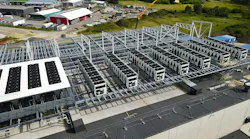
For large campuses, PCS should be evaluated as part of a repeatable medium-voltage building block rather than as an isolated converter. A typical architecture can combine battery blocks, medium-voltage transformers, switchgear, power plant controllers, protection, telemetry, and supervisory controls. Modular, factory-tested blocks reduce the number of site interfaces and create a platform that can be repeated as the campus expands, reducing integration risks and streamlining deployment.
The control hierarchy is equally important. Converter-level controls provide the fastest response. Plant controls coordinate multiple converters and enforce site-level active-power, reactive-power, voltage, frequency, and import or export objectives. Higher-level energy management can optimize state of charge, demand response, market participation, and on-site generation use. Clear ownership of each control loop is essential to avoid conflicting commands or unstable interactions.
Model first, then prove the response
AI data centers require a validation process that connects product capability to site behavior. The work should begin with the actual load profile, grid strength, fault levels, generator characteristics, protection philosophy, and intended operating modes. Steady-state studies alone are not enough for the most dynamic use cases. Electromagnetic-transient models, hardware-in-the-loop testing and staged commissioning can be used to test ramp events, voltage disturbances, current limits, control handoffs, and islanding sequences before the full site is energized.
This model-to-test-to-commission approach also changes procurement. Instead of buying an inverter only against a nameplate rating, owners can define measurable performance at the point of interconnection: response time, ramp-rate control, reactive capability, recovery after a fault, operating envelopes, and telemetry. The commercial specification becomes a performance specification.
From passive load to grid-interacting energy system
The power challenge facing AI data centers is not solved by adding capacity alone. It is solved by coordinating capacity with controllability. As campuses combine utility connections, on-site generation, batteries, renewables, and increasingly power-dense compute, the converter becomes one of the few assets capable of acting fast enough to keep those elements working together.
That is the strategic role of PCS; they convert energy, but more importantly, they shape how the facility behaves. Done well, PCS can help a data center protect availability, reduce stress on generators and the grid, create flexibility within constrained interconnections, and build a repeatable electrical platform for growth. In the AI era, the winners will not only secure power. They will control it.
About the Author
 Susan McLeod
Susan McLeod is Vice President of Data Center Market Development at Hitachi Energy, where she works at the intersection of power, digital infrastructure, and sustainability to help hyperscalers and colocation providers accelerate speed‑to‑power for the next generation of data centers. Connect with Susan on LinkedIn.
Hitachi Energy is a global technology leader advancing the world's energy system through electrification, supporting utilities, industries, transportation providers, and data center operators as they navigate increasingly complex power demands. With more than a century of experience in grid infrastructure and power conversion technologies, the company works across the energy ecosystem to help enable reliable, resilient, and sustainable energy systems.