Cooling at the Edge of Capability

Last week we launched our article series on practical approaches for building scalable, AI-ready environments. This week, we’ll explore how many operators are augmenting proven air-cooling foundations with additional thermal management approaches to improve precision, efficiency, and scalability.
For much of the data center industry’s history, thermal management followed a familiar model. Raised floors, hot and cold aisle containment, and air-based systems provided a reliable framework for cooling workloads that scaled gradually and behaved predictably. The focus was largely on optimization rather than major architectural change.
Today, AI workloads are introducing thermal conditions that many traditional environments were not originally designed to support at scale. As rack densities move beyond 40 kW and continue climbing, airflow management becomes more complex. Turbulence, recirculation, and localized hotspots can create operational challenges that require greater visibility and control.
The challenge is no longer just about temperature. Air quality, pressure balance, and environmental stability increasingly influence system performance and reliability, especially in high-density AI environments where infrastructure investments are significant.
The industry has long understood that higher densities require more advanced thermal strategies, but traditional air-based designs remained highly effective for the workloads they supported. As AI and HPC deployments grow, many operators are now augmenting those proven air-cooling foundations with additional thermal management approaches to improve precision, efficiency, and scalability.
Understanding the New Cooling Landscape
The cooling landscape is changing because workload behavior has changed. Traditional enterprise workloads were distributed across rows and rooms, creating heat profiles that were easier to manage with air-based systems.
Hyperscale and colocation AI and high-performance computing environments differ in behavior. They concentrate power in fewer racks, generate much higher heat flux at the chip level, and require closer coordination among workload placement, rack design, airflow strategy, and heat-rejection infrastructure.
According to the AFCOM 2026 State of the Data Center report, average rack density has climbed to 27 kW per rack, a 69% year-over-year increase and nearly four times what respondents reported five years ago. The same report found that 39% of respondents say their current cooling solutions do not meet all operational requirements. In comparison, 36% have already deployed liquid cooling, and another 28% plan to adopt within the next 12 to 24 months.
This does not mean every data center is becoming fully liquid-cooled. Instead, the industry is entering a more workload-aware cooling era. Some racks and environments can still be effectively supported by optimized air cooling, while higher-density AI and GPU deployments increasingly benefit from liquid-assisted or hybrid cooling strategies.
Common cooling approaches now include:
- Optimized air cooling: Still highly relevant for traditional enterprise workloads, storage, networking, and lower-density compute. The focus is on airflow management, containment, pressure balance, and environmental stability.
- Direct-to-chip cooling: Liquid is delivered to cold plates attached to high-heat components such as CPUs and GPUs. This approach removes heat close to the source while air continues to manage residual heat from memory, power supplies, storage, and other components.
- Rear-door heat exchangers: Heat is captured at the rack exhaust path, allowing liquid systems to assist or neutralize rack-level heat loads while preserving familiar rack and service models.
- Immersion cooling: IT equipment is submerged in dielectric fluid to support very high-density deployments. This can be effective for specific workloads and deployment models, but it requires different operational practices, maintenance approaches, and ecosystem readiness.
- Liquid-to-air and liquid-assisted architectures: These designs bridge liquid and air systems, helping operators address dense compute zones without completely redesigning the entire data hall.
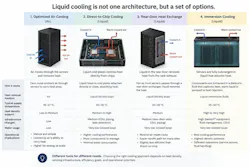
The important takeaway is that liquid cooling is not a single design choice. It is a family of approaches that must be aligned to workload requirements, facility constraints, service models, and long-term growth plans. The most successful operators will not ask, “Air or liquid?” They will ask, “Which cooling architecture fits this workload, this density, this facility, this geo climate, this silicon profile, and this business model?
How Hybrid Cooling Actually Works
Hybrid cooling is becoming one of the most important design patterns for AI-ready data centers because most facilities will operate mixed environments for years. Liquid cooling is typically deployed where heat is most concentrated, such as AI pods, high-density rows, or GPU-heavy racks, while air cooling continues to support the broader white space and residual heat. A simple way to think about hybrid cooling is this:
- Liquid cooling handles the highest-intensity thermal loads at or near the source.
- Air cooling maintains environmental stability across the room, row, and supporting infrastructure.
- Controls and monitoring systems coordinate both environments, so the facility operates as one thermal ecosystem.
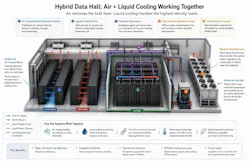
Even direct-to-chip systems do not remove every watt of heat. Components such as power supplies, memory, storage, networking interfaces, and board-level electronics still generate residual heat that air must manage. As a result, operators increasingly design zones: traditional air-cooled areas, liquid-assisted high-density zones, and AI pods with CDU-supported liquid loops. Key design considerations include:
- How supply and return air paths behave around liquid-cooled racks.
- Where CDUs, manifolds, pumps, and piping are placed without disrupting service access.
- How liquid-cooled zones affect containment strategy and room-level pressure balance.
- How facility teams monitor both airside and waterside performance.
- How maintenance procedures change when IT, facilities, and mechanical systems become more tightly connected.
The value of hybrid cooling lies in flexibility. It supports AI density without abandoning useful infrastructure, and it allows organizations to introduce liquid cooling in phases, prove the operating model, and scale as demand grows. That is especially important in brownfield environments, where structural capacity, layout, water distribution, and service access can all impose constraints.
The Operational Challenges Behind AI-Scale Cooling
As organizations deploy liquid cooling into production environments, operational complexity becomes one of the biggest challenges to manage. Cooling infrastructure now must support higher densities, tighter uptime expectations, customer SLAs, and more demanding serviceability requirements. Many operators are effectively building new cooling architectures while maintaining live workloads, creating little room for error. For retrofits, this is not simply a facilities project. It is a live-operations program that must protect uptime while increasing capacity. The industry is also paying closer attention to fluid management and long-term operational reliability. Areas receiving increased focus include:
- Water quality management: Maintaining loop cleanliness and fluid stability to reduce corrosion, biological growth, contamination, and equipment degradation over time.
- Dual-loop cooling systems: Separating facility water infrastructure from the technology cooling loop to improve reliability, maintainability, and operational control.
- Scaling and repeatability: Building modular deployment models that simplify future expansion and reduce variability across sites.
- Monitoring and instrumentation: Increasing visibility to temperature, flow rates, pressure, leak detection, and performance across both air and liquid systems.
- Controls and analytics: Connecting equipment data, alarms, and performance trends so teams can move from reactive response toward proactive maintenance.
- Lifecycle service and training: Defining commissioning, operating procedures, maintenance access, and escalation paths before high-density systems are placed into production.
The 2026 AFCOM report reinforces why these areas matter. Respondents cited integration complexity, cost concerns, and limited technical expertise as ongoing barriers to liquid cooling adoption. The report also found that 49 percent of organizations are improving airflow and 30 percent are increasing operational visibility as part of their density strategy, highlighting that cooling modernization is as much about control and optimization as it is about new infrastructure.
The challenge moving forward is not simply adding more cooling capacity. It is deploying thermal infrastructure that can scale alongside AI growth without introducing unsustainable operational complexity. This is where modularity, centralized controls, standardized deployment models, lifecycle services, and ecosystem partnerships become increasingly important. Trane and LiquidStack are helping to lead this industry movement toward scalable, operationally practical cooling architectures.
AI-ready cooling is not a single technology decision. It is an architecture decision, an operations decision, and increasingly a business decision. The next section looks at the design principles required to build cooling systems for the AI data center from the start.
Download the full report, Why AI is Forcing a Rethink of Data Center Cooling Design, featuring Trane, to learn more. In our next article, we’ll outline key design implications when integrating liquid cooling into a broader, resilient, hybrid operating model.
About the Author
 Bill Kleyman
Voices of the Industry

 Image courtesy of Midea Building Technologies