What Six Months of Fluid Data Says About Aluminum in Liquid Cooling


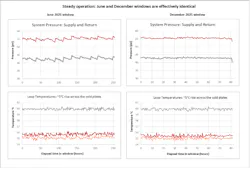
We have two sets of charts from our liquid cooling test. One is from June, the other from December. Same loop, same coolant, six months and more than 4,000 hours apart. Put them side by side and you cannot tell which is which.
That would be unremarkable in an all-copper system. This loop had an aluminum heat exchanger sharing coolant with copper cold plates and stainless steel plumbing, the mixed-metal combination the industry has spent a decade avoiding. Conventional caution says the June charts and the December charts should look different. They don't.
Here is what we built, why we built it, and what operators should take from it.
Why test aluminum at all
Liquid cooling inherited its materials. Copper went into cold plates, and stainless steel and brass went into manifolds, piping, and fittings. Each was a sound choice when it was made. At AI scale, the bundle is getting heavy, scarce, and expensive. A coolant distribution unit can weigh one to two tons, and an AI rack is approaching four to five thousand pounds. Copper is being pulled in several directions at once by grid buildout, electrification, and transportation, which means our industry is now competing for tonnage with the power grid it depends on.
Aluminum eases all three pressures. It is roughly one-third the density of copper, more abundant, less expensive, and easier to extrude into the geometries modern heat exchangers call for. What has kept it out of the wetted path is galvanic corrosion. Put aluminum and copper in the same water-based coolant without adequate protection and the aluminum gives up material to the fluid. For equipment expected to run for years untouched, few engineers wanted to take that risk on faith. So we tested it.
What we built
Working with Valvoline, we built a test bench at their research facility in Ashland, Kentucky, modeled on the wetted path of a liquid-to-air CDU serving direct-to-chip loads. An aluminum microchannel heat exchanger fed five copper cold plates in parallel through stainless steel tubing and EPDM hoses. The coolant was Valvoline's PG25 Advanced, a propylene glycol formulation with an inhibitor package tuned for data center loops.
Heat pads put one to two kilowatts on each cold plate. The loop moved 20 liters per minute in total, split unevenly across the five cold plates at roughly four to five liters per minute each. We left that imbalance in place on purpose, because real deployments are rarely balanced perfectly, and controlled the plates to a common temperature target instead. The test ran continuously from June through December 2025, 4,362 hours in total, and we pulled 28 fluid samples along the way.
What the fluid told us
We tracked the loop the way an operator would, through the fluid. Twenty-eight samples drawn over six months were analyzed for dissolved metals, coolant chemistry, and inhibitor levels, because the fluid is where corrosion leaves its record. We had not cut open the heat exchanger or cold plates before publication, and that is a fair limitation to name. But if aluminum were leaving the heat exchanger, the fluid would have shown it as a steady climb in dissolved aluminum.
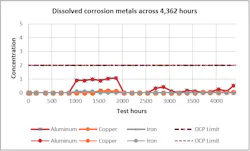
That climb never came. For most of the test, aluminum, copper, and iron (our proxy for the stainless steel) read at or near zero. During one stretch, between roughly 1,030 and 1,867 hours, all three rose briefly, with aluminum peaking at 1.08 ppm and copper and iron at about a tenth of that, then fell back and stayed low. Two things about that stretch matter. Every reading stayed well under the 2 ppm limit the OCP PG25 base specification sets for fresh fluid. And the three metals moved together. Galvanic corrosion would look different. Dissolved aluminum would climb on its own and keep building over time, while the copper stayed protected. Nothing in the data shows that pattern.
The rest of the chemistry held as well. pH stayed around 8, and reserve alkalinity stayed between 0.8 and 1.0. Specific gravity and freeze point were flat, so the glycol ratio did not drift. The organic acid inhibitors finished essentially where they started, and the copper-protecting azoles declined slowly and predictably, on a trend that projects useful protection well beyond the test window. Thermal conductivity and heat capacity matched their initial values, and the cold plates showed no thermal drift.
What operators should take from it
The lesson is not to swap your copper for aluminum. For now, copper remains the standard at the cold plate, where heat flux is highest and its conductivity earns its cost. Our focus was the CDU side of the loop. The same cost, weight, and supply pressures apply at the chip, though. We expect cold plate designers and chip makers to run their own analysis on whether aluminum makes sense there too. The lesson is that aluminum belongs where its strengths matter and its weakness can be managed. The heat exchanger has always been the toughest place to justify aluminum in the wetted path, and with the right chemistry it now has data behind it.
That makes the coolant a design decision rather than a commodity line item. If you are evaluating mixed-metal equipment, a few practices follow:
- Specify the fluid with the hardware. Ask which inhibitor package the loop was qualified with, and keep that chemistry in service.
- Sample on a schedule. Dissolved metals, pH, and reserve alkalinity are inexpensive to track and tell you early whether protection is holding.
- Watch the inhibitors, not just the metals. Inhibitor depletion shows up before metal loss does.
- Use the OCP PG25 specification as your yardstick. It gives buyers and suppliers a shared reference for what healthy fluid looks like.
None of this is exotic. Automotive cooling systems have run aluminum, copper, brass, and iron in one inhibited coolant for decades, at higher temperatures and with drivers who rarely check. A data center loop is a gentler version of the same problem, maintained by professionals.
What we don't know yet
One loop, one alloy, one coolant, six months. That is a meaningful result, but it is not a service-life guarantee for a facility designed to run ten years or more. Longer-duration testing, other alloys, higher temperatures for next-generation GPUs, and field validation are all still ahead, and nVent and Valvoline plan to keep publishing as we go.
In the meantime, the June and December charts make a simple point. In this loop, under these conditions, aluminum held up.
About the Author
 Jason Matteson
Jason Matteson is the Global Director of Product Management at nVent in Data Solutions. He has worked in the data center industry for 28 years. Prior to joining nVent, Jason worked at IBM, Lenovo, Vertiv and most recently Iceotope Technologies. Jason contributes to several industry consortiums, including ASHRAE and OCP, has over 100 U.S. Patents, authored or co-authored several intellectual-property publications, and has given several presentations about industry power and cooling trends at various technical symposiums and conferences. Jason received a Bachelor of Science degree in Mechanical Engineering from Rochester Institute of Technology in 1997.
Voices of the Industry

 Image courtesy of Midea Building Technologies