800 VDC for AI Data Centers: Rethinking Power Delivery in the White Space
Key Highlights
- High-density AI racks moving toward megawatt scale require 800 VDC power distribution.
- Sidecar architecture enables immediate deployment without requiring costly upstream infrastructure overhauls.
- Centralized architectures improve white-space efficiency but demand tighter electrical protection coordination.
- Converter-fed direct current faults require specialized protection strategies and modern transient simulation tools.
- Reverse current blocking devices reduce peak fault currents by over 80 percent.


The AI-driven evolution of data centers is pushing power requirements past the physical limits of traditional electrical engineering. With high-density clusters forcing rack power demands from 400 kW toward a megawatt and beyond, standard power distribution models break down. Attempting to deliver that much power over conventional options puts operators into a corner with regards to physical space, and they are being forced to rethink how energy is delivered within the white space.
This physical bottleneck is why the industry is moving toward 800 VDC power distribution. Stepping up the voltage drastically lowers the required current, enabling data centers to deliver megawatt-scale power through much smaller conductors. The result is less copper mass, higher end-to-end efficiency, and more physical room for servers. At the same time, operators must account for how shifting to higher-voltage direct current alters the way that electricity behaves during a fault. Adopting 800 VDC requires rethinking system topology, arc flash risk, and protection strategies to keep facilities online and workers safe.
Sidecar vs Centralized 800 VDC Architectures
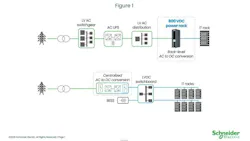
Embracing 800 VDC is not an all-or-nothing proposition where the entire data center must switch to a single architecture. Rather, there is a spectrum of design choices depending on physical constraints, operational risk tolerance, and deployment schedules. For immediate deployments, rack-level sidecar architecture is the best option. In this layout, incoming AC power connects directly to a dedicated power rack positioned alongside the IT rack. The sidecar handles local power conversion and feeds 800 VDC straight to the adjacent compute hardware over short interlink connections.
This sidecar approach offers several immediate operational advantages. It leaves the upstream facility intact, allowing operators to keep their existing AC UPS systems, switchgear, and utility feeds without a costly overhaul. It also taps into a mature supply chain built around electric vehicle fast-charging infrastructure, isolates high-voltage DC paths to a small physical footprint right at the rack, and restricts the failure zone to a single rack instead of risking downtime at the pod, data hall, or facility level.
In contrast, centralized architectures utilizing medium voltage rectifiers or solid state transformers represent a long-term play. Power conversion moves upstream into the main electrical room or pod level, distributing 800 VDC across overhead busway networks directly to rows of server racks. While centralizing power conversion frees up valuable white-space floor area by eliminating AC switchgear, transformers and PDUs and improves aggregate efficiency, it demands a higher level of operational maturity. Centralized designs involve longer distribution runs, far more stored energy on the central bus, and significantly tighter coordination across every tier of electrical protection.
Is 800 VDC Safe for Data Centers?
Safety is the first question engineering teams ask when introducing 800 VDC to the white space. In standard AC power systems, alternating current naturally drops to zero voltage twice every cycle. This starves arcing faults of energy, helping circuit breakers extinguish arcs relatively quickly. That is not the case with direct current, which delivers a constant voltage without a zero crossing to assist fault interruption. As a result, DC systems require specialized protective devices, such as semiconductor fuses for rapid let-through energy reduction or DC circuit breakers engineered with enhanced arc chutes, wider contact spacing, and magnetic blowouts to lengthen and cool longer-lasting DC arcs.
Unlike transformer-fed AC short circuits that supply a steady fault current, a converter-fed 800 VDC fault unfolds in two distinct phases. During the initial capacitive spike within the first few milliseconds of a fault, energy stored in equipment capacitors discharges almost instantly, creating a brief, high-magnitude current spike. Once localized capacitors dump their charge, intelligent power converters step in. Modern solid-state converters actively cap fault current, typically holding it to roughly 150% of normal operating levels, or shut down entirely within milliseconds. Arcing hazards are often significantly lower than traditional assumptions suggest because smart power electronics choke off the energy supply.
How Arc Flash Risk Is Evaluated in 800 VDC Systems
To protect site personnel, facility managers run arc flash assessments to set safety boundaries and select Personal Protective Equipment (PPE). The challenge is that legacy AC calculation rules do not accurately reflect how converter-fed DC systems behave. Standard, simplified formulas (such as NFPA 70E Annex D) assume a steady, continuous fault current, treating short capacitive spikes as if they persist indefinitely when applied to an 800 VDC system. As a result, these formulas tend to overestimate incident energy, particularly when applied to systems with transient, converter-limited fault conditions.
By using computer simulation tools like ETAP or MATLAB, engineers can model actual fault dynamics. The real-world numbers paint a very different picture. In a sidecar setup, local capacitors fully discharge in under half a millisecond, with high-fidelity modeling showing total incident energy staying well below 0.1 cal/cm² — a fraction of the 1.2 cal/cm² threshold where specialized arc-rated clothing becomes necessary.
For large, centralized halls where legacy calculations often predict severe arcing hazards, accounting for fast-acting converter current limiting reduces calculated incident energy by 70-to-90%, proving that centralized DC layouts can also easily achieve a safe operating environment.
What Infrastructure Leaders Should Consider Before Deployment
Transitioning to 800 VDC requires a clear operational strategy that connects system design, vendor selection, and site safety. Data center operators should begin by evaluating compute roadmaps early, setting clear density trigger points that initiate planning for 800 VDC sidecar architectures as rack demands cross the 400 kW threshold. During procurement, teams must demand transient performance data from hardware manufacturers, including converter shut-off speeds, capacitance values, and current-limiting behavior.
From an analytical standpoint, operators should apply dynamic transient simulation tools for an accurate representation of risk, rather than relying on generic tables or simplified assumptions. Operationally, facilities teams must establish clear maintenance workflows and boundaries between high-voltage feeds and server hardware, specifying modular, live-swappable power components so routine service can proceed without powering down critical workloads. Finally, local code officials and building inspectors are often unfamiliar with 800 VDC data centers, so bringing regulatory authorities into the loop early with detailed simulation results can help to streamline approvals and prevent costly commissioning delays.
The Future of AI Data Center Power Distribution
Shifting to 800 VDC is a necessary step for any facility scaling up to meet the demands of modern AI computing. While higher DC voltages require thoughtful protection design and updated safety modeling, the challenges are fully solvable. By starting with modular sidecar architectures, leveraging modern simulation tools, and applying intelligent circuit protection, operators can safely deliver the high-density AI demands without compromising site safety or uptime.