Mapping the Path to Safe Liquid Cooling
Key Highlights
- Liquid cooling for AI data centers: Nidec's CDUs, manifolds, and quick disconnects handle the intense heat loads of high-density AI clusters where air cooling falls short.
- Vertically integrated design: Nidec's in-house inverters and the pump motors optimize the CDU performance, increase the cost competitiveness and shorten the manufacturing lead-time.
- Built for reliability and service: The NIR 3.0 CDU delivers up to 3.2 MW with front-access maintenance, backed by leak sensors, fluid monitoring, and global support.

Data center operators are at a crossroads. Ever-more-intensive computing loads and rack density have challenged traditional cooling systems. And now, widely deployed AI processors, particularly the latest generation of chips from Nvidia, are generating even more concentrated heat loads. This has pushed air cooling to its practical limits and led to the growing deployment of liquid cooling, which has a greater ability to carry away concentrated heat and can discharge it more effectively.
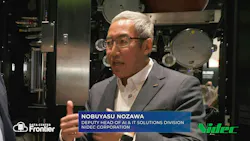
But, according to Nobuyasu Nozawa, Deputy Head of AI & IT Solutions Division, SPMS at Nidec, a global cooling tech vendor, some data center operators are still wary of introducing liquid cooling into facilities filled with expensive electronics. Their concerns include reliability, safety, and cost but ultimately come down to whether or not they trust the vendor.
Different liquid cooling vendors have different technical capabilities and depth of experience, notes Nozawa. For data center operators evaluating liquid-cooling vendors, their technical expertise — the ability to solve cooling problems — is only one part of the equation. Manufacturing capacity, serviceability, and the ability to support rapidly expanding deployments are also important.
There are many technical issues in data centers, including EMC challenges, that some liquid cooling vendors have only recently learned to address. Manufacturers must be able to demonstrate deep experience in solving server thermal management challenges in the challenging environment of the data center.
As data center build-outs continue, manufacturing capacity matters because the ability to deliver liquid cooling products reliably and rapidly, as well as at scale, has real-world fiscal consequences. As data centers now often face political opposition, delivery windows are even more critical. And, once cooling products are put in place, vendors must be able to demonstrate product serviceability and robust field service.
Nidec Cooling Capabilities
Nozawa said that Nidec initiated the development of liquid cooling technology as a next-generation alternative to fans and is a true data center thermal specialist. Leveraging the thermal management expertise cultivated through years of fan motor and heat module development, alongside the advanced pump and inverter capabilities of its own, “we are actively driving the development of cooling distribution units (CDUs),” said Nozawa.
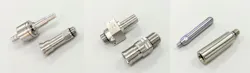
The quick couplings used in liquid systems require extreme precision machining to prevent any water leakage — a challenge Nidec has met by deploying the ultra-high-precision machining technologies originally developed for the company’s HDD motors. “It takes experience to engineer and manufacture these components,” he added.
To solve the intense heat challenges of high-density AI clusters, Nidec has invested in CDU/flow-rate control systems and differential-pressure control systems.
Future-Proofing Data Center Cooling
Because AI hardware is evolving rapidly, cooling infrastructure must accommodate technologies and heat loads that may not yet be commercially available, Nozawa stressed.
That’s why Nidec maintains a dedicated thermal research organization investigating next-generation cooling technologies while its current business remains focused primarily on single-phase liquid cooling. The company is also increasing its involvement with organizations such as the Open Compute Project and the American Society of Heating, Refrigerating, and Air-Conditioning Engineers (ASHRAE) to track developing standards and industry requirements.
Energy use is another concern as data centers face constraints on available electrical power. One emerging approach is warm-water liquid cooling, eliminating power-hungry mechanical chillers and compressors. By designing systems around higher coolant temperatures where appropriate, operators can reduce cooling-related power consumption while still maintaining desired equipment temperature levels.
The broader goal is to optimize thermal management from the design stage rather than treating cooling as an isolated subsystem. That includes considering cooling capacity, electrical consumption, water use, maintenance requirements, and coolant condition together.
Real-time fluid-quality monitoring and preventive maintenance can further help operators identify problems before they lead to downtime or inefficient operation. To strengthen its offerings, Nidec offers dew point control, leak sensors, data logging, and cooling monitoring capabilities for pH, turbidity, and conductivity. As AI computing continues to push rack densities higher, this combination of scalable liquid cooling, monitoring, and adaptable system design will become increasingly important to data center infrastructure.
As AI deployments accelerate, manufacturing scale rises in importance, explained Nozawa. “Rapid growth in liquid cooling has placed pressure on industry production capacity, but Nidec believes its multiple Asian manufacturing facilities provide an advantage as customers move from pilot deployments to large-scale installations, he said.
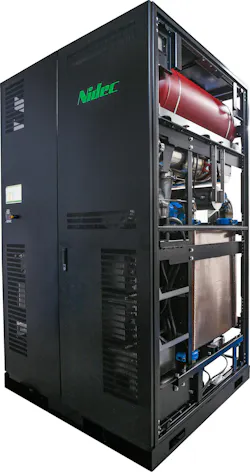
Service is another consideration. Because in-row CDUs are installed directly in data centers, requiring suppliers to take greater responsibility for maintenance and repair. Nidec is standing up a global support structure providing technical assistance, inspections, replacement parts, and repair services. The newest CDU, NIR 3.0, offers a maximum cooling capacity of 3.2 MW, while its front-access design is intended to make critical components easier to maintain or replace, helping significantly reduce downtime.
Learn More
Nozawa said Nidec aims to empower the AI era with liquid cooling solutions that can solve the intense heat challenges of high-density AI clusters. Nidec invites infrastructure and data center teams, hyperscalers, AI data center operators, VARs, SIs, and all others concerned with liquid cooling to explore Nidec’s scalable and high-efficiency liquid cooling innovations under the theme "Innovation Meets Efficiency: Designed for Scalability," including our latest in-row and in-rack CDUs, precision manifolds, and quick disconnects (QD) — engineered to maximize performance and sustainability.
About Nidec’s thermal and liquid cooling solutions:https://www.nidec.com/en/products/liquid-cooling-line-up/