H5 Data Centers’ 325 Hudson: A Manhattan Carrier Hotel with SoHo DNA - DCF Tours
Key Highlights
- 325 Hudson Street combines carrier hotel functionality, media presence, and office space, creating a unique 'SoHo vibe' for a modern urban data center.
- The facility offers access to over 40 networks, internet exchanges, and diverse entry points, supporting cloud, content, and financial workloads with low latency.
- Designed for Manhattan's physical constraints, it features high floor loading, secure freight access, pre-built conduit infrastructure, and energy-efficient cooling systems.
- The data center reflects a shift towards urban edge infrastructure, emphasizing proximity, interconnection density, and ecosystem gravity over sheer scale.
- H5's approach highlights the importance of precision placement and ecosystem integration in the future of digital infrastructure within dense city environments.
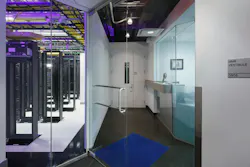
NEW YORK — Some data centers announce themselves with perimeter fencing, massive substations, and industrial sprawl. Others hide in plain sight, woven directly into the fabric of the city around them.
H5 Data Centers’ facility at 325 Hudson Street belongs firmly to the latter category. During a May 2026 walkthrough of the Manhattan property led by Adrian Bailey of H5 Data Centers, one phrase surfaced repeatedly as the right shorthand for what the building has become: “a technology hub with a SoHo vibe.”
The description fits.
Located along the fiber-dense Hudson Street corridor in lower Manhattan, 325 Hudson does not feel like a conventional enterprise data center campus. The building blends carrier hotel functionality, interconnection density, office space, media presence, and urban aesthetic into something distinctly New York.
And strategically, H5 sees it as something equally important: a flexible alternative to legacy Manhattan telecom landmarks such as 60 Hudson Street and 111 Eighth Avenue.
Manhattan Interconnection Without the Legacy Constraints
For decades, Manhattan interconnection has revolved around a handful of iconic carrier hotel properties. Those facilities remain foundational to the city’s network topology, but they also carry the realities of age, congestion, operational complexity, and increasingly constrained deployment flexibility.
H5’s position at 325 Hudson is not to replace those ecosystems, but to extend and complement them.
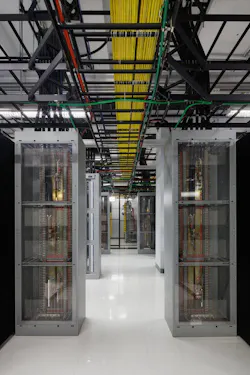
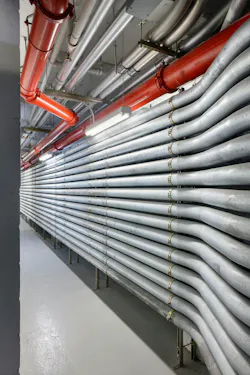
The building provides access to more than 40 communications networks along with connectivity to the DE-CIX New York and NetIX internet exchanges. H5 also emphasizes diverse points of entry, expansive north and south risers, and pre-constructed conduit infrastructure designed to simplify deployments inside one of the world’s most demanding metro markets.
The result is a facility aimed squarely at organizations that need urban edge presence, dense connectivity, and low-latency access without necessarily wanting the operational friction associated with older carrier hotel environments.
During the tour, Bailey positioned the building as particularly attractive for cloud connectivity, content distribution, financial workloads, media distribution, and enterprise edge deployments requiring proximity to Manhattan users and networks.
A Carrier Hotel Reimagined for Modern Colocation
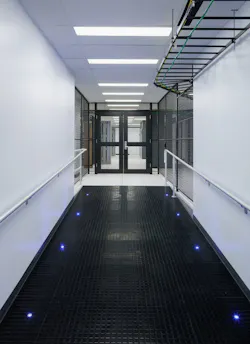
H5 formally announced its expansion into 325 Hudson, a 225,000 square-foot mixed-use building comprised of office, lab and data center uses, in 2021, describing its new location as a data center and carrier hotel in one of the world’s largest communications markets.
At the time, H5 founder and CEO Josh Simms framed the move as an opportunity to expand an already-established interconnection ecosystem while supporting growing demand from cloud providers, content delivery networks, and communications carriers.
That vision now appears fully realized inside the building.
The facility today operates as both a traditional carrier hotel and a modern enterprise colocation environment. H5’s infrastructure footprint supports high-density deployments, A/B UPS power architecture, N+1 emergency generators, N+1 CRAC systems, and energy-efficient in-row cooling with cold aisle containment.
The building also reflects the physical realities of Manhattan infrastructure engineering. Operators work within vertical constraints rather than sprawling horizontal campuses. Freight access, riser strategy, structured cabling pathways, and efficient floor utilization become critical operational variables.
H5 highlighted several features tailored for those realities, including 13-foot slab-to-slab heights, 150 pounds-per-square-foot floor loading capability, secure loading access, and extensive pre-built conduit infrastructure.
The Urban Edge Data Center
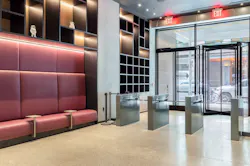
What stands out most about 325 Hudson is how clearly it reflects the ongoing evolution of the edge data center concept.
For years, “edge” often implied smaller regional facilities outside major core markets. Increasingly, however, the edge has become deeply urbanized — positioned directly inside the bandwidth, media, financial, and cloud exchange corridors where traffic density is highest.
325 Hudson exemplifies that shift.
The facility sits directly inside lower Manhattan’s digital infrastructure ecosystem while offering the operational posture of a modernized interconnection facility rather than a legacy telecom building retrofitted over decades.
Bailey’s “SoHo vibe” comment was not merely aesthetic shorthand. The building reflects a broader transition underway across data center infrastructure itself: facilities are becoming more integrated into mixed-use urban environments while simultaneously supporting increasingly mission-critical digital workloads.
That convergence is especially visible in New York, where the distance between media production, financial trading, enterprise cloud access, AI inference workloads, and dense user populations can often be measured in city blocks.
A Different Kind of Data Center Tour
Unlike hyperscale campuses defined by sheer acreage and megawatts, the tour of 325 Hudson underscored something equally important to the future of digital infrastructure: precision placement. This is infrastructure built around proximity, interconnection density, and ecosystem gravity. H5 currently operates more than 4 million square feet of data center space across 25 U.S. markets, but its Manhattan presence demonstrates how strategically important smaller-footprint urban interconnection facilities remain even as the industry races toward gigawatt-scale AI campuses.
Inside 325 Hudson, the emphasis is not spectacle. It is optionality. Carriers, cloud providers, enterprises, content firms, and edge operators all converge inside a facility designed to function less like a standalone data center and more like a digital meeting point for New York infrastructure itself.
And in a city where connectivity has always been about location as much as scale, that may be exactly the point.

At Data Center Frontier, we talk the industry talk and walk the industry walk. In that spirit, DCF Staff members may occasionally use AI tools to assist with content. Elements of this article were created with help from OpenAI's GPT5.
Keep pace with the fast-moving world of data centers and cloud computing by connecting with Data Center Frontier on LinkedIn, following us on X/Twitter and Facebook, as well as on BlueSky, and signing up for our weekly newsletters using the form below.
About the Author
 Matt Vincent
Matt Vincent
Matt Vincent is Editor in Chief of Data Center Frontier, where he leads editorial strategy and coverage focused on the infrastructure powering cloud computing, artificial intelligence, and the digital economy. A veteran B2B technology journalist with more than two decades of experience, Vincent specializes in the intersection of data centers, power, cooling, and emerging AI-era infrastructure. Since assuming the EIC role in 2023, he has helped guide Data Center Frontier’s coverage of the industry’s transition into the gigawatt-scale AI era, with a focus on hyperscale development, behind-the-meter power strategies, liquid cooling architectures, and the evolving energy demands of high-density compute, while working closely with the Digital Infrastructure Group at Endeavor Business Media to expand the brand’s analytical and multimedia footprint. Vincent also hosts The Data Center Frontier Show podcast, where he interviews industry leaders across hyperscale, colocation, utilities, and the data center supply chain to examine the technologies and business models reshaping digital infrastructure. Since its inception he serves as Head of Content for the Data Center Frontier Trends Summit. Before becoming Editor in Chief, he served in multiple senior editorial roles across Endeavor Business Media’s digital infrastructure portfolio, with coverage spanning data centers and hyperscale infrastructure, structured cabling and networking, telecom and datacom, IP physical security, and wireless and Pro AV markets. He began his career in 2005 within PennWell’s Advanced Technology Division and later held senior editorial positions supporting brands such as Cabling Installation & Maintenance, Lightwave Online, Broadband Technology Report, and Smart Buildings Technology. Vincent is a frequent moderator, interviewer, and keynote speaker at industry events including the HPC Forum, where he delivers forward-looking analysis on how AI and high-performance computing are reshaping digital infrastructure. He graduated with honors from Indiana University Bloomington with a B.A. in English Literature and Creative Writing and lives in southern New Hampshire with his family, remaining an active musician in his spare time.
Related
Voices of the Industry
 Source: SNEHIT PHOTO/Shutterstock.com
 Source: Matthew G Eddy/Shutterstock.com