Fiber Connect 2026: AI Infrastructure Meets the Quantum Networking Era
Key Highlights
- Fiber is transitioning from a speed-focused infrastructure to a foundational element enabling real-time AI synchronization and distributed intelligence.
- Hyperscale AI investments are driving a need for three times more fiber deployment, making fiber networks integral to AI and quantum infrastructure growth.
- Quantum computing is moving closer to mainstream data centers, relying heavily on fiber-based timing, synchronization, and photonic transport.
- The traditional boundaries between telecom, broadband, and AI infrastructure are dissolving, creating an integrated ecosystem for diverse technologies.
- Security concerns like Q-Day are accelerating development of quantum-safe networks, emphasizing collaboration between quantum firms and fiber operators.
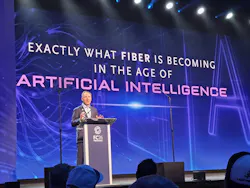
For years, the fiber broadband industry talked about speed, coverage maps, and homes passed. At Fiber Connect 2026 in Orlando, the language changed.
What emerged instead was a far broader, and more consequential, infrastructure thesis: fiber is no longer merely telecommunications infrastructure. It is becoming foundational AI infrastructure.
That framing appeared repeatedly throughout the conference’s opening keynote sequence, where Fiber Broadband Association leadership described the emergence of what CEO Gary Bolton called a new “thinking economy” - one where the movement of intelligence itself becomes the defining infrastructure challenge.
“We are no longer in an information economy,” Bolton said during his opening address. “We are entering a thinking economy.”
For data center stakeholders, the significance of that statement extended far beyond broadband deployment.
The event increasingly resembled a summit on the convergence of AI infrastructure, hyperscale interconnection, optical networking, and emerging quantum systems.
Fiber’s Expanding Role in the AI Stack
Fiber Connect leadership repeatedly tied the future of AI directly to fiber expansion.
Bolton noted that Microsoft, Amazon, Google, and Meta are collectively investing roughly $370 billion annually into AI infrastructure, while Meta alone recently announced a $600 billion multi-year AI infrastructure initiative that includes major investments in fiber and optical systems.
The implication was clear: hyperscale AI buildouts are now inseparable from optical transport expansion.
According to Bolton, supporting the AI era will require:
- Three times more hyperscale data center capacity
- Two times more fiber route miles
- Three times more total fiber deployment
That framing mirrors a growing reality across the data center industry itself, where networking constraints are increasingly emerging alongside power availability as a critical deployment bottleneck.
In Bolton’s formulation, fiber is evolving into the “nervous system” of AI infrastructure, meaning the underlying substrate responsible not merely for connectivity, but for real-time synchronization, inference movement, and distributed intelligence.
“We are no longer optimizing networks for speed,” Bolton said. “We are optimizing them for intelligence in motion.”
That conceptual shift matters for data center operators because AI factories increasingly depend on tightly synchronized, latency-sensitive fabrics spanning regions, campuses, cloud zones, and eventually distributed inference environments.
In that sense, Fiber Connect 2026 offered a revealing parallel narrative to the one dominating most AI infrastructure conferences today.
While much of the industry remains focused on GPUs, power density, and liquid cooling, Fiber Connect emphasized the connective architecture enabling those systems to operate coherently at scale.
The Quiet Convergence of Telecom and AI Infrastructure
One of the more notable themes throughout the event was the disappearance of traditional industry boundaries.
Bolton described a future where fiber-to-the-home deployments, hyperscale AI campuses, middle-mile operators, optical vendors, and cloud providers increasingly operate inside a single integrated infrastructure ecosystem.
“The same fiber that connects a rural home is part of the system that connects AI,” he said.
That convergence is already visible in capital markets.
Fiber Broadband Association data showed that more than 90% of recent fiber expansion is being driven by private capital, while regional providers, electric co-ops, municipal operators, and new entrants now account for roughly 40% of deployment activity.
There are now more than 1,560 active fiber providers in the United States, including dozens of new entrants and providers rapidly expanding footprints.
That growth increasingly overlaps with AI infrastructure geography.
As hyperscale campuses expand into secondary and rural markets in search of power and land, fiber densification is following similar pathways, creating a new alignment between broadband economics and AI infrastructure deployment.
Quantum Computing Moves Closer to the Data Center
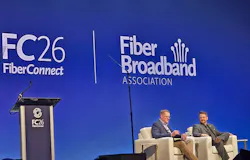
If the opening keynote established fiber as the nervous system of the AI economy, a later fireside discussion between Dell’Oro Group Vice President Jeff Heynen and IonQ Director of Partnerships and Alliances Ryan Harring extended that vision into quantum computing.
And notably, the discussion treated quantum not as a distant research project, but as an emerging infrastructure layer.
“The reality is they’re closer than most think,” Harring said of quantum technologies. “Quantum technologies are going to be integrated into the stack sitting right next to artificial intelligence.”
Harring outlined IonQ’s aggressive roadmap toward 80,000 logical qubits by 2029 while emphasizing that quantum networking, photonic interconnects, quantum sensing, and distributed quantum systems are all developing in parallel.
For infrastructure operators, however, the most important takeaway may have been this: quantum computing is rapidly becoming a networking problem as much as a computational one.
Timing, Synchronization, and the Quantum Network
According to Harring, future quantum systems will rely heavily on timing, synchronization, and photonic transport across fiber networks.
“Quantum technologies rely on timing and synchronization in a big way,” he said.
That has major implications for data center interconnect architecture.
Distributed quantum computing ultimately depends on the ability to move photons and entangled qubits reliably across optical infrastructure without disruption. Current limitations around polarization, aerial fiber, and distance tolerance remain major engineering hurdles.
In practice, this means the optical layer itself may become increasingly computationally aware.
Harring repeatedly emphasized that integrating quantum technologies into fiber infrastructure remains an open research challenge, and one likely to create entirely new categories of infrastructure services.
“We’ve got to figure out ways that we can integrate these technologies into fiber strands,” he said.
EPB and the Emergence of Quantum Infrastructure Operators
A major focus of the discussion centered on Chattanooga utility and fiber provider EPB, which IonQ described as its largest customer and partner nationwide.
EPB is deploying what IonQ calls the nation’s first commercially available quantum network using IonQ equipment, while simultaneously installing an IonQ Forte Enterprise quantum computing system.
The current system footprint spans roughly twenty 42U racks, hardly practical for traditional colocation today. But Harring said IonQ expects rapid miniaturization as the company transitions toward semiconductor-based fabrication in partnership with SkyWater.
Eventually, he said, quantum systems will resemble another accelerator category inside the data center.
“A quantum computer will just be another accelerator that sits in the data center,” Harring said, comparing future deployments to GPUs, CPUs, and FPGAs.
That statement may ultimately prove one of the most important infrastructure observations from the conference.
For years, quantum computing has largely existed outside mainstream data center discussions. But IonQ’s roadmap suggests a future where quantum accelerators eventually coexist alongside AI clusters inside enterprise and hyperscale facilities.
Security, Q-Day, and Infrastructure Readiness
The conversation also underscored the growing urgency around quantum security.
Harring referenced “Q Day,” i.e the point at which sufficiently powerful quantum systems could potentially crack RSA encryption, as a looming concern for banking, healthcare, energy, and government infrastructure.
That concern is already accelerating development around quantum key distribution (QKD), entanglement-based networking, and secured optical transport systems.
Importantly, Harring noted that many of these technologies will require substantial collaboration between quantum firms and fiber infrastructure operators.
“We don’t necessarily have all the fiber expertise,” he acknowledged. “It’s going to take an ecosystem.”
That ecosystem framing echoed the broader message of Fiber Connect 2026 itself.
Infrastructure Is Becoming Computational
Perhaps the clearest takeaway from Fiber Connect 2026 is that infrastructure categories once treated separately, e.g. broadband, hyperscale networking, optical transport, AI clusters, and quantum systems - are beginning to collapse into a single operational stack.
The AI era is not merely increasing demand for fiber. It is redefining what fiber networks fundamentally are. For data center stakeholders, that shift carries increasingly significant implications.
The next generation of infrastructure competition may not simply center on compute density or power acquisition, but on synchronization, photonic transport, distributed intelligence, and the ability to move computation itself fluidly across interconnected environments.
In other words, the network is becoming part of the computer.
At Data Center Frontier, we talk the industry talk and walk the industry walk. In that spirit, DCF Staff members may occasionally use AI tools to assist with content. Elements of this article were created with help from OpenAI's GPT5.
Keep pace with the fast-moving world of data centers and cloud computing by connecting with Data Center Frontier on LinkedIn, following us on X/Twitter and Facebook, as well as on BlueSky, and signing up for our weekly newsletters using the form below.
About the Author
 Matt Vincent
Matt Vincent
Matt Vincent is Editor in Chief of Data Center Frontier, where he leads editorial strategy and coverage focused on the infrastructure powering cloud computing, artificial intelligence, and the digital economy. A veteran B2B technology journalist with more than two decades of experience, Vincent specializes in the intersection of data centers, power, cooling, and emerging AI-era infrastructure. Since assuming the EIC role in 2023, he has helped guide Data Center Frontier’s coverage of the industry’s transition into the gigawatt-scale AI era, with a focus on hyperscale development, behind-the-meter power strategies, liquid cooling architectures, and the evolving energy demands of high-density compute, while working closely with the Digital Infrastructure Group at Endeavor Business Media to expand the brand’s analytical and multimedia footprint. Vincent also hosts The Data Center Frontier Show podcast, where he interviews industry leaders across hyperscale, colocation, utilities, and the data center supply chain to examine the technologies and business models reshaping digital infrastructure. Since its inception he serves as Head of Content for the Data Center Frontier Trends Summit. Before becoming Editor in Chief, he served in multiple senior editorial roles across Endeavor Business Media’s digital infrastructure portfolio, with coverage spanning data centers and hyperscale infrastructure, structured cabling and networking, telecom and datacom, IP physical security, and wireless and Pro AV markets. He began his career in 2005 within PennWell’s Advanced Technology Division and later held senior editorial positions supporting brands such as Cabling Installation & Maintenance, Lightwave Online, Broadband Technology Report, and Smart Buildings Technology. Vincent is a frequent moderator, interviewer, and keynote speaker at industry events including the HPC Forum, where he delivers forward-looking analysis on how AI and high-performance computing are reshaping digital infrastructure. He graduated with honors from Indiana University Bloomington with a B.A. in English Literature and Creative Writing and lives in southern New Hampshire with his family, remaining an active musician in his spare time.
Voices of the Industry
 Source: Nimbus Advanced Process Cooling
 Image courtesy of Bell & Gossett