Fiber's Next Act: How AI Is Driving Connectivity Closer to the Edge
Key Highlights
- AI expansion is pushing network infrastructure closer to the edge, requiring differentiated data center types from hyperscale to edge deployments.
- Fiber density is a growing operational challenge, with racks now supporting over 3,000 fiber connections, impacting scalability and maintenance.
- Better fiber management can improve airflow and cooling efficiency, especially in space-constrained edge environments, by freeing up room for thermal infrastructure.
- Clearfield's active cabinet platform exemplifies mini data centers that support distributed AI workloads near end users.
- The convergence of fiber management and thermal infrastructure highlights the need for integrated solutions to support dense, high-performance AI environments.
ORLANDO, Fla. — Much of the conversation surrounding AI infrastructure has focused on GPUs, power generation, cooling systems, and the unprecedented scale of next-generation data center development.
But at Fiber Connect 2026, another reality became increasingly clear: none of those investments matter without the network infrastructure required to connect them.
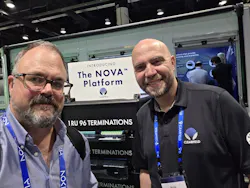
That theme emerged repeatedly during a conversation between Data Center Frontier Editor-in-Chief Matt Vincent and Clearfield Chief Commercial Officer Anis Khemakhem, whose perspective sits at the intersection of broadband infrastructure, fiber deployment, and emerging AI connectivity requirements.
While Clearfield is best known throughout the broadband industry for its fiber management and connectivity solutions, Khemakhem argued that AI's rapid expansion is creating new opportunities, and new challenges, that extend well beyond traditional fiber-to-the-home deployments.
"AI is driving that connectivity closer and closer to the edge," Khemakhem said, noting that growing compute requirements and increasingly latency-sensitive workloads are fundamentally changing assumptions about where infrastructure must reside and how it must be connected.
For Data Center Frontier readers, the significance lies in a growing realization that AI infrastructure is becoming as much a networking challenge as a compute challenge.
Beyond the Traditional Data Center
One of the more notable themes of the discussion was Khemakhem's view that the term "data center" has become too broad to be useful.
The industry often speaks of data centers as a single category, but Clearfield increasingly differentiates between hyperscale campuses, colocation facilities, central office environments, and a rapidly emerging class of edge deployments.
"There is no one-size-fits-all data center," Khemakhem said, describing a continuum that extends from hyperscale facilities all the way to edge locations positioned near users and applications.
That distinction matters because many AI applications are introducing latency requirements that cannot always be addressed by centralized facilities alone.
As AI inference moves closer to users, enterprises, autonomous systems, industrial applications, and smart-city deployments, networking infrastructure must increasingly support distributed compute architectures rather than simply connecting centralized facilities.
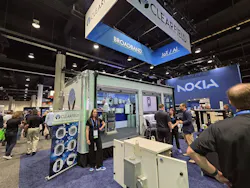
The result is growing interest in what Khemakhem described as active cabinets: essentially miniature data centers deployed closer to end users and applications.
"This can be the data center," he said while demonstrating Clearfield's active cabinet platform. "A miniature data center that can be on the side of the road."
For data center operators, the observation echoes a broader trend increasingly visible across the AI infrastructure landscape: the emergence of hybrid architectures that combine hyperscale AI campuses with distributed edge resources designed to reduce latency and support real-time applications.
AI Is Creating a Fiber Density Problem
Power and cooling may dominate industry headlines, but Khemakhem repeatedly returned to another challenge: fiber density.
As AI clusters grow larger and network fabrics become more complex, the physical management of fiber is becoming increasingly important.
"You need more fiber," Khemakhem said. "Fiber management becomes more critical. Density becomes more critical."
That challenge is especially acute inside modern AI environments.
According to Khemakhem, some data center racks now accommodate more than 3,000 fiber connections, creating significant operational challenges for deployment, maintenance, and future scalability. Poor design decisions made during initial installation can become difficult and expensive to correct later.
His comments reinforce an increasingly important reality for AI facility operators: networking infrastructure is becoming a first-order design consideration rather than a supporting utility.
As GPU clusters continue scaling and interconnect architectures grow more sophisticated, physical-layer decisions may increasingly determine how effectively operators can deploy, upgrade, and manage AI environments.
The Overlooked Link Between Fiber and Cooling
Perhaps the most interesting observation from a Data Center Frontier perspective involved the relationship between fiber management and thermal infrastructure.
At first glance, connectivity and cooling appear to be separate disciplines.
Khemakhem argued otherwise.
As AI equipment moves into increasingly dense environments, every cubic inch inside a rack or enclosure becomes valuable. Better fiber management not only improves serviceability and reliability but also creates additional space for airflow and cooling infrastructure.
"The more we manage fiber better, it gives you more room for other equipment, but also for cooling," he explained.
That dynamic becomes particularly important in edge deployments, where physical space is often constrained and thermal management can quickly become a limiting factor.
Clearfield's active cabinet strategy focuses on integrating fiber management, power distribution, and environmental protection while partnering with specialists for cooling technologies such as heat exchangers and advanced thermal systems.
The discussion also touched on the growing industry interest in liquid and immersion cooling. While Khemakhem said those technologies remain more common in traditional data center environments today, he expects advanced cooling approaches to move rapidly toward carrier and edge environments as AI deployments expand.
Nova and the Convergence of Broadband and Data Centers
The conversation also provided insight into Clearfield's expanding focus on data center infrastructure through its Nova platform.
Originally built around broadband connectivity, the company is increasingly adapting decades of expertise in fiber management, cable routing, density optimization, and deployment simplicity for AI-era infrastructure requirements.
The Nova product line includes racks, cabling systems, patching infrastructure, fiber management platforms, and associated connectivity products designed specifically for data center environments.
Rather than reinventing its technology stack, Clearfield is attempting to evolve familiar architectures and deployment methods to support significantly higher densities and faster deployment cycles.
Khemakhem described the effort as an evolution rather than a reinvention—leveraging existing installer familiarity while adapting products to accommodate AI-driven requirements for speed, density, and operational simplicity.
Why This Matters for Data Center Frontier Readers
The conversation served as a reminder that AI infrastructure is increasingly blurring traditional industry boundaries.
Data centers, telecom networks, broadband infrastructure, edge computing platforms, and physical connectivity ecosystems are becoming more interconnected as AI workloads expand beyond centralized campuses.
For hyperscale operators, the implications center on fiber density, network architecture, and the physical realities of connecting increasingly large AI clusters.
For colocation providers, the discussion highlights the growing importance of connectivity design as a competitive differentiator.
For emerging edge operators, Clearfield's active cabinet vision offers a glimpse into how distributed AI infrastructure may ultimately be deployed.
And for the broader industry, the interview underscored a lesson repeatedly reinforced throughout Fiber Connect 2026:
The AI revolution may be powered by GPUs and electricity, but it will ultimately be connected by fiber.
At Data Center Frontier, we talk the industry talk and walk the industry walk. In that spirit, DCF Staff members may occasionally use AI tools to assist with content. Elements of this article were created with help from OpenAI's GPT5.
Keep pace with the fast-moving world of data centers and cloud computing by connecting with Data Center Frontier on LinkedIn, following us on X/Twitter and Facebook, as well as on BlueSky, and signing up for our weekly newsletters using the form below.
About the Author
 Matt Vincent
Matt Vincent
Matt Vincent is Editor in Chief of Data Center Frontier, where he leads editorial strategy and coverage focused on the infrastructure powering cloud computing, artificial intelligence, and the digital economy. A veteran B2B technology journalist with more than two decades of experience, Vincent specializes in the intersection of data centers, power, cooling, and emerging AI-era infrastructure. Since assuming the EIC role in 2023, he has helped guide Data Center Frontier’s coverage of the industry’s transition into the gigawatt-scale AI era, with a focus on hyperscale development, behind-the-meter power strategies, liquid cooling architectures, and the evolving energy demands of high-density compute, while working closely with the Digital Infrastructure Group at Endeavor Business Media to expand the brand’s analytical and multimedia footprint. Vincent also hosts The Data Center Frontier Show podcast, where he interviews industry leaders across hyperscale, colocation, utilities, and the data center supply chain to examine the technologies and business models reshaping digital infrastructure. Since its inception he serves as Head of Content for the Data Center Frontier Trends Summit. Before becoming Editor in Chief, he served in multiple senior editorial roles across Endeavor Business Media’s digital infrastructure portfolio, with coverage spanning data centers and hyperscale infrastructure, structured cabling and networking, telecom and datacom, IP physical security, and wireless and Pro AV markets. He began his career in 2005 within PennWell’s Advanced Technology Division and later held senior editorial positions supporting brands such as Cabling Installation & Maintenance, Lightwave Online, Broadband Technology Report, and Smart Buildings Technology. Vincent is a frequent moderator, interviewer, and keynote speaker at industry events including the HPC Forum, where he delivers forward-looking analysis on how AI and high-performance computing are reshaping digital infrastructure. He graduated with honors from Indiana University Bloomington with a B.A. in English Literature and Creative Writing and lives in southern New Hampshire with his family, remaining an active musician in his spare time.
Voices of the Industry
 Image courtesy of Midea Building Technologies
 Adobe Stock image courtesy of Hitachi Energy